MP: 40 years after Bhopal gas disaster, toxic waste leaves Union Carbide factory for disposal
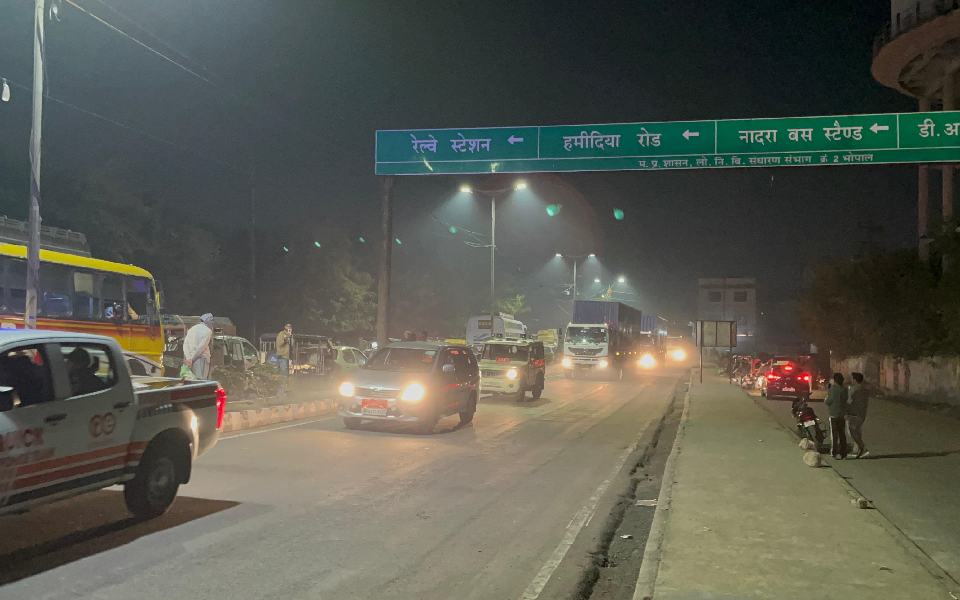
Bhopal, Jan 1: Forty years after the Bhopal gas tragedy, the shifting of some 377 tons of hazardous waste began from the defunct Union Carbide factory on Wednesday night for its disposal, an official said.
The toxic waste is being shifted in 12 sealed container trucks to the Pithampur industrial area in Dhar district, 250 km away from Bhopal.
"12 container trucks carrying the waste set off on a non-stop journey around 9 pm. A green corridor has been created for the vehicles which are expected to reach Pithampur industrial area in Dhar district in seven hours," said Bhopal Gas Tragedy Relief and Rehabilitation Department Director Swatantra Kumar Singh.
He said around 100 people worked in 30-minute shifts since Sunday to pack and load the waste in trucks.
"They underwent health check-ups and were given rest every 30 minutes," he added.
Highly toxic methyl isocyanate (MIC) gas leaked from the Union Carbide pesticide factory on the intervening night of December 2-3, 1984, killing at least 5,479 people and leaving thousands with serious and long-lasting health issues. It is considered to be among the worst industrial disasters in the world.
The Madhya Pradesh High Court on December 3 rebuked authorities for not clearing the Union Carbide site in Bhopal despite directions from even the Supreme Court and set a four-week deadline to shift the waste, observing that even 40 years after the gas tragedy, authorities were in a "state of inertia".
The high court bench had warned the government of contempt proceedings if its directive was not followed.
"If everything is found to be fine, the waste will be incinerated within three months. Otherwise, it might take up to nine months," Singh told PTI on Wednesday morning.
Initially, some of the waste will be burnt at the waste disposal unit in Pithampur and the residue (ash) will be examined to find whether any harmful elements are left, Singh said.
The smoke from the incinerator will pass through special four-layer filters so that the surrounding air is not polluted, he added.
Once it is confirmed that no traces of toxic elements are left, the ash will be covered by a two-layer membrane and buried to ensure it does not come in contact with soil and water in any way.
A team of experts under the supervision of officials of the Central Pollution Control Board and State Pollution Control Board will carry out the process, Singh said.
Some local activists have claimed that 10 tons of Union Carbide waste was incinerated on a trial basis in Pithampur in 2015, after which the soil, underground water and water sources in surrounding villages became polluted.
But Singh rejected the claim, stating that the decision to dispose of the waste at Pithampur was taken only after the report of the 2015 test and all the objections were examined.
There would be no reason to worry, he said.
A large number of people had on Sunday taken out a protest march in Pithampur to oppose the disposal of Union Carbide waste in the city which has a population of about 1.75 lakh.
12 trucks carrying 337 tonnes of toxic waste from the Union Carbide factory in Bhopal, stored for 40 years, left at 9:05 p.m. for Pithampur near Indore. The waste is expected to arrive early on January 2nd, following a 250-km green corridor with heavy security.
— The Hindu (@the_hindu) January 1, 2025
📹@MehulMalpani pic.twitter.com/zU78cVRE85
Let the Truth be known. If you read VB and like VB, please be a VB Supporter and Help us deliver the Truth to one and all.
Polling begins for 152 assembly seats in 1st phase of Bengal elections
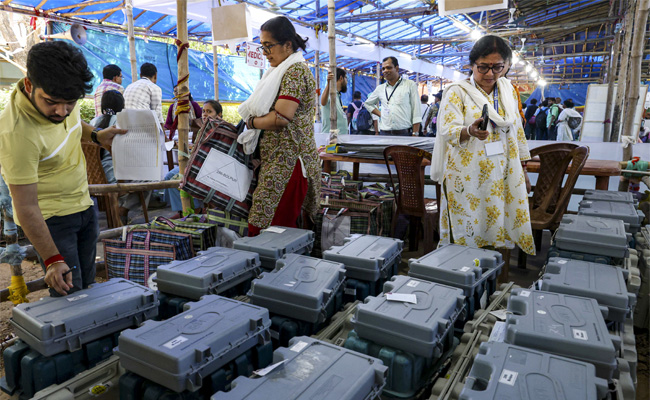
Kolkata (PTI): Voting began on Thursday in 152 constituencies in the first phase of the West Bengal assembly elections, amid unprecedented security arrangements and a high-stakes battle that could shape the direction of the entire contest.
Polling started at 7 am with voters queueing up outside booths in districts ranging from Darjeeling and Jalpaiguri in the north to Murshidabad, Nadia, Birbhum and Hooghly in the south.
The opening round covers more than half of the state's 294 assembly seats and is being seen as the BJP's best opportunity to make an early breakthrough and the ruling Trinamool Congress' most important test in its bid for a fourth consecutive term.
According to the Election Commission, over 3.60 crore electors are eligible to vote in this phase, including around 1.75 crore women and 465 third-gender voters.
A record 2,450 companies of central paramilitary forces, comprising nearly 2.5 lakh personnel, have been deployed across the state for the polls, with over 8,000 polling stations identified as highly sensitive.
The Election Commission has placed districts such as Malda, Murshidabad, Uttar Dinajpur, Cooch Behar, Birbhum and Purba Bardhaman under special surveillance.
More than 2,193 quick response teams, surveillance units and flying squads have also been deployed to prevent violence and ensure free and fair polling.
The first phase assumes political significance because it includes all 54 seats in north Bengal, the region that powered the BJP's rise in the 2019 Lok Sabha elections and helped it emerge as the principal challenger to the TMC in the 2021 assembly polls.
Of the 152 seats, the BJP had won 59 in 2021, while the TMC had secured 93.
For the saffron camp, retaining its dominance in north Bengal is crucial if it is to remain in contention in the statewide battle. For the TMC, led by Chief Minister Mamata Banerjee, preventing a BJP sweep in the north is equally important to establish momentum before the second round.
This phase is also being closely watched because it comes after the Special Intensive Revision of electoral rolls, which resulted in the deletion of around 91 lakh names from the state's voter list.
The controversy has sharply polarised the campaign, with the BJP alleging that the revision weeded out infiltrators and bogus voters, while the TMC has accused the Centre and the Election Commission of disenfranchising genuine electors, especially minorities and migrant workers.
Several high-profile candidates are in the fray in the first phase.
Key candidates in this phase include leader of the opposition Suvendu Adhikari (BJP, Nandigram), former Union minister Nisith Pramanik (BJP, Mathabhanga), state minister Udayan Guha (TMC, Dinhata), Goutam Deb (TMC, Siliguri), and Adhir Ranjan Chowdhury (Congress, Baharampur).
The second phase of polling will be held on April 29. Counting of votes will take place on May 4.