MP bans sale of Coldrif cough syrup after 14 children die; samples contained toxic substance
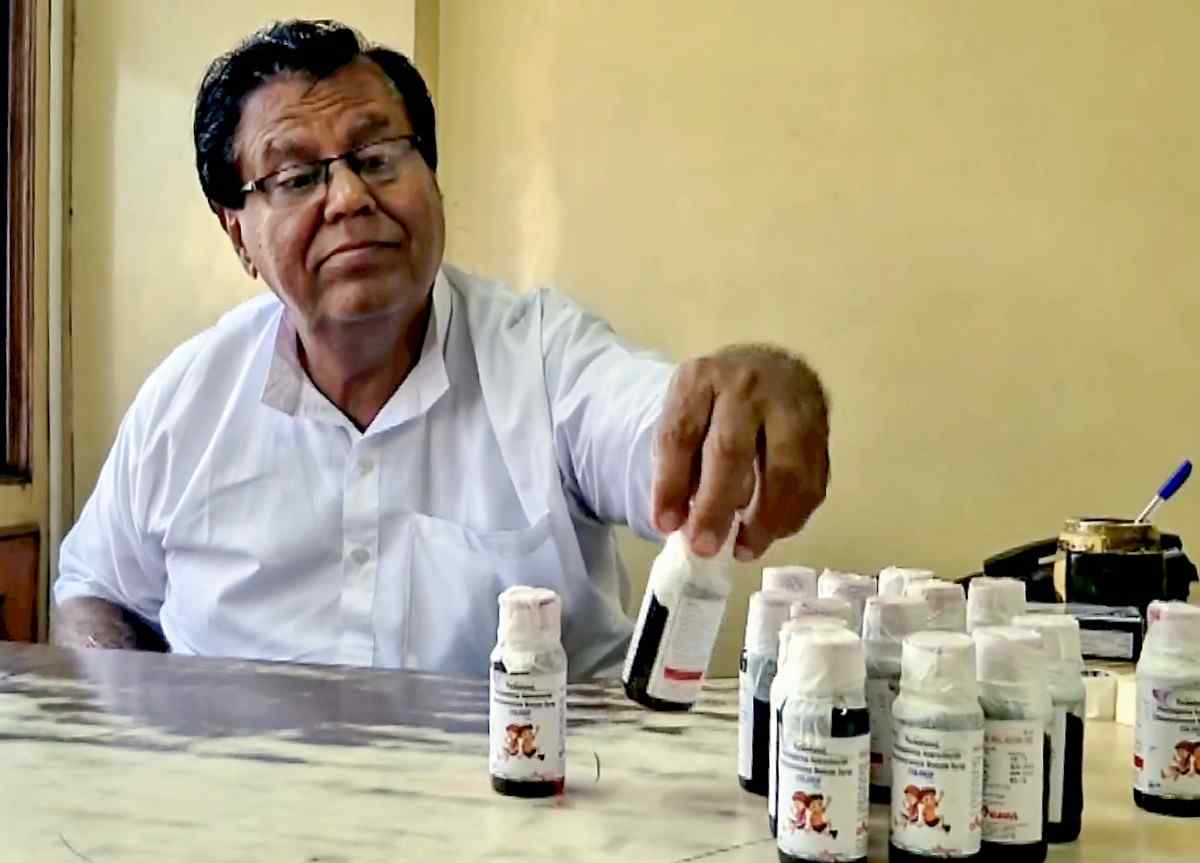
Bhopal (PTI): The Madhya Pradesh government on Saturday banned the sale of Coldrif cough syrup following the death of 14 children in Chhindwara due to suspected renal failure, with officials stating that samples of the drug were found to contain 48.6 % diethylene glycol, a highly toxic substance.
A sample of the syrup, tested by the government drug analyst at the Drug Testing Laboratory in Chennai, was declared "Not of Standard Quality" by the Tamil Nadu Directorate of Drug Control, officials said here.
The action by the Madhya Pradesh government came in the wake of the deaths of 14 children in Chhindwara district due to suspected kidney failure. Of these, 10 deaths were reported in Parasia subdivision since September 7, local officials said.
Yogita (2), a resident of Parasia, died at a Nagpur hospital in the morning, Sub-Divisional Magistrate (SDM) Saurabh Kumar Yadav told PTI.
Six children were undergoing treatment, five in Nagpur and one in Chhindwara, he said, adding that the condition of three children admitted in Nagpur was critical.
Financial assistance of Rs 4 lakh was sanctioned for the kin of the 14 deceased children, officials said.
Of those died, 11 were from Parasia sub division, two from Chhindwara city and one from Chaurai tehsil.
The nine children who died earlier in Parasia were identified as Shivam (9), Vidhi (6), Adnan (6), Usaid (9), Rishika (10), Hetansh (11), Vikas (9), Chanchlesh (8) and Sandhya Bhosom (7).
SDM Yadav said that as a precautionary measure, the local administration had already banned the sale of Coldrif and another cough syrup, 'Nextro-DS', on Monday. The test report for Coldrif arrived on Saturday, while that of Nextro-DS is awaited.
The Tamil Nadu drug control authorities, in their report dated October 2, declared the Coldrif syrup sample (Batch No SR-13; Mfg: May 2025; Exp: April 2027) manufactured by Sresan Pharmaceuticals, Kancheepuram, as adulterated because it contained diethylene glycol (48.6% w/v), a poisonous substance "which may render the contents injurious to health."
Following the report, the Madhya Pradesh Food and Drug Administration issued instructions to stop further sale and distribution of Coldrif statewide and immediately seize any available stock for investigation under the Drugs and Cosmetics Act, 1940. It also ordered that other products manufactured by Sresan Pharmaceuticals be removed from sale pending testing.
Chief Minister Mohan Yadav, in a post on X, called the deaths "extremely tragic" and said strict action will be taken against those responsible.
"The sale of this syrup has been banned across Madhya Pradesh. A ban is also being imposed on other products of the company that manufactures the syrup," the CM stated.
The Tamil Nadu government had on Friday banned Coldrif following reports of deaths in Madhya Pradesh and at least three similar fatalities in Rajasthan due to suspected kidney infections.
Samples from the affected children have been sent to the National Institute of Virology in Pune, while further tests on the syrup's adulteration and contamination are underway.
The Central Drugs Standard Control Organisation (CDSCO) has initiated risk-based inspection at the manufacturing units of 19 drugs, including cough syrups and antibiotics, across six states, the Union health ministry said on Saturday.
A team comprising experts from the National Institute of Virology, the Indian Council of Medical Research, National Environmental Engineering Research Institute, CDSCO and AIIMS-Nagpur, among others, are analysing various samples to assess the cause of deaths in and around Chhindwara, it stated.
Let the Truth be known. If you read VB and like VB, please be a VB Supporter and Help us deliver the Truth to one and all.
NIA registers case to probe recovery of 79 crude bombs in poll-bound West Bengal
New Delhi (PTI): The National Investigation Agency (NIA) on Sunday registered a case to probe recovery of 79 crude bombs in poll-bound West Bengal, officials said.
The move came following a directive by the Union Home Ministry in this regard, they said.
In pursuance to the home ministry's order, the anti-terror agency on Sunday registered a case, which was originally filed at Uttar Kashi police station, Bhangar division, Kolkata on Saturday, and took up the investigation, an NIA spokesperson said in a late night statement.
"The case pertains to recovery of 79 crude bombs and other incriminating materials by Kolkata police, which were being stored at a spot, thereby endangering human life and property," the spokesperson said.
Earlier in the day, the Election Commission had directed the West Bengal Police to launch a special drive to arrest those involved in illegal manufacturing of crude bombs in the poll-bound state, an official said.
It asserted that all cases related to the making of any such explosive would be probed by the National Investigation Agency, the official said.
The directive came after the police recovered a large number of crude bombs from the house of a person, allegedly a TMC worker, at Bhangar in South 24 Parganas district, days ahead of the second and final phase of the assembly polls in the state.
The explosives were recovered during a search at the residence of Rafikul Islam following specific inputs, the official said.
The poll panel also issued a warning to senior police officers across the state over any lapse in maintaining law and order before the April 29 polling.
The first phase of the assembly elections in West Bengal was held on April 23, while the second phase will take place on April 29. Votes will be counted on May 4.
A record 93.19 per cent turnout has been recorded in the first round of polling. Bhangar will vote in the second phase.