MP: Protests against Union Carbide waste disposal rock Pithampur, two attempt self-immolation
Dhar (MP), Jan 3: Two persons attempted self-immolation, flaring tensions in Pithampur in Madhya Pradesh on Friday as protests against the planned disposal of 337 tonnes of hazardous waste from Union Carbide continued.
According to eyewitnesses, the two men, who were part of a demonstration organised by 'Pithampur Bachao Samiti', poured flammable liquid on themselves and tried to ignite it, but their actions were swiftly thwarted by fellow protesters who intervened to extinguish the flames.
The quick response of the crowd likely prevented a tragedy, and the men were subsequently shifted to a local hospital by public and police officers present at the scene.
The protests stem from concerns by people regarding the safety and environmental implications of relocating hazardous materials to the township, located approximately 30 kilometres from Indore.
The situation is under control but tense, Dhar Superintendent of Police Manoj Singh told PTI over the phone from a protest site near Pithampur bus stand.
The two men who attempted self-immolation were shifted from a local hospital to a private facility in Indore, where doctors confirmed they are out of danger, the SP said.
Protests continued in several parts of the town through the day amid a bandh call given by Pithampur Bachao Samiti, with a mob marching to the industrial unit in which the waste is set to be incinerated, and another agitation that saw the participation of children.
Pithampur, about 50 kilometres from the Dhar district headquarters, has a population of about 1.75 lakh and its industrial area here has nearly 700 factories in three sectors.
In view of the tense situation in the town, District Collector Priyank Mishra and SP Singh released two separate videos asking people to maintain calm and to not take law in their hands, adding that the administration was ready to listen to their demands.
Both the top officials said health of the people was paramount for the state government, but asserted those trying to disturb peace would be dealt with strictly.
Shops and markets remained closed as part of the bandh call given by Pithampur Bachao Samiti, which claimed the planned incineration of the waste linked to the Bhopal gas tragedy would harm local residents and the environment of the region.
Dhar Additional Superintendent of Police Indrajeet Singh Bakarwal confirmed the presence of children in the protests.
On the intervening night of December 2-3, 1984, methyl isocyanate (MIC) gas leaked from the Union Carbide pesticide factory in Bhopal, killing at least 5,479 persons and leaving thousands with serious and long-lasting health issues in Bhopal.
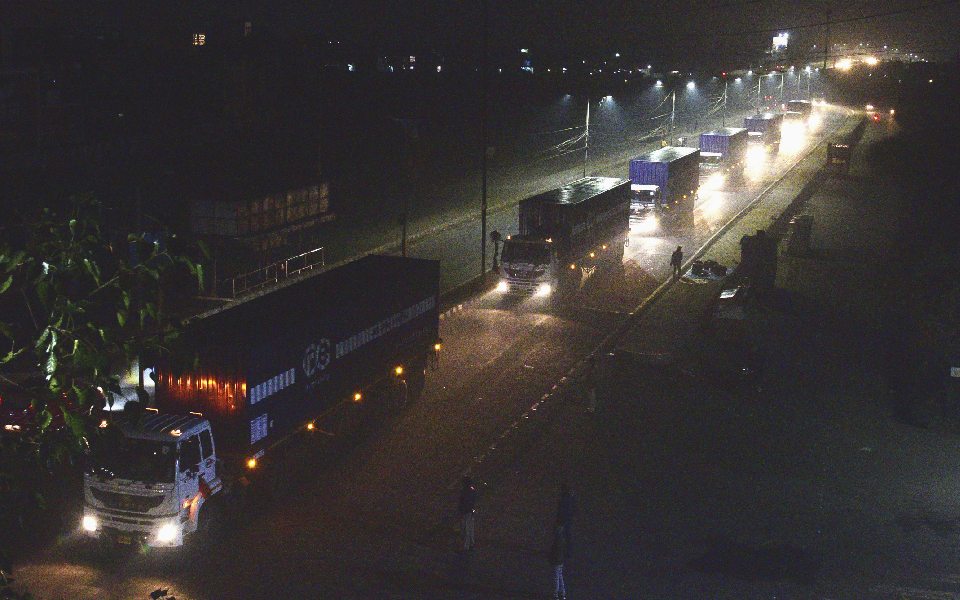
The authorities have shifted 337 tonnes of waste from the Carbide factory to Pithampur for scientific disposal, though the move has triggered protests. The material from Bhopal reached an incineration unit in Pithampur on Thursday.
During the protests, a group blocked the road near Eicher Motors, but police prevailed over them and restored normalcy after a mild cane charge.
A mob of 500-600 persons marched to the Ramky Group's Industrial Waste Management Private Limited premises, where the waste is set to be incinerated, but police managed to disperse them in time.
Officials said police had to resort to mild lathi-charge at some places to disperse protesters.
Sandeep Raghuvanshi, who has been on a hunger strike at the bus stand since Thursday, said a large number of people have expressed solidarity with him over his protest against the disposal of the Union Carbide waste in Pithampur.
Meanwhile, heavy police deployment has been made in Pithampur to maintain law and order.
Barricades came up on several roads in the town, while police teams moved about trying to pacify protesters in a bid to bring back normalcy.
At several places, SP Singh spoke to protesters assuring them that the waste disposal would take place only after citizens are taken into confidence.
The Madhya Pradesh High Court had on December 3 rebuked the authorities for not clearing the Union Carbide site in Bhopal despite court directives, including that of the Supreme Court.
It had set a four-week deadline to shift the waste, observing that even 40 years after the gas tragedy, authorities were in a "state of inertia".
The HC had warned the government of contempt proceedings if its directive was not followed.
Chief Minister Mohan Yadav on Thursday addressed doubters and said the issue should not be politicised. He asserted the waste comprised 60 per cent mud and 40 per cent naphthol used to make pesticide methyl isocyanate (MIC) and was "not at all harmful".
Let the Truth be known. If you read VB and like VB, please be a VB Supporter and Help us deliver the Truth to one and all.
KMES Institutions shine in SSLC result, continue four-decade legacy of education in rural Karkala
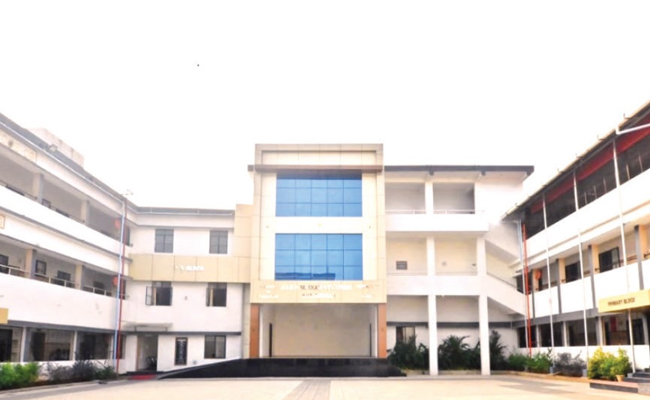
Karkala: KMES Institutions of Education at Kukkundooru in Karkala taluk has recorded outstanding results in the 2025-26 SSLC and PUC examinations, continuing a four-decade educational journey that began with just 22 kindergarten students and no building of its own.
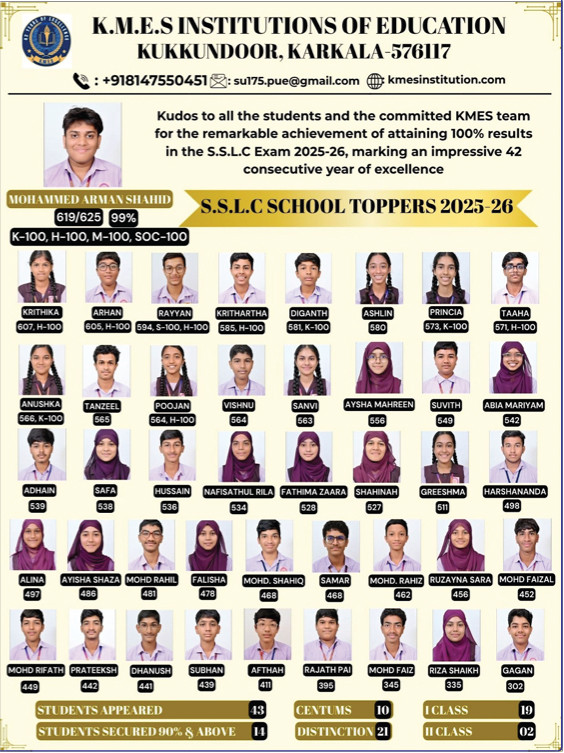
The institution secured a 100 per cent result in the SSLC examinations, with all 43 students passing the examination this year.
Muhammad Arman Shahid emerged as the school topper by scoring 619 marks out of 625, securing 99 per cent and also ranking sixth at the state level. He scored full marks in Kannada, Hindi, Mathematics and Social Science.
Krithika V. Nayak secured the second position in the school with 607 marks and 97.12 per cent, while Arhan stood third with 605 marks and 96.8 per cent.
Out of the 43 students, 21 passed with distinction, 19 secured first class, two students obtained second class and one student passed in third class. Fourteen students scored above 90 per cent.
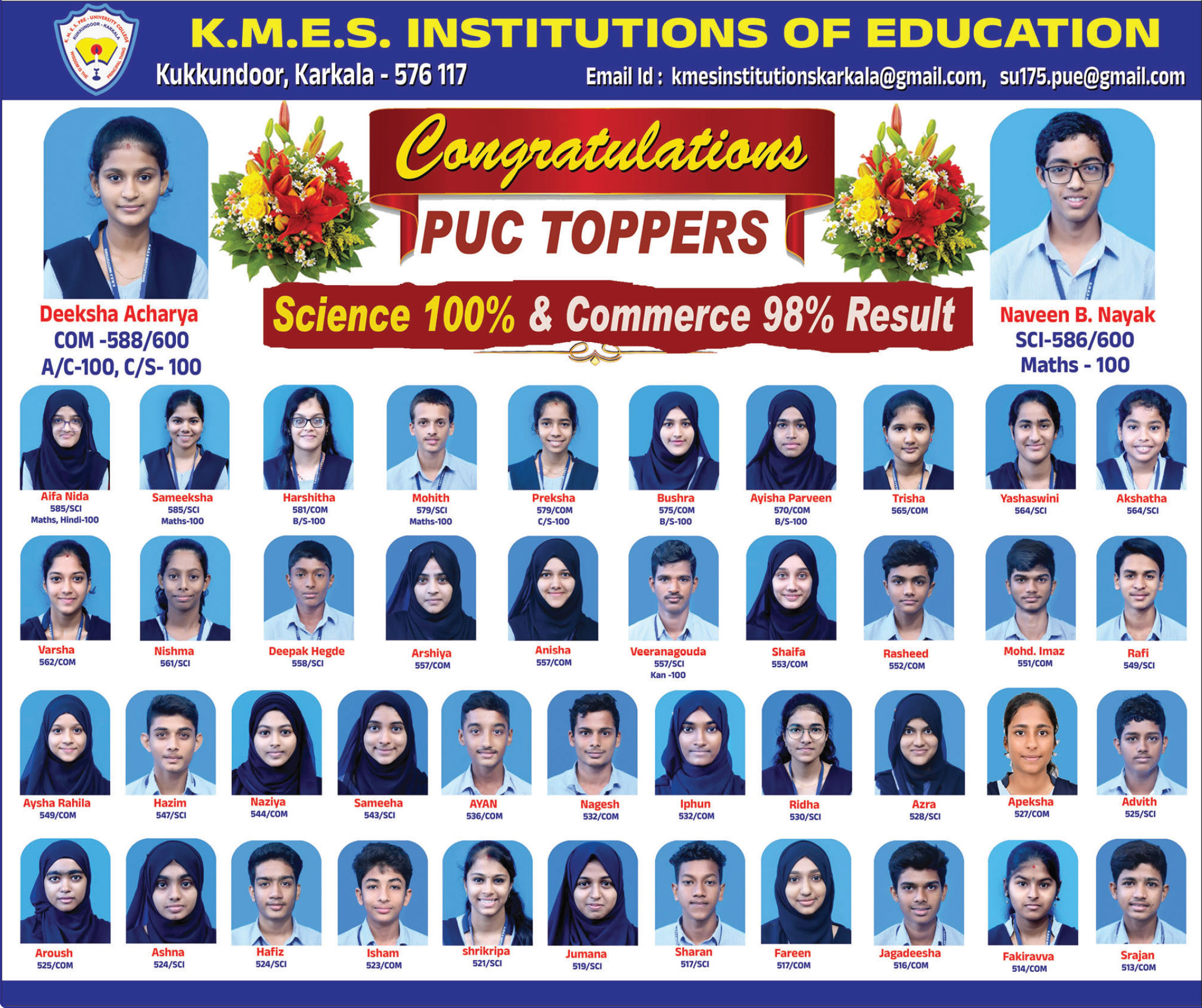
The institution also performed strongly in the PUC examinations. The Science stream recorded a 100 per cent result, with all 44 students passing, while Commerce secured a 98 per cent pass percentage.
Twelve students scored full marks in different subjects, including Mathematics.
In Commerce, Deeksha Acharya topped the college with 588 marks, while Harshitha H. Kini secured the second position with 581 marks.
In Science, Naveen B. Nayak emerged as topper with 586 marks, followed closely by Sameeksha Moily and Aifa Nidha, who both secured 585 marks.
Speaking about the achievement, High School head teacher Shrimati Patkar said the institution has always focused on supporting academically weak students through affordable education and free special classes.
“Our ambition is to provide quality education even to students who struggle in studies. The fees are very low, and free coaching classes are conducted. I have worked here for 28 years and have always found the atmosphere supportive of education,” she said.
Primary School head teacher Lolita Zeena D’Silva appreciated the dedication of the teaching staff and said the school encourages students not only to achieve high marks but also to become role models.
PU College Principal Balakrishna Rao said the institution focuses on value-based education and overall personality development.
“The aim is to help students succeed not only academically but also in cultural activities, sports and leadership. We encourage qualities such as patience, tolerance and discipline,” he said.
Rao also credited the institution’s growth to the support of founders K.S. Mohammed Masood and K.S. Nissar Ahmed, along with President K.S. Imtiaz Ahmed.
Speaking on the occasion, Imtiaz Ahmed said the institution was built on the dream of making quality education accessible to financially backward families in rural areas.
He said the guidance and encouragement of his elder brothers, Mohammed Masood and Nissar Ahmed, along with the contribution of teachers, students and parents, helped transform the institution into a model educational centre.
The KMES Institutions trace their roots back to 1984, when they were founded by senior social activists Haji P.M. Khan, K.S. Nazeer Ahmed and Haji A.S. Rashid Haider.
The institution initially functioned from the Government Urdu School premises as it did not have a building of its own. Classes began with only 22 students in lower kindergarten and two teachers.
Later, under the leadership of K.S. Mohammed Masood and with continuous financial and moral support from non-resident businessman K.S. Nissar Ahmed, the institution gradually expanded.
In 1993, the school shifted to its own building and began conducting classes from LKG to Class 5.
As student admissions increased, Nissar Ahmed personally funded the construction of three additional classrooms to address infrastructure shortages.
The institution’s new school building was completed in 1997, while the PU College building was constructed in 2001.
From humble beginnings in a borrowed building to producing state-level rank holders and consistent academic results, the KMES Institutions have grown into one of the prominent educational centres in the Karkala region.