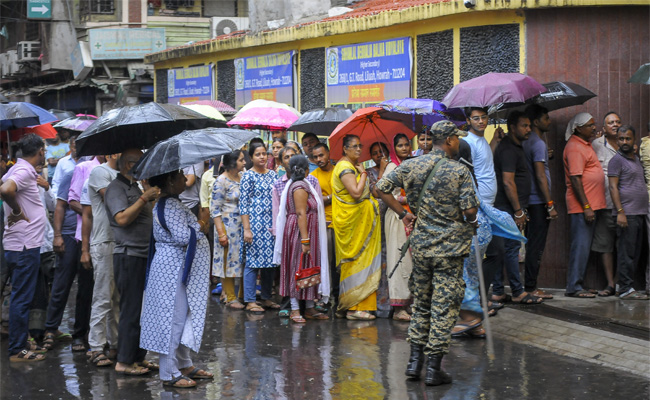
MP: Woman gives birth in rickshaw after being denied admission at district hospital

Neemuch, May 23: A 30-year-old woman gave birth to a baby in an auto rickshaw after she was denied admission at the Neemuch district hospital in Madhya Pradesh for want of an anaesthetist.
While the mother and the infant were subsequently admitted to the hospital and doing fine, the district collector has ordered an inquiry into the incident.
Dinesh Silavat, who hails from Gangrar area of Chittorgarh district, Rajasthan, and ekes out a living by selling blankets, said he has been living at Malkheda village of Neemuch for some days.
His wife Rajni started having labour pains around 2.30 pm on Wednesday and he rushed her to the district hospital here in a rickshaw, he told reporters.
But the hospital staff asked him take his wife to Udaipur, Rajasthan, he claimed.
"Despite my repeated requests, they did not budge, and women staffers told us to leave the hospital. As we came out of the hospital around 4 pm, my wife gave birth in the auto rickshaw," Silavat added.
"Some good-hearted people arranged sheets to provide privacy to my wife when she delivered the baby," he said.
When the hospital staff learnt about the delivery, they let the woman and her new-born in the hospital, Silavat said.
Maternity department head Dr Lad Dhakad said the anaesthetist was on leave, and as a result, caesarean deliveries could not take place there. The hospital did not have enough doctors even for regular duty, he added.
"My duty was till 2 o'clock. After that the woman was brought to the hospital. When the staff informed me, I went and saw her. Her blood pressure was shooting up. The family members were told that she was needed to be taken to a big hospital, but they stayed back. We do not admit such serious patients to avoid risk," he said.
Neemuch collector Dinesh Jain said he had ordered an inquiry, and action will be taken if anyone was found guilty.
Let the Truth be known. If you read VB and like VB, please be a VB Supporter and Help us deliver the Truth to one and all.
Rupee falls 32 paise to all-time low of 95.20 against US dollar
Mumbai, Apr 30 (PTI): The rupee depreciated 32 paise to an all-time low of 95.20 against the US dollar in early trade on Thursday, weighed down by elevated Brent crude oil prices, hovering around USD 122 per barrel, and strong American currency.
Forex traders said the USD/INR pair may see further downside, as rising crude oil prices are likely to sharply impact India's import costs, while concerns over potential wider conflict in West Asia are fuelling investor anxiety.
Meanwhile, the US dollar added to gains after the US FED Reserve kept rates unchanged. Safe-haven demand was also boosted by another diplomatic setback between Washington and Tehran.
At the interbank foreign exchange market, the rupee opened at 95.01 against the US dollar, then lost some ground and touched an all-time low of 95.20 against the US dollar in initial trade, registering a fall of 32 paise over its previous close.
On Wednesday, the rupee depreciated 20 paise to close at an all-time low of 94.88 against the US dollar.
ALSO READ: Meghalaya: Interstate ATM theft racket busted, 6 arrested
"The main effect on the rupee has been from the rising oil prices, which touched USD 120 per barrel and looked headed for further upside as the US continues with its blockade of Iranian ports, while Iran does not allow any ship/tanker to pass through the Strait of Hormuz," said Anil Kumar Bhansali, Head of Treasury and Executive Director Finrex Treasury Advisors LLP.
Meanwhile, the dollar index, which gauges the greenback's strength against a basket of six currencies, was trading 0.01 per cent higher at 98.96.
Brent crude, the global oil benchmark, was trading higher by 3.16 per cent at USD 121.76 per barrel in futures trade.
On the domestic equity market front, Sensex tumbled 821.79 points to 76,674.57 in early trade, while the Nifty dived 287.3 points to 23,890.35.
Foreign Institutional Investors offloaded equities worth Rs 2,468.42 crore on Wednesday, according to exchange data.
"FPIs continue with their sale of Indian Equities and debt (the yield touched 7 per cent on Wednesday) and are also dollar buyers consistently," Bhansali added.