Mumbai not for developers; SRA intended for public welfare: Bombay HC
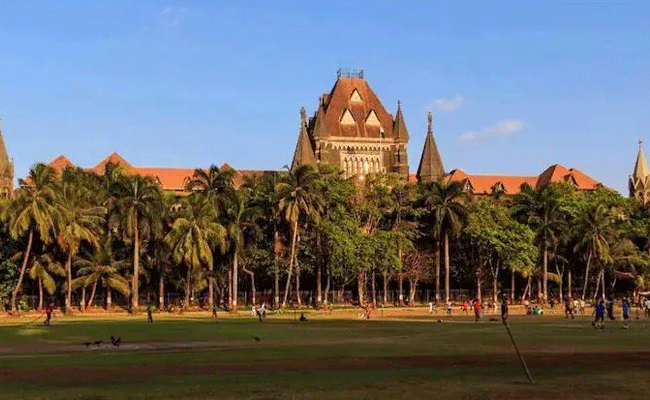
Mumbai, Feb 28 (PTI) This city is not for developers, and the Slum Rehabilitation Act (SRA) is intended to serve the purpose of public welfare and not the developers, the Bombay High Court said, directing two developers to pay transit arrears of Rs 11 crore to a suburban SRA project.
A division bench of Justices Gautam Patel and Neela Gokhale made the observation on Monday while hearing a petition filed by Shree Sai Pawan SRA CHS Ltd claiming that the two developers appointed for redevelopment of their society had not paid them transit rent since 2019.
Afcons Developers Ltd and Ameya Housing Private Ltd were appointed as co-developers of the slum rehabilitation project at Jogeshwari in suburban Mumbai.
More than 300 people eligible to get flats in the project have not been getting any transit rent since 2019. Of the 300, 17 were put up in transit accommodations and were hence not receiving transit rent, but these houses were also in a dilapidated condition.
The remaining 230 persons have not received any transit rent since 2019 and have been left to fend for themselves. The two co-developers are locked in a never-ending arbitration and there is no work being done at the site, the court said.
"This city is not for developers. The Slum Rehabilitation Act is not for developers. The Act is intended to serve a public welfare purpose. Developers are a means to that end," it observed.
The court further said that the developers are entitled to a free sale component provided by the incentive Floor Space Index (FSI), but this is a consideration for fulfilling their obligations under the contract.
"Those obligations include not only rebuilding or building of the rehabilitation structures and tenements both commercial and residential, but also the payment of transit rent or providing habitable transit accommodation," it said.
A developer, who does not pay transit rent, does not provide habitable transit accommodation or otherwise is in default of his obligations, all of which have to be performed on a schedule and within a time frame, is not entitled to any of the benefits of the slum rehabilitation project, i.e., the free sale component, the court said.
If there is a demonstrated default by the developers, then the privileges or entitlements are liable to be taken away, it said.
"A party in default cannot be allowed to take advantage of its own wrong and failure. That would be profiteering and that too at public expense because many of these slum projects are on public lands such as this one and the developer is not being made to pay the cost of land," the bench said.
The court also warned of terminating the developers' contract and appointing a new one noting that "the developer can always be changed, but the beneficiaries of a SRA project cannot".
If the two co-developers are at all serious about the project and want their rights to continue, they must demonstrate their bona fides and pay around Rs 11 crore transit rent arrears to the petitioner society by March 3, it said.
"They (developers) must prove their sincerity. To seek equity, they must do equity," the court said while posting the matter for further hearing on March 3.
Let the Truth be known. If you read VB and like VB, please be a VB Supporter and Help us deliver the Truth to one and all.
Noida International Airport appoints Nitu Samra as interim CEO

New Delhi (PTI): Noida International Airport on Friday announced the appointment of its Chief Financial Officer Nitu Samra as the interim Chief Executive Officer after authorities denied permission for foreign national Christoph Schnellmann to be at the helm.
"This change follows directions issued by the Bureau of Civil Aviation Security (BCAS) that the Chief Executive Officer of an airport in India is required to be an Indian national," NIA said in a statement.
Samra will replace Schnellmann, a Swiss national who has led Noida International Airport (NIA) as the CEO since August 2020.
The regulatory issue related to the requirement of having an Indian national as CEO has been delaying the start of commercial operations of the airport, which was inaugurated by Prime Minister Narendra Modi on March 28.
Schnellmann will join the airport's Board of Directors as Executive Vice Chairman. In this role, he will continue to support the project and its transition to operations, the statement said.
With immediate effect, NIA said Samra has been appointed as the CEO on an interim basis until the Board of Directors can conclude a formal selection process.
Samra has been serving as the CFO since October 2021 and was closely involved in the airport’s development journey, overseeing financial stewardship, governance, and strategic planning during a key phase of the project, the statement added.
NIA will be operated by Yamuna International Airport Pvt Ltd (YIAPL), a subsidiary of Zurich Airport International AG, under a public-private partnership.
Originally scheduled to commence passenger services in September 2024, NIA is being developed in four phases, along with a dedicated cargo terminal. It received an aerodrome license from the aviation regulator Directorate General of Civil Aviation (DGCA) in March.
YIAPL Chairman Daniel Bircher said that since the inauguration of the airport by the Prime Minister, the goal was to enable the start of operations as early as possible.
"This management change brings the airport into compliance with Bureau of Civil Aviation Security requirements while maintaining continuity in the airport’s leadership team. The newly structured team will support a smooth transition into operations, guided by clear and transparent governance and a strong corporate culture," he said.
On March 28, Civil Aviation Minister K Rammohan Naidu said commercial flight operations from the airport would start in the next 45 to 60 days.
Among the largest greenfield airport projects in the country, NIA will initially have a capacity to handle 12 million passengers per annum.
Once fully developed, the airport will have a total passenger handling capacity of 70 million.
The first phase of NIA has been developed at an investment of around Rs 11,200 crore. 'DXN' is the code for the airport.
The airport features a 3,900-metre runway capable of handling wide-body aircraft, along with modern navigation systems, including Instrument Landing System (ILS) and advanced airfield lighting.
The peak handling capacity in the first phase will be 30 flights per hour.
In the first phase, there will be 28 aircraft stands, and the projected cargo capacity is around 2.5 lakh tonnes.
Terminal 1 of the airport is spread across 1,37,985 square metres with 48 check-in counters. Over 40 acres of land have been earmarked for developing MRO (Maintenance, Repair and Overhaul) facilities at the airport.