My father would say his stint with Indira Gandhi was 'golden period': Sharmishtha Mukherjee
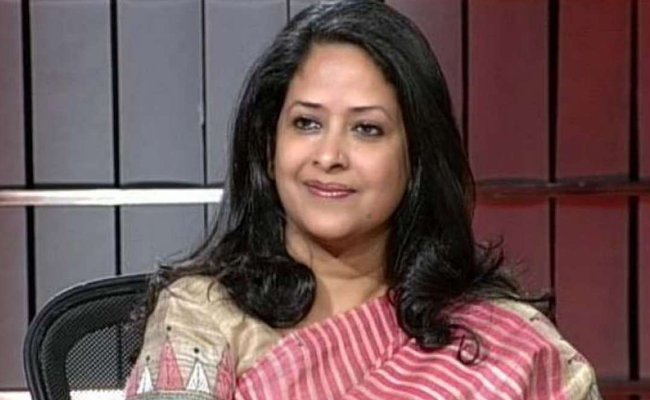
New Delhi (PTI): Former president Pranab Mukherjee's daughter Sharmishtha Mukherjee said her father felt he was not included in the cabinet of Rajiv Gandhi due to his "non-subservient" attitude.
At the launch of her book "Pranab My Father: A Daughter Remembers" on Monday, Sharmishtha said her father would say that his stint with former Prime Minister Indira Gandhi was the "golden period" of his political life.
The book, that has references taken from Mukherjee's diaries, was launched on the occasion of his birth anniversary. The event also saw the attendance of Congress leader P Chidambaram and BJP leader Vijay Goel.
She also touched upon his assessment of Congress leader Rahul Gandhi, which is part of the book and excerpts of which stirred a controversy.
Sharmishtha said that even her father was opposed to the proposed ordinance a copy of which was torn by Rahul Gandhi at a press conference in September 2013, but he felt that it should be discussed in the Parliament.
The ordinance aimed to bypass a Supreme Court order of immediate disqualification of convicted legislators, and instead proposed that they may continue as a member while an appeal in a higher court was pending.
"I was the one to break the news (about tearing of the ordinance) to him. He was so angry," Sharmishtha said.
She also said that her father, as the President of the country, and Prime Minister Narendra Modi worked as a team.
During a conversation over the book with former bureaucrat Pavan K Varma, she also recalled her opposition to her father attending an RSS event.
"I fought with Baba for three to four days over his decision. One day he said that it's not me who is giving legitimacy but it's the country. Baba felt that democracy is all about dialogue. It is about having a conversation with the opposition," she added.
At the start of the discussion, she had also said that the book has very few references of Rahul Gandhi.
Sharmishtha said that her father would often say that the Congress established parliamentary democracy and the "job of upholding it lies with the party".
Reacting to the criticism of the book, she said that none of the senior leaders have spoken over the book with only Prithviraj Chavan saying he cannot comment on it since he hasn't read it.
Noting that only Chidambaram turned up among Congress leaders, Sharmishtha said that she was pained.
"This reaction to a certain excerpt of the book shows that they should introspect and see whether they are actually upholding the values, actually practising what they are preaching," she opined.
Sharmishtha, who has quit politics, also clarified that she has not tried to tweak her father's views about anyone.
Talking about his association with Indira Gandhi, she said, "My father would say that the Indira Gandhi period was the golden period of his political life. Indiraji kept an eye on Baba. If there was one person with whom my father's loyalty lay, it was Indira Gandhi and nobody else."
Recalling how he rose through the ranks in Indira Gandhi's cabinet, she said it didn't happen in a day and underlined that the former prime minister was impressed by her father's homework.
"The real bonding started post-Emergency. He stood by her through thick and thin. Many stalwarts left her during that time," she noted, while stressing that her father remained loyal to her.
Highlighting that the imposition of Emergency had a historical context, she said that the conditions which led to it should also be looked into since the country was in a state of anarchy at that time.
"She made a mistake and she realised it. If I had the political maturity, a political meeting could have been managed between JP and Indira Gandhi...," Sharmishtha recalled her father's assessment of the scenario at that time.
Former bureaucrat Varma then asked her about the "trust deficit" between her father and Rajiv Gandhi, who succeeded his mother following her assassination.
Sharmishtha said there were "stories planted" by certain people that her father was not in favour of Rajiv Gandhi becoming the prime minister.
"As per Baba's notes, it was actually a planted story...to create misunderstanding between Rajiv Gandhi and Baba. The main reason behind trust deficit was Baba's staunch personality and his non-subservient attitude. Baba said Rajiv was correct in not taking me in his cabinet since I am a tough nut," she said.
Varma then touched upon Mukherjee being dropped from the Congress Working Committee in January 1986 and his expulsion from the Congress a few months later in the same year.
Sharmishtha recalled that her father was depressed and also formed the Rashtriya Samajwadi Congress but later returned to the Congress.
She then talked about how her father got upset about not being included in the PV Narsimha Rao cabinet since he considered the latter a friend but was offered the Planning Commission chairman's post.
Sharmishtha also discussed about the working relationship between her father and former Prime Minister Manmohan Singh.
"There was exemplary courtesy shown by Dr Manmohan Singh... and there was a strong mutual respect between the two of them. They knew how to handle the differences," she added.
Mukherjee held key portfolios during the Congress rule. He held charges of defence, external affairs and finance.
Varma asked Sharmishtha whether Mukherjee was the first choice for the President's post.
"I don't know whether he was the first choice, the second choice or the third choice. But from Baba's diary, I got to know that Mrs Gandhi was exploring the possibility and winnability of Shri Hamid Ansari ji," she said.
Let the Truth be known. If you read VB and like VB, please be a VB Supporter and Help us deliver the Truth to one and all.
AI, IndiGo, SpiceJet seek ATF price relief; say airline industry on verge of 'stopping operations'
Mumbai (PTI): Air India, IndiGo and SpiceJet have told the government that the country's airline industry is under extreme stress and on the verge of "stopping operations", as they sought revision in ATF pricing and financial support.
The West Asia turmoil has pushed up oil prices, and airspace restrictions have increased airlines' operating costs, especially on long-haul routes. Aviation Turbine Fuel (ATF) accounts for around 40 per cent of a carrier's operational expenses.
Against this backdrop, the Federation of Indian Airlines (FIA) has written to the civil aviation ministry, seeking steps to extend the same fuel pricing mechanism uniformly across both domestic and international operations as was done in the past with the establishment of the crack band.
ALSO READ: Tharoor junks Rijiju's claim that he agreed Cong is 'anti-women'; hails his party
With an unprecedented rise in jet fuel prices and exorbitant crack/differential between crude and ATF, the federation said the operation of airlines is being challenged in totality.
"... any ad hoc pricing (domestic vs international) and/or irrational increase in the price of ATF will result in unsurmountable losses for airlines and will lead to grounding of aircraft, resulting in cancellation of flights," the federation, which represents Air India, IndiGo and SpiceJet, said.
"In order to survive, sustain and continue operation, we request your urgent intervention for immediate and meaningful financial support to tide over the current situation," it said in a letter on April 26.
Also, the airlines have sought temporary deferment of excise duty on ATF, which is at 11 per cent.
"With the abnormal increase in ATF prices from the pre-crisis period, adding rupee depreciation to the increased prices, the 11 per cent excise duty also increases manifold for the airlines and adds to the ATF price as a big impact on airlines," they said.
Last month, the government limited the hike in ATF price to Rs 15 per litre for domestic operations, but for international operations, the price rose by Rs 73 per litre.
The airlines said the situation has practically made international operations, along with domestic operations, completely unviable and resulted in significant losses for the aviation sector in April.
Seeking urgent intervention on the current ATF ad hoc pricing, FIA said the current situation is creating a severe imbalance in domestic and international operations and rendering airline networks unviable and unsustainable.
"The airline industry in India is under extreme stress and is on the verge of closing down or of stopping its operations."
The federation has pitched for a transparent pricing framework under the crack band mechanism (USD 12–22/BBL) that was implemented in October 2022, saying there was a fair and reasonable margin for Oil Marketing Companies (OMCs).
According to FIA, the country's largest aviation hub Delhi has the second-highest value-added tax (VAT) of 25 per cent on jet fuel, while the highest rate is 29 per cent levied in Tamil Nadu.
"The other major aviation cities, viz. Mumbai, Bangalore, Hyderabad, and Kolkata range between 16 per cent and 20 per cent. These 6 cities cover more than 50 per cent of airlines' operations within India," the federation said.