Nagma Mallick from Kasaragod appointed Indian Ambassador to Japan

New Delhi: Senior IFS officer from the 1991 batch and current Indian Ambassador to Poland Nagma Mohamed Mallick has been appointed as the next Ambassador of India to Japan, the Ministry of External Affairs (MEA) has stated in a press release on Thursday.
Nagma Mallick, who will soon take up her assignment, will be the second lady officer to be the Indian Ambassador to Japan after Deepa Gopalan Wadhwa.
Kasaragod-based Nagma Mallick, who has served in the Foreign Services for more than three decades, has held various important posts in France, Nepal, Sri Lanka, Thailand, Tunisia, Brunei and currently Poland during her diplomatic career. She also handled the relations with Russia and Africa as an officer in the Prime Minister’s Officer (PMO). She was the first woman to be appointed as the Deputy Chief of Protocol.
Nagma Mallick is the daughter of late Mohamed Habibullah and Zulu Banu, residents of Fort Road in Kasaragod. She is also the niece of the famous writer, the late Sara Aboobacker.
Her father Habibullah had shifted with his family to New Delhi after he was posted to the Central Government's Department of Overseas Communications.
Nagma Mallick was born and raised in New Delhi. An alumna of St Stephen’s College and School of Economics, she holds a degree in English literature and MA in Economics.
She began her career as a diplomat in the MEA and was first sent to Paris to represent the Indian Mission at the UNESCO. She has also held various other posts in the Ministry.
Nagma Mallick has served in the offices of former Prime Ministers IK Gujral and Atal Bihari Vajpayee and was the first Indian woman officer to be appointed as the Deputy Chief of the Protocol Division in the MEA.
She is interested in English literature and performs classical dance. She is fluent in five languages, English, French, Hindi, Urdu and Malayalam.
Let the Truth be known. If you read VB and like VB, please be a VB Supporter and Help us deliver the Truth to one and all.
Mercury likely to touch 44 deg C in Delhi; IMD issues alert for heatwave-like conditions
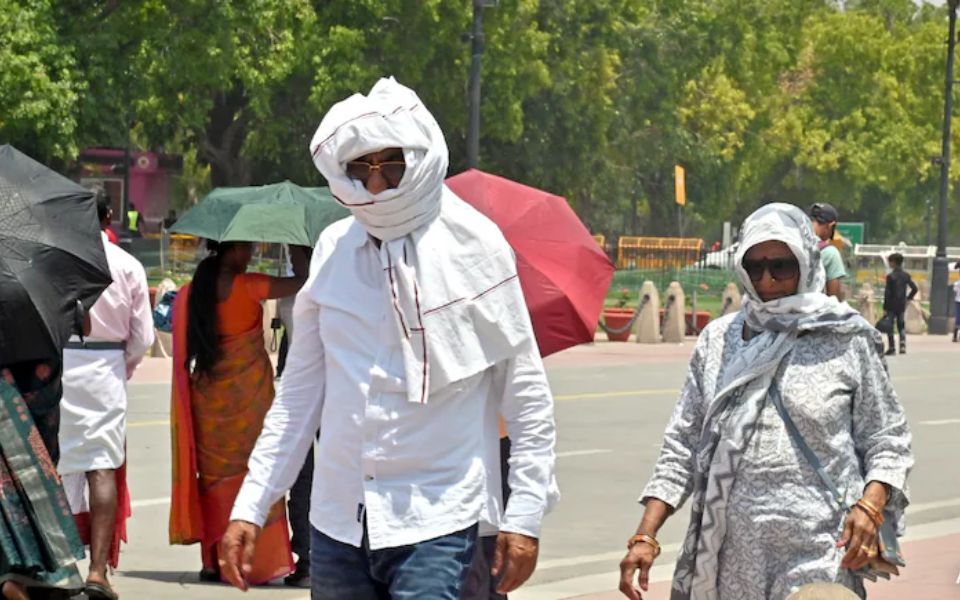
New Delhi (PTI): Delhi recorded a minimum temperature of 26.2 degrees Celsius on Sunday, 2.4 notches below the seasonal average, according to the India Meteorological Department.
The weather department has forecast partly cloudy sky with an orange alert for heatwave-like conditions at isolated places by the evening.
The maximum temperature is expected to reach around 44 degrees Celsius on Sunday, the IMD said.
The relative humidity in the capital was recorded at 43 per cent at 8.30 am.
The air quality was 'poor' at 9 am, with an Air Quality Index (AQI) reading of 223, Central Pollution Control Board (CPCB) data showed.
According to the CPCB, an AQI between zero and 50 is considered 'good', 51 and 100 'satisfactory', 101 and 200 'moderate', 201 and 300 'poor', 301 and 400 'very poor', and 401 and 500 'severe'.