Nagrota attacker made multiple Pakistan visits legally to meet Jaish leaders: NIA
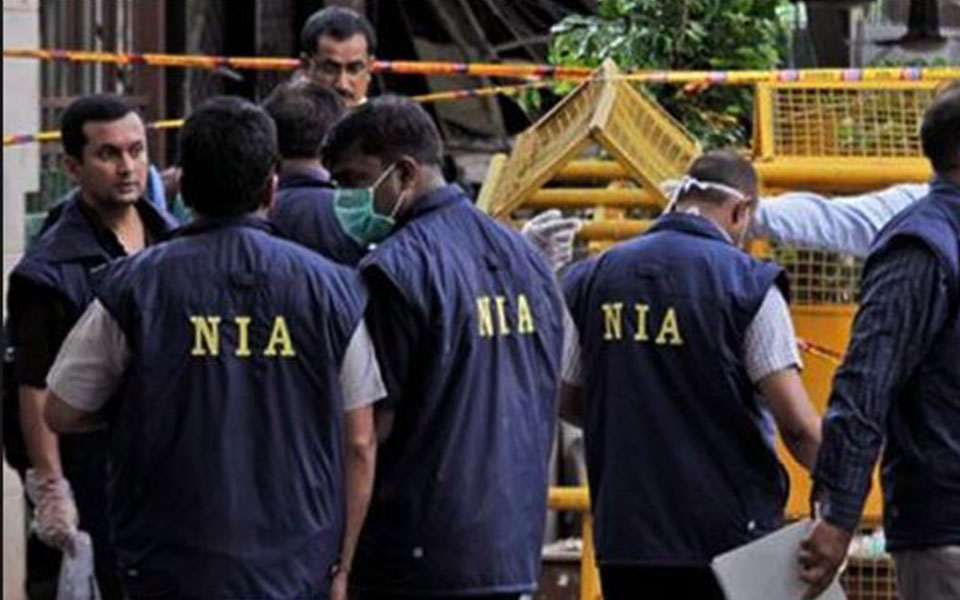
New Delhi, June 7: Mohammad Ashiq Baba, one of the arrested accused in the terror attack on Nagrota Army camp in Jammu and Kashmir in 2016, had visited Pakistan four times "legally" with a reference letter issued by senior Hurriyat leaders, the NIA said on Thursday.
"As part of conspiracy to conduct attacks on the security forces in Jammu and Kashmir, terrorist Baba visited Pakistan four times, crossing the Wagah border between 2015 to 2017 legally," a National Investigation Agency (NIA) official said in Delhi.
"He obtained his visas after getting reference letters from Huriyat leaders Syed Ali Shah Geelani, Abdul Gani Bhat and Mirwaiz Umar Farooq," the official added.
The officer revealed that Baba met Jaish-e-Mohammad (JeM) commanders in Pakistan and took directions from them after getting clearance from a local ISI (Inter-Services Intelligence) agent.
"Baba thereafter, on return, received instructions on how and when to receive the group of terrorists.
"Baba later went to Pakistan in April/May 2017, and met Waseem, Abu Talha and Mufti Ashghar. He also met Maulana Rauf, brother of Maulana Masood Azhar, and an accused in the Pathankot attack case at their headquarters at Bahawalpur," the official revealed.
The counter-terror probe agency also said that the three terrorists arrested for the November 2016 attack on the camp -- Baba, JeM operative Syed Muneer-Ul-Hasan-Qadri and Pulwama-based timber dealer Tariq Ahmad Dar -- were in regular touch with JeM commanders based in Pakistan.
"... they were in contact through Whatsapp voice and text messages with Maulana Mufti Ashghar based in Muzaffarabad, whose nephew Waqas, a JeM commander in south Kashmir, died in a shootout with security forces near Pulwama.
"They were also in touch with Qari Zarar, another JeM commander in charge of launching terrorists into Jammu region, based out of Rawalpindi and Waseem and Abu Talha," the NIA official said.
Seven soldiers were killed in the attack on the Nagrota Army camp in November 2016. Three attackers too were killed in the counter-operation.
The official said that nearly a week prior to the attack, the three arrested accused were given GPS coordinates along the Samba Sector and possible targets along the Nagrota Army camp through Whatsapp from Pakistani handlers. They were also asked to conduct reconnaissance of these targets, which they did.
The NIA claimed that the three accused received a group of three attackers on November 28, 2016, a day before the attack and travelled in two vehicles to Jammu after keeping their weapons concealed in one of the two cars owned by Dar and Baba.
"They parked the car with weapons at a paid parking slot and then stayed at a hotel in Jammu. The same day, Baba took one of the attackers, Abu Hisham, to Nagrota to show him the spot to be attacked and returned to the hotel," the official said.
The official said that later in the night, the three Indian terrorists left for the attack site along with the Pakistani attackers and were dropped near the Army camp.
He said that Baba and Qadri received another group of three terrorists in March 2017 from the Samba Sector and dropped them at Khrew near Pampore.
The NIA official said that a hefty amount of money originating from the Gulf countries was transferred into Baba's HDFC Bank account.
Let the Truth be known. If you read VB and like VB, please be a VB Supporter and Help us deliver the Truth to one and all.
Bank account in Ramgarh tracked for fraudulent fund transactions across 24 states, 4 arrested
Ramgarh (Jharkhand) (PTI): Jharkhand police on Thursday said it has unearthed a network of interstate cyber frauds and arrested four miscreants for fraudulent transactions through a bank account in Ramgarh district after complaints of 274 suspected transactions in 24 states.
The states where complaints for fraudulent transactions were registered included Maharashtra, Karnataka, West Bengal, Uttar Pradesh, Telangana, Tamil Nadu, Kerala and Andhra Pradesh.
The action followed inputs received through 'Samanvaya portal', a centralised, web-based platform launched by the Union Home Ministry to curb cybercrime.
"We arrested four cyber miscreants after a current account with Kuju (Ramgarh) branch of the State Bank of India was found to have registered suspected financial transactions in 24 states with the help of the Pratibimba portal of the Home Ministry through the Samanvaya portal," Ramgarh Superintendent of Police Mukesh Kumar Lunayat said.
During the probe, police found that the account was opened under the MSME Udyam Registration scheme in the name of Shree Ganesh Enterprises, he said.
The account had been linked to as many as 274 complaints from different states related to cyber fraud and illegal fund transfers.
The registered proprietors of the enterprise were identified as Rahul Gupta (37), Ravi Kumar Verma (34), and Ajay Sharma (33), all residents of Ramgarh district, a statement from the Ramgarh police said.
During interrogation, Rahul Gupta and Ravi Kumar Verma revealed that they had opened multiple current accounts at the behest of Ritesh Agrawal alias Munna (40) and Sonu Kumar Jha (34).
They admitted receiving Rs 1.2 lakh in exchange for facilitating the opening of these accounts.
"The accused further confessed to sharing OTPs, activating mobile banking services, and handing over control of the accounts to the main operators through WhatsApp and Telegram groups. These accounts were then allegedly used to route fraudulent transactions.
Police said mobile data analysis of the accused led to the recovery of crucial digital evidence, including details of SIM cards, bank accounts, passbooks, ATM cards, QR code scanners, Aadhaar cards, and PAN cards shared through messaging platforms.
A total of four accused have been arrested so far and sent to judicial custody.
A case has been registered at the Cyber Crime Police Station under relevant sections of the Bharatiya Nyaya Sanhita (BNS) 2023 and Sections 66C and 66D of the Information Technology Act, 2000.
Further investigation is underway, the police said.