Narayana Guru's philosophy counters majoritarianism amid social divisions, says Siddaramaiah
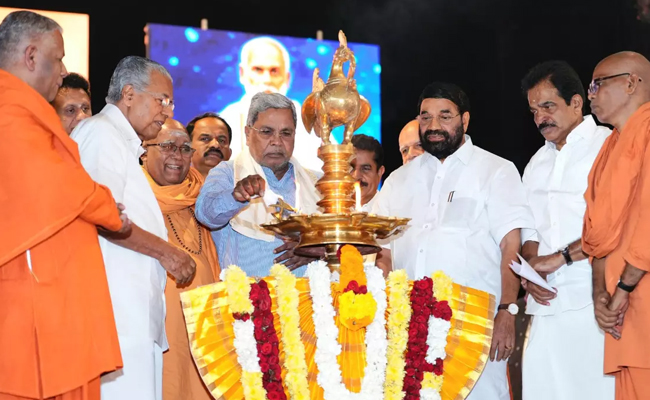
Varkala (Kerala) (PTI): Karnataka Chief Minister Siddaramaiah on Wednesday said saint and social reformer Sree Narayana Guru's philosophy remains a powerful answer to rising majoritarianism and social divisions in an India that boasts of economic progress even as unity weakens.
Speaking at the 93rd Sivagiri Pilgrim Conclave at Sivagiri Math, founded by Guru here, Siddaramaiah, the chief guest at the function, lamented that today's India faces a paradox where "we boast of economic growth, digital expansion and global influence, and yet social solidarity is weakening, and hatred is being normalised".
He said caste has not disappeared, but it has just changed its grammar.
Noting that communalism no longer speaks openly of hierarchy, it speaks the language of identity, fear, and majoritarian pride, Siddaramaiah said Guru foresaw this danger.
"He understood that when religion is separated from compassion and ethics, it becomes a tool of domination," Siddaramaiah said.
"Guru's philosophy directly counters religious majoritarianism, cultural nationalism without equality and identity politics without justice. His message reminds us that nation-building without social justice is merely state-building, not democracy," he said.
The Karnataka chief minister said it was no coincidence that after meeting Guru, Mahatma Gandhi sharpened his stance against untouchability, took a stand in favour of a simple life, and refused to attend weddings if they were not inter-caste.
He said that Rabindranath Tagore's idea of the "universal man" was inspired by the works of Guru.
He also shaped the ethical universe of Tagore, who acknowledged that dividing human beings in the name of religion is the greatest injustice, the CM said.
"Thus, Guru stands at the ideological crossroads of modern India by bridging spirituality, rationalism, humanism and social justice," Siddaramaiah said. The conclave was inaugurated by Kerala Chief Minister Pinarayi Vijayan.
According to Siddramaiah, Guru's influence was not confined to Kerala.
"His historic dialogue with Mahatma Gandhi in 1925 altered the intellectual course of the freedom movement. It made Gandhiji confront a fundamental truth that “Caste is not cultural diversity, it is institutionalised injustice," he said.
Using the mango tree analogy, Guru revealed that though leaves differ, their essence is the same, making Mahatma Gandhi realise that caste and religion, not diversity, are the world's deepest social problems, the Karnataka CM said. Siddaramaiah also spoke about Guru's impact on Karnataka.
ALSO READ: Congress and NCP (SP) to contest separately in Nagpur civic polls
"Though geographically rooted in Kerala, Guru's influence crossed linguistic and state boundaries, shaping reform movements along the Karnataka coast, especially in Dakshina Kannada, Udupi, Uttara Kannada, and parts of Malnad," he said.
He said the Billava, Elava, Ediga, Mogaveera, and other backward communities of coastal Karnataka drew inspiration from Guru's call for dignity, education, and organisation.
"His message strengthened anti-caste assertion and self-respect movements in the region. This is one of the main reasons for strong resistance to attempts by communal forces to divide the people in the region," he said.
The chief minister said Basavanna's Kayaka (dignified labour) finds a direct echo in Narayana Guru's insistence on economic self-reliance alongside spiritual growth.
"Basavanna democratised devotion through Vachanas, Narayana Guru democratized divinity itself, asserting that human beings' exclusions are not graded by birth, but equal by existence. Both transformed religion from a tool of exclusion into a language of social justice," he said.
Siddaramaiah opined that the Sivagiri Pilgrimage cannot remain a yearly ritual.
"It must become a continuous social movement," the chief minister said and called upon religious leaders to speak against hatred, scholars to take Guru's philosophy into classrooms, youth to challenge injustice, not inherit silence and political institutions to align governance with ethical values," he said.
Concluding his address, Siddaramaiah called for an India rooted in dignity, dialogue and equal humanity, saying this was the democratic vision shared by Narayana Guru, Mahatma Gandhi and the Sivagiri movement.
Let the Truth be known. If you read VB and like VB, please be a VB Supporter and Help us deliver the Truth to one and all.
Two injuries, one DNF, a DQ as India end messy World Relays campaign

Gaborone (Botswana) (PTI): Amoj Jacob and Ragul Kumar got injured during the men's 4x400m and 4x100 races respectively as India ended their World Athletics Relays campaign in disappointment on the second day of competitions here on Sunday.
The Indian camp had high hopes of making the 2027 World Championships in the men's 4x400m relay but the team did not finish (DNF) the race as Jacob suffered cramps and pulled out of the race after taking the baton from the first leg runner Dharamveer Choudhary. Rajesh Ramesh and Vishal TK were to run in the third and fourth legs.
Those teams which could not qualify for the 2027 Beijing World Championships by reaching the final round of each of the six relay events on Saturday were given another chance in the second qualification round on Sunday.
The top two teams in each of the two heats (in all six relay events) booked the Beijing ticket on Sunday.
India will now have to try and qualify for the World Championships through the Top Lists of the World Athletics, which is a long and tedious process.
In the men's 4x100m race, third leg runner Ragul Kumar fell down the track after failing to hand over the baton inside the exchange zone to fourth leg runner Gurindervir Singh, which clearly showed the lack of coordination among the runners.
Harsh Santosh Raut and Animesh Kujur ran the first two legs.
The Indian quartet was disqualified and Kumar was seen being taken away from the Field of Play with the help of the volunteers.
It was a comedy of errors in the case of the women's 4x100m race, which saw the baton being dropped during an exchange between first leg runner Tamanna and second runner Nithya Gandhe, though the Indians finished the race in 53.09 seconds.
Gandhe started running quite a distance, but after realising that the baton was not in her hand, she turned and ran back to pick it up.
The only silver-lining for the Indian contingent was the national record time in the mixed 4x100m relay race, though the quartet of Ragul Kumar, Nithya Gandhe, Animesh Kujur and Sneha SS finished sixth in heat number two with a time of 41.35 seconds, bettering the previous national mark of 42.30 seconds set in March in Chandigarh.
The mixed 4x400m relay quartet of Theerthesh P Shetty, Kumari Saloni, Nihal William and Rashdeep Kaur ended at fifth in heat number one with a time of 3 minutes and 19.40 seconds.
On Saturday, all the five Indian relay teams had failed to make it to the respective final rounds and thus missed out on the 2027 World Championships berths.