Nation first, parties are means to make country better: Shashi Tharoor
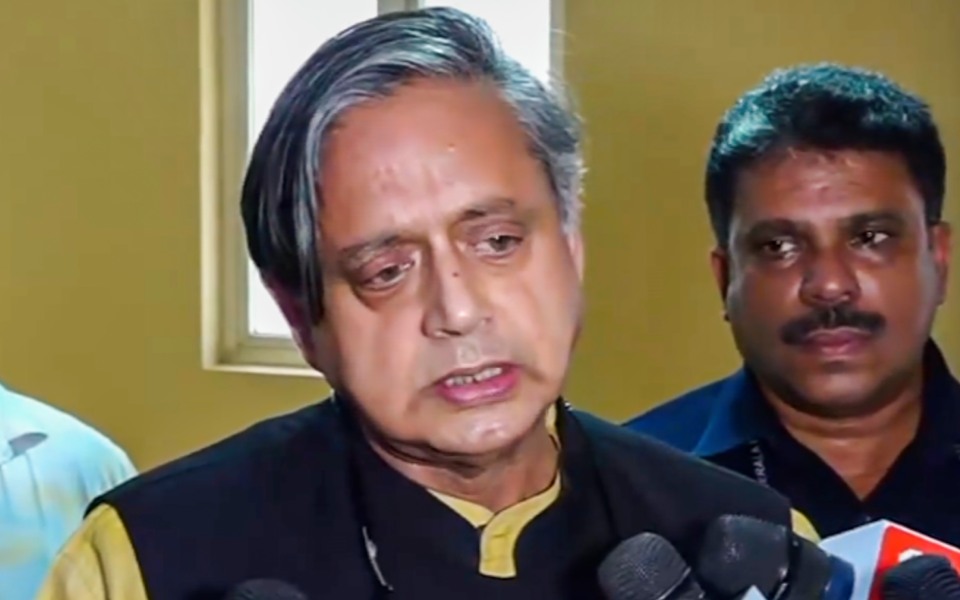
Kochi, Jul 19 (PTI): Congress Working Committee (CWC) member Shashi Tharoor on Saturday said that nation comes first and parties are the means of making the country better.
Tharoor, the MP from Thiruvananthapuram, said that the objective of a party is to create a better India and parties have the right to disagree on the best way to do that.
He also said that he will stand his ground regarding supporting the nation's armed forces and the government as he believes "this is the right thing for the country".
"Which is your first loyalty? To my mind, the nation comes first. Parties are a means of making the nation better. So, to my mind, whichever party you belong to, the objective of the party is to create a better India in its own way.
"Now, parties have every right to disagree about the best way of doing that.. As you know, a lot of people have been very critical of me because of the stand I have taken, supporting our armed forces and our government, and what happened recently in our country and our borders," he said, while speaking at a private event here on 'Peace, Harmony and National Development'.
"But I will stand my ground, because I believe this is the right thing for the country," the Congress MP added.
During his speech, he further said that politics is unfortunately or otherwise, in any democracy, about competition.
"As a result, when people like me say we respect our parties, we have certain values and convictions that keep us in our parties, but we need to cooperate with other parties in the interests of national security, sometimes the parties feel that its disloyal to them and that becomes a big problem," he said.
Later, on the sidelines of the event, he told reporters that "nation first was always my philosophy".
He said that he came back to India only to serve the nation in whatever he can, through and outside politics.
"I have tried to do that," he said.
On being asked whether he has any problems with the Congress high command, he said he was not here to discuss any politics or problems.
"I came to give two speeches. Both the speeches were on themes I hope the public will respect and value. First one was about development, the role of businesses and peace and harmony.
"The second was mainly on the theme of communal harmony and trying, at the same time, to live together in order for all of us to grow and develop. Inclusive development has been my theme throughout my 16 years in politics and I believe in inclusiveness and in development. I also believe in national security and national interest," he said.
Regarding the recent survey controversy, Tharoor said he frankly does not know who carries out such surveys.
"Someone forwarded it to me and I did a salute as a reply. I did not have anything more to say and I made no comment and I am not making any comment," he said.
He was replying to a reporter's query regarding a survey which suggested he is the Congress-led UDF's most preferred choice for chief minister.
Let the Truth be known. If you read VB and like VB, please be a VB Supporter and Help us deliver the Truth to one and all.
Ladakh a living land of dharma for centuries: Amit Shah
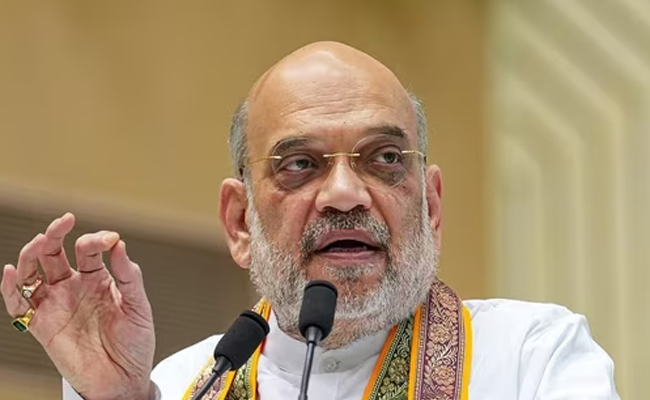
Leh/Jammu (PTI): Union Home Minister Amit Shah on Friday described the return of sacred relics of Lord Buddha to Ladakh after 75 years as a "historic reunion" and said that the Union Territory has remained a "living land of dharma", preserving and nurturing Buddhist knowledge for centuries.
Stressing the relevance of Buddha's teachings in modern times, Shah said the message of peace, compassion and the middle path was even more important today than it was 2,500 years ago.
"Ladakh has been a living land of dharma for centuries. When the Dalai Lama comes here, he says this land is not merely a geographical land but a living laboratory of Buddhist culture and compassion," Shah said, speaking after the inauguration of the sacred holy relics exposition of Tathagata Buddha and the 2569th Buddha Purnima celebrations at Jivetsal in Leh during his two-day visit to Ladakh.
Calling Ladakh a land of compassion, he said this land has preserved and nurtured knowledge. "Whenever Buddhism faced crises, this land worked to protect the teachings of Buddha. And when peace returned, it helped to expand and carry forward that preserved wisdom," he added.
"Unless one internalises knowledge and makes it a part of oneself, liberation is not possible. Knowledge is incomplete without spiritual practice, while spiritual practice without knowledge is blind. Therefore, the union of spiritual practice and knowledge is the right path. Even after all this, if there is no moral discipline, one cannot lead a truly wise life. The basis of a life of wisdom is moral discipline," he said.
Shah said it was through Ladakh and adjoining routes that the teachings of Tathagata Buddha, which originated in India, spread to China and several other countries.
"The message that emerged from the land of Ladakh has become a guiding force for many people around the world to take their lives forward. The presence of these sacred relics in Ladakh reminds us that India's civilisation has, for thousands of years, given the message of peace and coexistence," he said.
He said that in a diverse region like Ladakh and Kargil, this message becomes even more relevant. "This heritage still tells us today that amidst conflict and unrest, only the path of peace and compassion can provide solutions."
He said the return of the relics on Buddha Purnima had enhanced the significance of the festival for the people of Ladakh.
"These sacred relics have come to Ladakh after 75 years. It is as if Buddha himself is present here today," Shah said, adding that followers of Buddhism and people of other faiths in Ladakh and Kargil would draw spiritual energy from the relics.
Highlighting Ladakh's role in the spread of Buddhism, Shah said Kashmir was once an ancient centre of Buddhist studies, Mahayana philosophy and Buddhist art, from where Ladakh first came into close contact with Buddhism.
He said Emperor Ashoka's envoys laid the foundation of Buddhist influence in Ladakh through Kashmir and Gandhara, while Mahayana Buddhism expanded in the region during the Kushan period between the first and third centuries CE.
The Silk Route linking Kashmir, Leh, Yarkand, Khotan and Tibet became a channel not only for trade but also for ideas, monks, manuscripts and artistic traditions, Shah said.
He added that later, Tibetan influence between the seventh and tenth centuries further enriched Ladakh through Mahayana and Vajrayana traditions.
Stressing the relevance of Buddha's teachings in modern times, Shah said the message of peace, compassion and the middle path was even more important today than it was 2,500 years ago.
"Amid conflict and unrest, only the path of peace and compassion can provide solutions," he said.
Shah also appealed to the Ladakh administration to ensure complete arrangements so that followers of all faiths, especially Buddhists, could visit and pay obeisance to the relics.
#WATCH लेह, लद्दाख: केंद्रीय गृह मंत्री अमित शाह ने कहा, "जब दलाई लामा यहां आते हैं तो वे कहते हैं कि यह भूमि केवल भौगोलिक भूमि नहीं है। यह भूमि बौद्ध संस्कृति और करुणा की जीवंत प्रयोगशाला है। इस भूमि पर ज्ञान का संरक्षण हुआ है... भारत की सभ्यता हजारों वर्षों से शांति का संदेश… https://t.co/2nwG0w2CE6 pic.twitter.com/W13itRBqeX
— ANI_HindiNews (@AHindinews) May 1, 2026