'Nation forgot Manipur':Traders at world's only women-run market question poll relevance amid unrest
Imphal (PTI): Amidst the lingering aftermath of ethnic conflicts, the women traders at Manipur's iconic 'Ima market' - the only market in the world run entirely by women - have expressed a deafening lack of enthusiasm towards the upcoming Lok Sabha elections.
Questioning the relevance of the electoral process amidst the ongoing turmoil, the women traders from various market associations, are contemplating a boycott of the polls with their major grievance being -- "the nation forgot Manipur".
Nema Devi, a seasoned fish vendor at the market, reflects the sentiment shared by many, emphasising the absence of tangible change despite months of unrest.
"Even 11 months after the violence, there has not been a resolution and no restoration of peace. We continue to live by the rule of taking one day at a time. Living in continuous fear and going ahead with our usual lives.
"What will change with the elections? The nation, the government, everybody forgot Manipur," 52-year-old Devi, who has been running the shop in the market for over a decade, told PTI.
Debjani, a fruits and vegetables vendor, succinctly said, "Elections nai chahiye" (elections not needed)", echoing the prevailing scepticism.
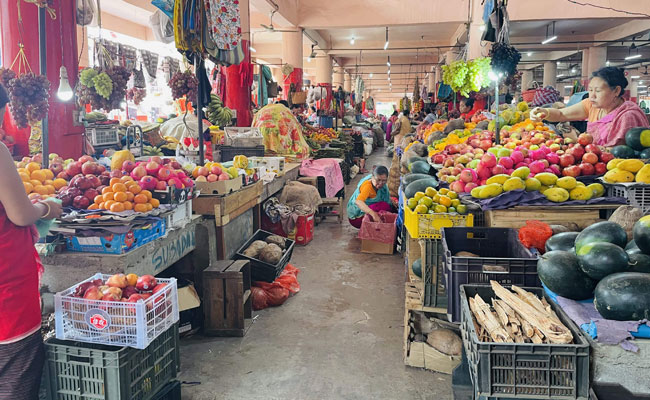
At first glance, the 500-year-old "Ima Keithel" is much like any other popular market. Lines of vendors selling everything from fresh fruit to fish and fabrics from dusk until dawn.
But after walking through its long lanes with more than 4,500 stalls spread across three multi-story buildings and a sea of surrounding tin shacks, one unique aspect becomes hard to ignore: every single trader, without exception, is a woman, a fact they take pride in.
The famous market was also the theme of the state's Republic Day tableau this year.
Priya Kharaibam, a third-generation pottery trader, questioned the purpose of elections if the status quo remains unchanged.
"If everything has to go on the way it is going on, why do we need elections? What will change?" she asked.
Against this backdrop, a traders' group in the market called Manipur Keithel Phambi Apunba Lup, has opted to abstain from engaging in election-related activities, citing governmental disregard for the populace's well-being.
"The decision to hold the elections shows that the government has no concern for the life and property of the common people. The people of the state have been witnessing a cycle of violence arising out of conflict between two communities for the last 11 months.
"We have been facing immense hardship due to the protracted violence," said Yumnam Ibeyaima, General Secretary of the traders' body.
The unfolding crisis stemming from clashes between the Meitei and tribal Kuki communities has claimed over 200 lives, with thousands displaced and living in camps.
Asem Nirmala, General Secretary of another traders' body in the market called Lukmaisellup, lamented the lack of governmental responsiveness to the prolonged crisis, emphasising the urgent need for solutions over elections.
"This is the time for solutions. This is not the time for elections. These polls are being enforced at the very wrong time.
"We are contemplating whether we should either not vote or vote in unison against the government in power and give other parties a chance and see if there is restoration of peace. I am trying to counsel the women in the market but they are not keen on voting," she told PTI.
Some traders find themselves at a crossroads, contemplating whether to vote collectively against the incumbent government in pursuit of peace restoration.
As many as 75 'Imas' or 'mothers' (elderly women traders) from the famed market had visited Delhi in June last year and staged a sit-in protest at Jantar Mantar, demanding a solution and opposing any territorial division of the state on ethnic lines.
Expressing disillusionment with the electoral process, Kunjang Phema, a fabric vendor, highlights the failure of elected representatives to address their grievances effectively.
"Why do we choose a representative? So our voices are heard and acted upon. If that has not happened in such a critical situation when will it happen? Why should we vote? We are still contemplating whether to vote or not but if you ask us if we have faith in elections? No," says Phema, who was part of the group.
The elections for two Lok Sabha seats in Manipur will be held in two phases on April 19 and 26.
While Inner Manipur and some segments of Outer Manipur will vote in the first phase on April 19, the remaining segments of Outer Manipur will vote in Phase 2 on April 26.
The Election Commission has announced that the displaced population will have the opportunity to cast their votes from relief camps.
The effort to facilitate voting for the displaced offers a glimmer of hope amidst the prevailing despair, as the state grapples with deep-seated unrest and a yearning for lasting peace.
Amidst the prevailing unrest and feelings of abandonment, the traders' voices echo a profound sense of disillusionment with the government's response to Manipur's plight.
"The government cannot see that Manipur is burning, it feels like it is some state outside India and hence peace here is not on their agenda. Why should we impose our faith in such a system which has abandoned us at this crucial time? Despite the huge deployment of forces, we do not feel safe in our own homeland," said K Dhaneshori.
Let the Truth be known. If you read VB and like VB, please be a VB Supporter and Help us deliver the Truth to one and all.
Putin meets Iran's FM Araghchi, says Russia ready to do its best to help bring peace to West Asia
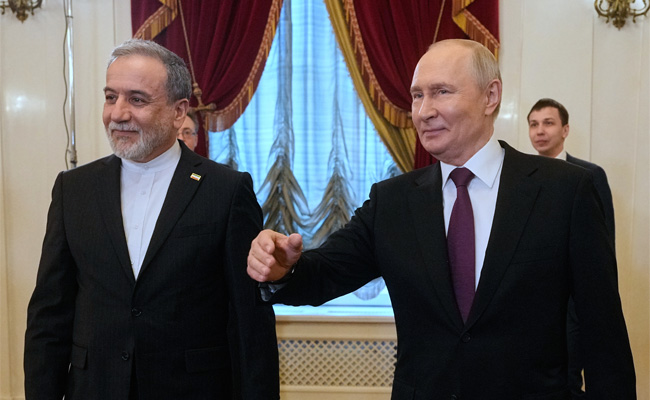
Moscow (PTI): Iran's Foreign Minister Abbas Araghchi on Monday met Russian President Vladimir Putin, who hailed the Iranian people for fighting bravely and heroically for their sovereignty and said Moscow is ready to do its best to help bring peace to West Asia as soon as possible.
Araghchi, who held talks with Omani and Pakistani leadership before arriving in Russia, met Putin in St. Petersburg and thanked him for supporting Iran, state-owned TASS news agency reported.
"Russia is ready to do everything in its power to ensure that peace in the Middle East is achieved as soon as possible," Putin said during his meeting with Araghchi, which was also attended by Russian Foreign Minister Sergey Lavrov.
Revealing that he received a message from Iranian Supreme Leader Mojtaba Khamenei last week, Putin asked Araghchi to convey his "gratitude for this message and best wishes for his health and well-being."
He praised the Iranian people for fighting "bravely and heroically" for their sovereignty, Iran's state-run PRESS TV reported.
"We really hope that, based on the courage and desire for independence, the Iranian people, under the guidance of the new leader, will weather this difficult period of trials and peace will come,” Putin said.
He also stressed that Russia “intends to maintain” its strategic relations with Iran.
Araghchi said that the world witnessed Iran’s strength in countering the US during the recent war, and that the Islamic Republic is a "stable and powerful establishment."
"With their courage, the Iranian people succeeded in resisting the US aggression and will be able to endure it,” he said.
He said that it became clear that Iran has “great friends and allies” like Russia, and conveyed “warmest greetings” from Supreme Leader Mojtaba Khamenei and President Masoud Pezeshkian to the Russian leader.
Araghchi said relations between Moscow and Tehran represent a “strategic partnership at the highest level” and will continue to develop "regardless of circumstances."
"We are grateful to you for the solid and strong positions in support of the Islamic Republic of Iran," he said.
Foreign Minister Lavrov said that the talks between President Putin and the Iranian Foreign Minister were "useful and constructive."
Kremlin Spokesman Dmitry Peskov later said that Russia is "ready to provide any good offices, any mediation services that are acceptable to the parties."
"We will be ready to do everything so that ultimately peace ensues, guaranteed peace, and that there is no return to hostilities," Peskov was quoted as saying by TASS.
He was asked how Moscow can assist in future negotiations on the Iranian settlement.
Araghchi arrived in Russia after his whirlwind trip to Islamabad, which, according to him, was “very productive” and involved “good consultations" with Pakistan's Army Chief Field Marshal Asim Munir, amid uncertainty over the second round of peace talks to resolve the war in West Asia.
"We held good consultations with our friends in Pakistan. The trip was successful. We assessed the outcome of our recent (meetings) and discussed in what direction and under what conditions talks can move on,” Araghchi said in a video posted on his Telegram channel upon his arrival in St Petersburg.
Referring to the second round of talks between the US and Iran to resolve the conflict in West Asia, Araghchi said: "Developments have taken place in the negotiations."
"Despite some progress in earlier rounds, the talks failed to reach their objectives due to the Americans' approach, the excessive demands they made, and the wrong approaches they adopted. Therefore, it was necessary to consult with our friends in Pakistan to review the latest situation,” Iran's official news agency IRNA quoted him as saying.
He said that the trip to Pakistan was a good opportunity to review developments related to the US-Israeli war against Iran, expressing confidence that “these consultations and coordination between the two countries will be highly significant.”
Araghchi arrived at St. Petersburg's Pulkovo Airport early Monday, where he was welcomed by Russian officials and Iran’s ambassador to Russia, Kazem Jalali, the report said.
The first round of peace talks between Iran and the US, held on April 11 and 12, failed to bring the desired result for the parties to the conflict.
The Iranian minister arrived in Islamabad for the second time on Sunday after a short visit to Oman, where he held talks with Sultan Haitham bin Tariq al-Said on security in the Strait of Hormuz and diplomatic efforts to end the Iran-US conflict.
After Araghchi left Pakistan for Oman on Saturday, President Donald Trump announced that US negotiators Steve Witkoff and Jared Kushner would no longer be going to Islamabad for talks with Iran, contending that Washington held all the cards on the matter.
Trump on Sunday reiterated that the US and Iranian officials can talk by phone for a peace solution to the conflict.
On Tuesday, Trump extended the two-week ceasefire with Iran indefinitely to give Tehran more time to prepare a unified proposal to end the war, just hours before the truce was set to expire.
The war began when the US and Israel jointly attacked Iran on February 28, killing Iranian Supreme Leader Ayatollah Ali Khamenei and several top commanders. The retaliation by the Islamic Republic extended the war to the entire Gulf region.