National award-winning filmmaker Buddhadeb Dasgupta dies at 77

Kolkata: Eminent film director Buddhadeb Dasgupta, who had been battling kidney ailments for quite some time, died at his residence here early on Thursday following a cardiac arrest, family members said. He was 77.
The national award-winning director is survived by his wife, and two daughters from a previous marriage.
Extending her condolences to the ace director's friends and family, West Bengal Chief Minister Mamata Banerjee tweeted, "Saddened at the passing away of eminent filmmaker Buddhadeb Dasgupta. Through his works, he infused lyricism into the language of cinema. His death comes as a great loss for the film fraternity."
Dasgupta was found motionless by his wife, Sohini, at his residence in Kalikapur area of the city at 6 am, according to the family members.
He suffered cardiac arrest in his sleep, they added.
Mourning his demise, filmmaker Goutam Ghosh said, "Buddha da continued to make films, write articles and stay active, despite his failing health. He had directed 'Tope' and 'Urojahaz' even when he was unwell. It is a great loss for all of us."
Actor-director Aparna Sen said Dasgupta's films were "soaked in surrealism".
"I am sad that I won't be able to bid a final farewell to Buddhadeb da at the crematorium, like I did in the case of Mrinal da. It is upsetting that we cannot give due recognition to a director of his calibre, due to this COVID pandemic and the lockdown," Sen said.
Actor and theatre personality Kaushik Sen said Dasgupta was in the league of filmmakers such as Satyajit Ray, Ritwik Ghatak and Mrinal Sen, "who took Bengali cinema to global platforms".
"He had often been accused of making cinema in a style that was not easily understood by the masses. But he stuck to that style, never deviated from what he believed in," Sen said.
Born in 1944 in Purulia, Dasgupta began his career as a lecturer in a college before taking a plunge into filmmaking in the 70s, after having enrolled his name as a member of Calcutta Film Society.
He made his first feature film 'Dooratwa' in 1978, leaving his mark as a poet-lyricist-director.
Prior to that, he had made a short 'Samayer Kache'.
Some of the notable films he has helmed include 'Neem Annapurna', 'Grihajuddha', 'Bagh Bahadur', 'Tahader Katha', 'Charachar', 'Lal Darja', 'Uttara', 'Swapner Din', 'Kaalpurush' and 'Janala'.
He had also directed Hindi films -- 'Andhi Gali' and 'Anwar Ka Ajab Kissa'.
Dasgupta -- who bagged 12 national awards in his lifetime -- was liberal in his views, having criticized several political activities in the recent times.
He stood by younger filmmaker Anik Dutta, when anti- establishment 'Bhobisyoter Bhoot' was withdrawn from theatres in the city one week after release.
A recipient of Venice film festival silver lion, Locarno critics' award and Locarno Special Jury award, the auteur, after one of his ventures did not get a commercial release a few years ago, had told PTI, "It hurts me when my film gets recognized internationally but doesn't hit the theatres in Kolkata and the rest of Bengal. But there is a strong distribution lobby at work."
Let the Truth be known. If you read VB and like VB, please be a VB Supporter and Help us deliver the Truth to one and all.
Sujit Nair raises concerns over speculation of DMK-AIADMK understanding to block TVK
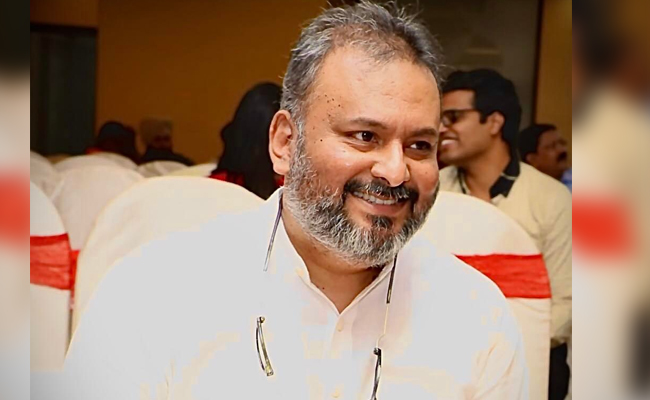
Chennai: Journalist and political commentator Sujit Nair has expressed concern over speculation that the Dravida Munnetra Kazhagam and the All India Anna Dravida Munnetra Kazhagam could explore a post-poll understanding to prevent Vijay-led Tamilaga Vettri Kazhagam from forming the government in Tamil Nadu.
In a social media post, Sujit Nair said the election verdict in Tamil Nadu reflected a clear public demand for political change and argued that the mandate should be respected irrespective of political preferences.
Referring to reports and political discussions surrounding a possible understanding between the DMK and AIADMK, he said he hoped such developments remained only speculative conversations and did not turn into reality.
Nair stated that if such an alliance were to take shape, it would raise serious questions about ideological politics in the country. He said TVK had emerged through a democratic electoral process and that the legitimacy to govern in a parliamentary democracy comes from the people’s verdict.
According to him, attempts to prevent an electoral winner from forming the government through unexpected political arrangements may be constitutionally valid, but many people could view them as politically opportunistic.
He further said that such a move could particularly affect the political image of the DMK, which has historically projected itself around ideology, social justice and opposition politics. Nair said that in ideological terms, the DMK appeared closer to TVK than to the AIADMK, and joining hands with its long-time political rival only to remain in power could weaken its broader political narrative.
He added that the same questions would apply to the AIADMK as well, as the party had spent decades positioning itself against the DMK and such an arrangement could create discomfort among its cadre and supporters.
Drawing a comparison with Maharashtra politics in 2019, Nair said he had expressed similar views when the Shiv Sena formed an alliance with the Indian National Congress and the Nationalist Congress Party after the Assembly elections.
He said post-poll alliances between long-standing political rivals often create a public perception that ideology and electoral mandates become secondary when political power equations come into play.
Nair also said such developments increase public cynicism towards politics and reinforce the belief among voters that ideology is often sidelined after elections.
He maintained that the Tamil Nadu verdict was emphatic and said respecting both the spirit and substance of the mandate was important for the credibility of democratic politics.