National Sports Awards: Manu, Gukesh among four to receive Khel Ratna from President Murmu
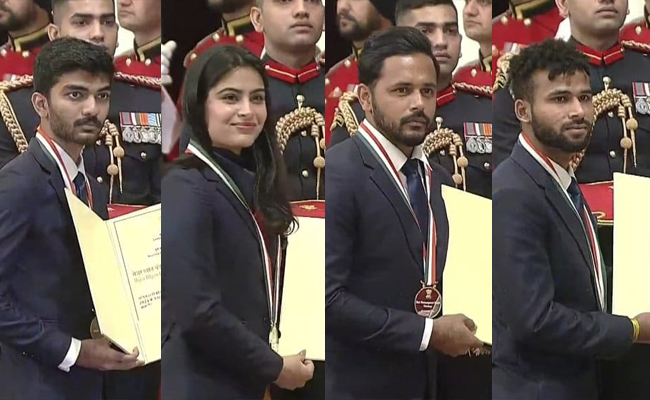
New Delhi (PTI): Double Olympic-medallist shooter Manu Bhaker and teenage chess world champion D Gukesh received a euphoric round of applause as they walked up to receive the prestigious Major Dhyan Chand Khel Ratna from President Droupadi Murmu in a glittering National Sports Awards ceremony here on Friday.
The other two recipients of the country's highest sporting honour were men's hockey captain Harmanpreet Singh and Paralympic gold-winning high jumper Praveen Kumar when the annual honours were bestowed at the Rashtrapati Bhavan here.
Harmanpreet was a part of the national sides that won bronze medals in the Tokyo as well as Paris Olympics. Praveen, on the other hand, upgraded his silver at the Japanese capital to a gold last year in Paris. He was born with a short left leg.
Thirty-two athletes are being honoured with the Arjuna Award out of which an unprecedented 17 are para-athletes.
The athletes selected for the Arjuna award include Paris Olympics bronze medal-winning group of wrestler Aman Sehrawat, shooters Swapnil Kusale and Sarabjot Singh and the men's hockey team players Jarmanpreet Singh, Sukhjeet Singh, Sanjay and Abhishek.
The para-athletes outnumbered the able-bodied ones in the list of Arjuna winners this time due to the magnificent Paris Paralympics performance in which they returned with 29 medals, including seven gold and nine silver.
The 22-year-old Bhaker became independent India's first athlete to win two medals in a single edition of the Olympics with her bronze-winning show in the 10m air pistol individual and 10m air pistol mixed team events in August last.
The 18-year-old Gukesh became the youngest world champion ever by beating China's Ding Liren last month. He is only the second India after the great Viswanathan Anand to achieve this feat.
The annual honours are decided by a points system in which the maximum emphasis is on performances delivered at the Olympics and the World Championships.
Let the Truth be known. If you read VB and like VB, please be a VB Supporter and Help us deliver the Truth to one and all.
Massive turnout in assembly polls across states, women voters outnumber men: EC data
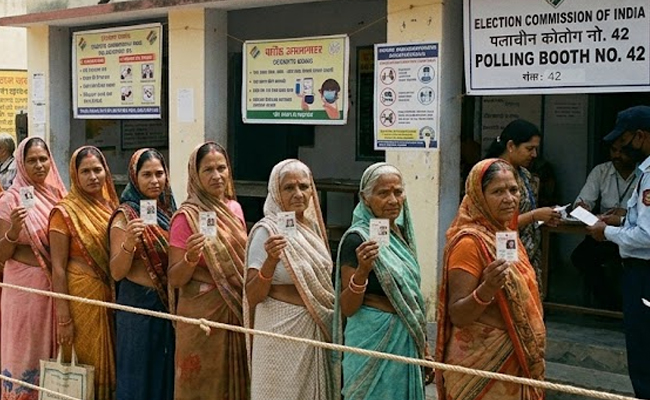
New Delhi (PTI): The recently-concluded assembly elections witnessed exceptionally high voter participation across states, with women voters outnumbering men in turnout percentages, according to Election Commission data.
West Bengal recorded the highest voter turnout among states, with 93.71 per cent polling in 293 constituencies where counting has been completed. The state saw over 6.38 crore votes cast, including postal ballots, against a total of more than 6.81 crore electors.
Women voters recorded a turnout of 93.8 per cent in the West Bengal Assembly polls, slightly higher than the 92.06 per cent participation among men.
The data for West Bengal does not include the figures for the Falta assembly constituency, which is scheduled for repolling.
Tamil Nadu registered an 85.01 per cent turnout, with nearly 4.8 crore votes polled from an electorate of 5.74 crore. Women voters recorded a turnout of 86.2 per cent, higher than the 83.77 per cent among men.
Assam also witnessed robust participation, with the final turnout touching 85.74 per cent. More than 2.15 crore votes were cast in the state, while female turnout at 86.53 per cent marginally exceeded the 84.95 per cent recorded among male voters.
Kerala registered a turnout of 78.11 per cent, with over 2.12 crore votes polled. Female voter participation stood at 81.17 per cent against 74.9 per cent among men.
Puducherry recorded a turnout of 89.82 per cent, with women voters again leading participation at 91.39 per cent. More than 8.5 lakh votes were polled in the Union territory.
Yet, women's representation among elected candidates remained modest.
Tamil Nadu elected 23 women MLAs (9.83 per cent) out of 234 members, West Bengal elected 37 women legislators (12.62 per cent) out of 293, while Kerala returned only 11 women MLAs (7.85 per cent) in the 140-member House.
Only two third-gender candidates contested the elections - one each from Tamil Nadu and Kerala, and both lost, forfeiting their deposits.
The elections also reflected extensive electoral mobilisation infrastructure. West Bengal had the highest number of polling stations at 85,092, followed by Tamil Nadu with 75,064 and Assam with 31,490.
In terms of candidates, Tamil Nadu saw the largest contest with 4,023 candidates in the fray across 234 constituencies, averaging 17 candidates per seat and peaking at 79 contestants in one constituency.
West Bengal pitted 2,920 candidates for 293 constituencies, while Kerala had the fewest contestants among the major states, with 883 candidates for 140 seats.
The data also showed relatively low NOTA votes across states. Tamil Nadu recorded the lowest NOTA share at 0.4 per cent of total votes polled, while Assam recorded the highest at 1.23 per cent. In West Bengal, 0.78 per cent of the total votes polled were NOTA, while it 0.77 per cent and 0.57 per cent of the electorate opted for None of the Above (NOTA) in Puducherry and Kerala, respectively.