Naveen Patnaik inducts three more ministers into Odisha cabinet
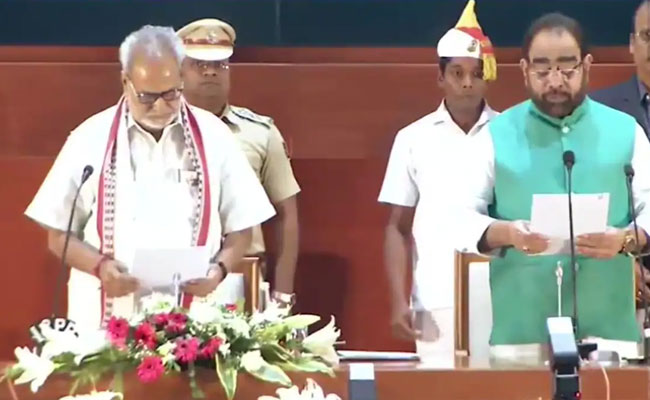
Bhubaneswar (PTI): Senior BJD lawmakers Bikram Keshari Arukha, Sundam Marndi and Sarapda Prasad Nayak on Monday took oath as ministers in the cabinet of Odisha Chief Minister Naveen Patnaik.
Governor Ganeshi Lal administered the oath of office to the three cabinet ministers at a function held at the convention centre on the premises of Lok Seva Bhavan here in the presence of the CM.
The trio had earlier served as ministers and this was their re-induction into the cabinet.
Both Arukha and Marndi were dropped from the council of ministers during the previous reshuffle held in June last year. Nayak had also earlier served as a minister in the Patnaik cabinet.
While Arukha was appointed as the speaker of the assembly, Marndi continued to work as a lawmaker from Bangiriposi assembly seat in Mayurbhanj district.
With the induction of the three new ministers, the strength of the cabinet has mounted to 22, including the CM.
Last week, School and Mass Education Minister Samir Ranjan Dash and Labour Minister Srikant Sahu resigned. No appointment was also made in place of Health Minister Naba Kishore Das, who was assassinated in January.
The additional charge of School and Mass Education, and Labour Departments was given to Revenue Minister Pramila Mallick. Earlier, Finance Minister Niranjan Pujari was given the additional charge of the Health and Family Welfare Department.
Odisha cabinet reshuffle | Bikram Keshari Arukha, Sudam Marndi and Sarada Prashad Nayak take oath as ministers in the state cabinet. pic.twitter.com/V8G0tatOfB
— ANI (@ANI) May 22, 2023
Let the Truth be known. If you read VB and like VB, please be a VB Supporter and Help us deliver the Truth to one and all.
India, New Zealand ink free trade agreement
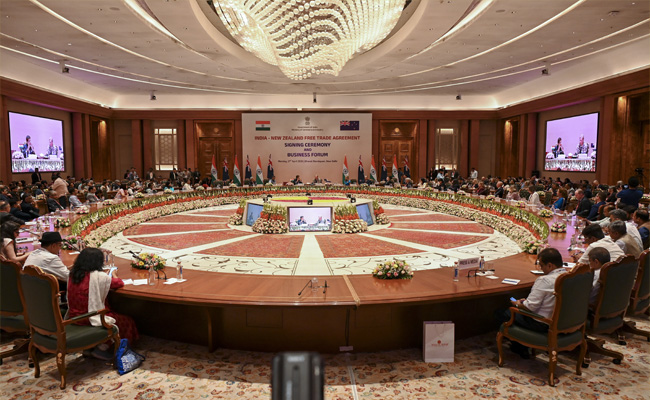
New Delhi (PTI): India and New Zealand on Monday inked a free trade agreement, aimed at boosting two-way commerce and investments.
The pact was signed by Commerce and Industry Minister Piyush Goyal and visiting New Zealand's Trade and Investment Minister Todd McClay.
The FTA provides duty-free access for 100 per cent of India's exports to New Zealand, covering all tariff lines or produce categories, and is expected to significantly boost MSMEs and employment by enhancing competitiveness in labour-intensive sectors such as textiles, apparel, leather, footwear, gems and jewellery, engineering goods, and processed foods.
Earlier, New Zealand maintained peak tariffs of up to 10 per cent on key Indian exports, including ceramics, carpets, automobiles, and auto components.
With zero-duty market access from entry into force as New Zealand's other trade partners, Indian products will be fully competitive in that country, enjoying a level playing field.
ALSO READ: Cal HC urges EC to dispose of TMC complaint over police observer's meeting with BJP nominee
Significantly, India also secured duty-free inputs for its manufacturing sector, including wooden logs, coking coal, and waste and scraps of metals, lowering production costs and enhancing the global competitiveness of the Indian industry.
On the other hand, India has offered tariff liberalisation on 70.03 per cent of tariff lines covering 95 per cent of bilateral trade value, while keeping 29.97 per cent of tariff lines excluded to protect India's sensitive sectors.
The products that are kept in exclusion are mainly -- dairy (milk, cream, whey, yoghurt, cheese etc.), animal products (other than sheep meat), agricultural products (onions, chana, peas, corn, almonds), sugar, artificial honey, animal, vegetable or microbial fats and oils, arms and ammunition, gems and jewellery, copper and articles thereof (cathodes, cartridges, rods, bars, coils), aluminium and articles thereof (ingots, billets, wire bars) among others.
On 30 per cent of tariff lines of New Zealand, India will provide duty elimination on goods such as wood, wool, sheep meat, and leather-raw hides.
Similarly, 35.60 per cent of tariff lines are subject to phased elimination over 3, 5, 7, and 10 years, including petroleum oil, malt extract, vegetable oils, selected electrical and mechanical machinery, and peptones.
New Zealand products which enjoy tariff reductions include wine, pharmaceutical drugs, polymers, aluminum, iron and steel articles, and goods that only 0.06 per cent fall under tariff rate quotas, including Manuka honey, apples, kiwi fruit, and albumins, including milk albumin.
The FTA also includes a commitment to facilitate USD 20 billion in investment into India.
A rebalancing clause is incorporated into the Agreement to provide a framework for addressing any shortfall in investment delivery, thereby ensuring robust and tangible economic outcomes.
Total bilateral trade in goods and services reached USD 2.4 billion in 2024.