NCERT removes cartoon on coalition govts from Class 12 textbook
says it casts India in ‘negative light’
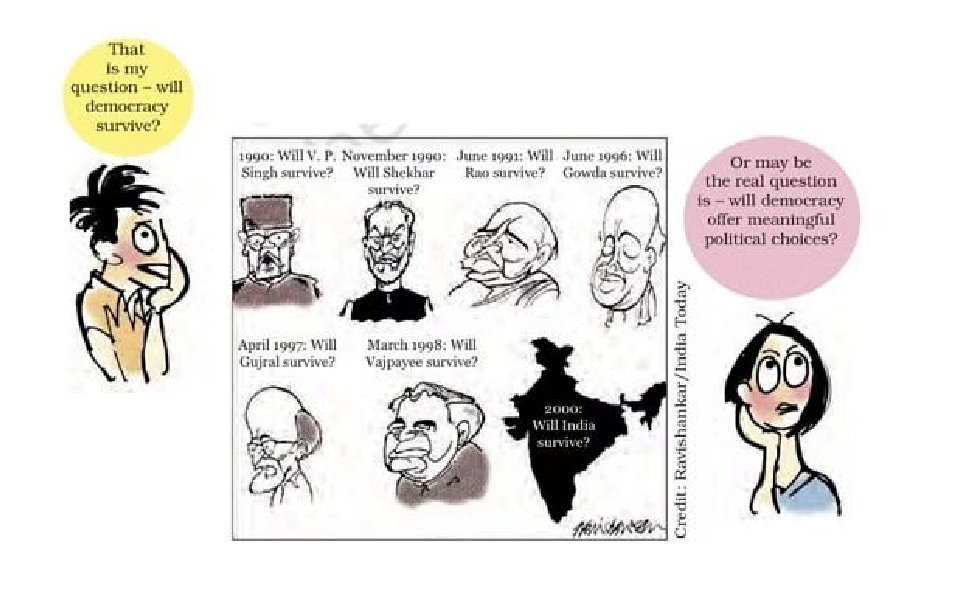
New Delhi: The National Council of Educational Research and Training (NCERT) has made a change to its Class 12 political science textbook by removing a political cartoon that illustrated the challenges and uncertainties faced by coalition governments in India. The decision to remove the cartoon was made as it portrayed the country in a “negative light.”
The cartoon, created by Ravishankar and originally published in India Today magazine, featured images of several Prime Ministers, including V.P. Singh (1990), Chandra Shekhar (1990), P.V. Narasimha Rao (1991), H.D. Deve Gowda (1996), I.K. Gujral (1997), and A.B. Vajpayee (1998). It included a series of questions about the stability of their coalition governments and the state of democracy in India.
According to a report in The Hindu, the illustration has been replaced with two students conversing with each other in speech bubbles. In the new illustration, one student questions, “Does that mean that we will always have coalitions? Or can the national parties consolidate their positions again?” The other student responds, “I am not worried about whether it is a single party or a coalition government. I am more worried about what they do. Does a coalition government involve more compromises? Can we not have bold and imaginative policies in a coalition?”
The document published by the NCERT outlining these changes dates back to April 2024, before the general election and the formation of the National Democratic Alliance (NDA) coalition government led by Prime Minister Narendra Modi, in which the Bharatiya Janata Party (BJP) does not hold a majority on its own.
Let the Truth be known. If you read VB and like VB, please be a VB Supporter and Help us deliver the Truth to one and all.
Rahul Gandhi to go on two-day Raebareli visit from May 19
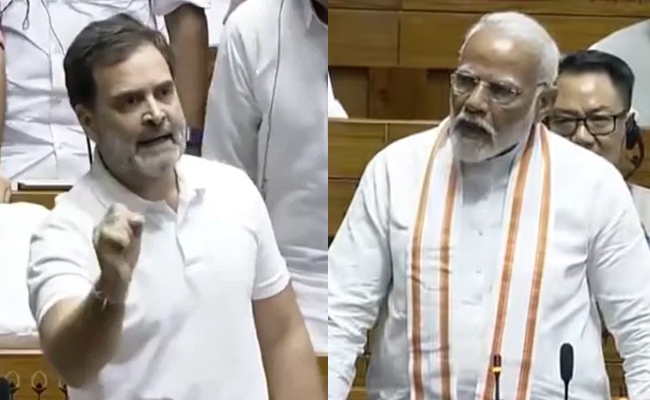
Raebareli (UP) (PTI): Leader of the Opposition in the Lok Sabha and Congress MP from Raebareli Rahul Gandhi will arrive here on May 19 on a two-day visit, a Congress office-bearer said on Monday.
Congress district president of Raebareli Pankaj Tiwari said that on the first day, Gandhi will inaugurate a marriage hall at Thakurain Kheda in Bachhrawan. Subsequently, he will address a public meeting in Khiron. In Lalganj, he will participate in a 'mahila samvaad' programme.
He further said that on May 20, he will meet the public during a 'Janata Darshan' programme at the Bhuyemau Guest House. Following this, he will participate in the unveiling of a statue of Veera Pasi and attend a public meeting in Lodhwari.
He will then depart for Amethi.
In Amethi, Gandhi will hold meetings with party functionaries, workers and senior leaders at the party's district headquarters, Congress district unit chief Pradeep Singhal said on Sunday.
According to political observers, this meeting would form a part of the strategic preparations for the 2027 Uttar Pradesh Assembly elections, alongside an organisational review.
Discussions during the meeting are likely to focus on strengthening the party organisation down to the booth level, increasing participation of youth and women workers, and accelerating public outreach campaigns across villages.
According to sources, a large number of party workers -- from Gram Sabha to the district level -- have been invited to attend the meeting.
Gandhi is expected to interact directly with workers.
During the one-day visit, the Congress leader will also travel to Poore Ramdeen Pandit -- the native village of late Congress district president Yogendra Mishra -- to meet his family members.
Mishra, considered a close associate of the Gandhi family, passed away on March 1 following a prolonged illness.
Political activities in the district have intensified ahead of Gandhi's visit, and party workers have already started making arrangements for his reception.
Kishori Lal Sharma, the Congress MP from Amethi, is also holding regular meetings with local leaders and functionaries to review the preparations.