NCRB reports says Kolkata safest city in India; experts allege suppression of facts
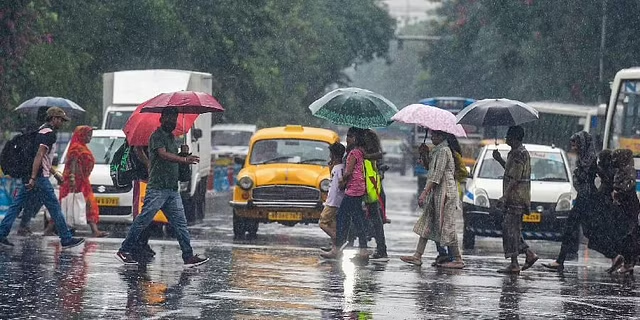
Kolkata, Aug 31: Kolkata has topped the list of cities with the least number of cognisable offences per lakh of its population, making the metropolis the safest city of India in 2021, according to the latest National Crime Records Bureau (NCRB) report.
The city scored 103.4 per 1-lakh people in terms of the number of cognisable offences, marching ahead of Pune, which stood second (256.8) and Hyderabad (259.9), the data showed.
Kanpur (336.5), Bengaluru (427.2) and Mumbai (428.4) were among the other cities in the list.
Kolkata had scored 129.5 in the 2020 report of NCRB. Its IPC crime rate declined to 92.6 in 2021 compared with 109.9 the previous year, as per the report.
Experts, however, expressed apprehension over Kolkata's dwindling crime numbers in the report.
"This data seems to be quite absurd. There is clearly suppression of facts on the part of the state government," claimed Ruby Sain, former head of the department of sociology and coordinator of the Centre for the Study of Religion and Society at Jadavpur University.
"Most criminal activities in Kolkata are going unreported, and I am quite confident the data provided by the authorities is not the actual picture," she told PTI.
Emeritus Professor of Sociology, Presidency College, Prasanta Ray, also echoed Sain's views, and said there has been suppression of facts by the state government, leading to a glorified picture for West Bengal .
"Criminal activities in the city go unreported for several reasons and that is a fact. If you ask me to believe in this data, I would say the migration of youths in search of work to other far-off states could be one reason. But I still have my doubts," Ray said.
According to former Kolkata Police Joint CP (Crime) Pallab Kanti Ghosh, the "hard work" of the dedicated police personnel was instrumental in this achievement.
"The city's crime rate has been sliding for the past seven years We must thank our dedicated policemen for making this possible," Ghosh said.
He also said that despite the jurisdiction of Kolkata Police being expanded following the addition of areas like Behala, Thakurpukur, Kasba and Survey Park, the infrastructure remained "unchanged".
"Most of the crimes these days are happening in the areas that were added, but our police officers are dealing with those quite intelligently. However, we must not forget that conventional crimes have come down as criminals are going high-tech now, Ghosh added.
Let the Truth be known. If you read VB and like VB, please be a VB Supporter and Help us deliver the Truth to one and all.
Trump says EU has until July 4 to approve last year's trade deal or it will face higher tariffs
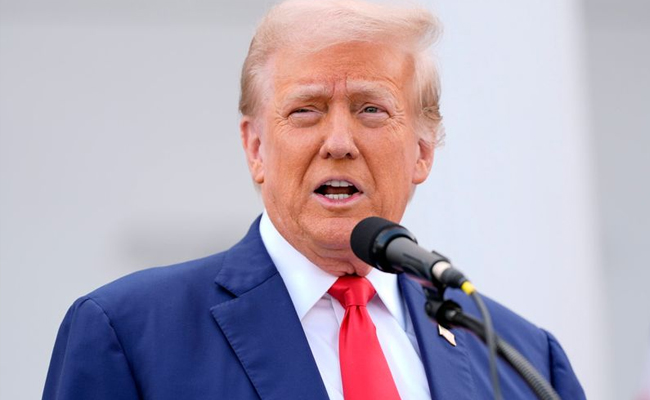
Washington (AP): President Donald Trump has said in a social media post that goods from the European Union would face higher tariff rates if the 27-member bloc fails to approve last year's trade framework by July 4.
The announcement on Thursday appeared to be a deadline extension after the president said last Friday that EU autos would face a higher 25 per cent tariff starting this week. Trump made the updated announcement after what he described as a "great call" with European Commission President Ursula von der Leyen.
Still, the US president was displeased that the European Parliament had yet to finalize the trade arrangement reached last year, which was further complicated in February by the US Supreme Court ruling that Trump lacked the legal authority to declare an economic emergency to impose the initial tariffs used to pressure the EU into talks.
"A promise was made that the EU would deliver their side of the Deal and, as per Agreement, cut their Tariffs to ZERO!" Trump posted. "I agreed to give her until our Country's 250th Birthday or, unfortunately, their Tariffs would immediately jump to much higher levels."
It was unclear from the post whether Trump was implying that the tariff rates would jump on all EU goods or the increase would only apply to autos.
His latest statement indicates he might be backing away from his earlier threat on EU autos by giving the European Parliament several more weeks to approve the agreement.
Under the original terms of the framework, the US would charge a 15 per cent tax on most goods imported from the EU.
But since the Supreme Court ruling, the administration has levied a 10 per cent tariff while investigating trade imbalances and national security issues, aiming to put in new tariffs to make up for lost revenues.