NDA will get more seats in 2019: Modi
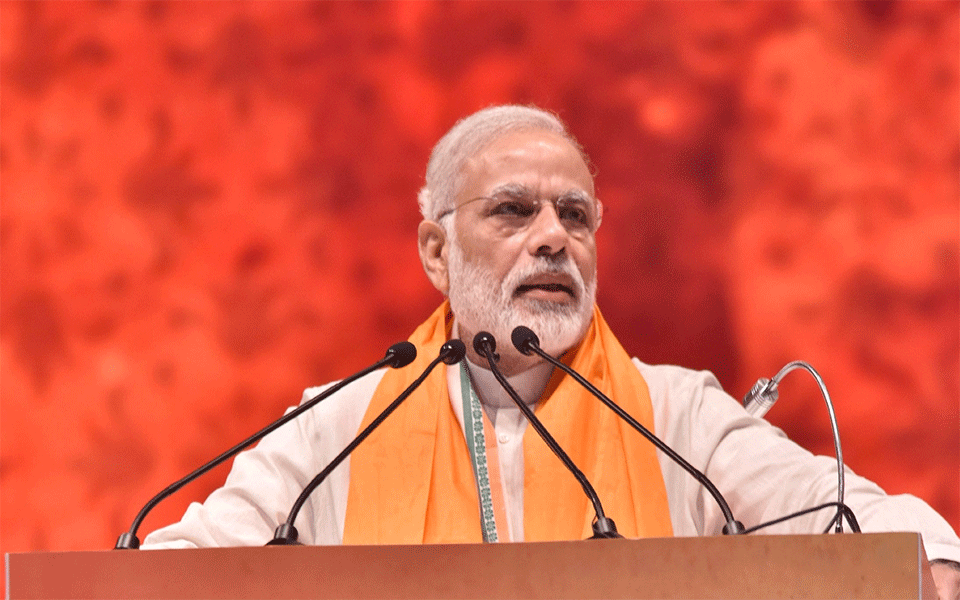
New Delhi, Aug 12 : Terming the opposition grand alliance as a "failed idea", Prime Minister Narendra Modi said the the BJP-led NDA will definitely get more seats in the next Lok Sabha polls than it got in 2014 and break all records.
In an interview with the Times of India published on Sunday, Modi said people wanted a strong and decisive government and his campaign will focus on "development, fast development and development for all".
"We will definitely get more seats than we got the last time and I am confident we will break all records of the seats won by NDA in the past and achieve greater glory," he said. "The people are with us and we have nothing to fear."
On the opposition's planned "mahagathbandhan" (grand alliance), Modi said India's status has improved globally since he took power.
"After 30 years, a performing, strong and stable government is in power at the Centre. People have bitter experience of coalition governments burdened by politics of compulsions.
"I have faith (electorate) will not compromise its vote for a disparate group that has nothing more to offer than a single ideology (if we may even call it so) - to remove Modi," he said.
The Prime Minister said "a non-ideological alliance of desperate and disparate groups is not mahagathbandhan but political adventurism.
"It is a failed idea that has never succeeded. History tells us such adventurism failed in 1979, 1990 and in 1996. People want a strong and decisive government."
Asked about some unease in the ruling BJP-led alliance, Modi said the recent election of the Rajya Sabha Deputy Chairman - by an NDA candidate despite not having a majority - will put the apprehensions of sceptics to rest.
Modi took dig at Congress President Rahul Gandhi for hugging him during the Parliament no-confidence motion and called him a 'naamdar' (one with famous family name).
"‘Naamdars' have their own rules. They decide when to hate, where to hate and how to hate. They also decide when to show affection, where to show affection and how to show affection. We are ‘kaamdars'; we have no such privilege," Modi said.
Modi said the government's way of working was not to make policy keeping elections in view.
"I have a vision for the country till 2022 that's in public domain. All policies and actions are aimed at achieving that vision."
Let the Truth be known. If you read VB and like VB, please be a VB Supporter and Help us deliver the Truth to one and all.
'Red' alert for severe thunderstorms, hailstorms issued in Delhi
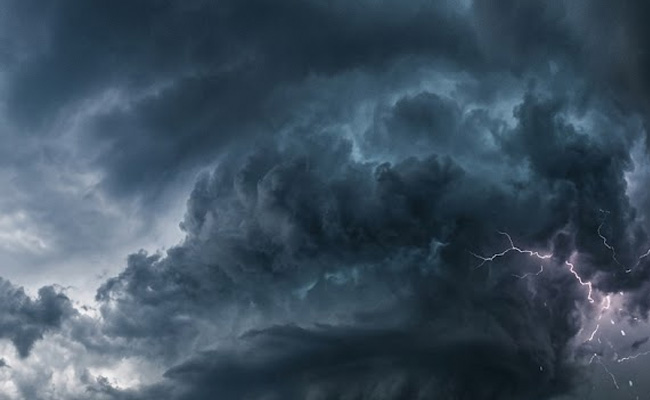
New Delhi (PTI): A "red" alert for severe thunderstorms and hailstorms was issued for Delhi late on Sunday evening, with some parts of the national capital placed under an "orange" alert, as residents were advised to be prepared for potentially-disruptive weather conditions.
A "red" alert stands for "take action", indicating severe weather conditions.
According to the India Meteorological Department (IMD), severe thunderstorms accompanied by lightning, hailstorms, dust storms and moderate rainfall, along with gusty winds reaching speeds of up to 80 kmph, are very likely over the city, with some areas expected to witness moderate thunderstorm activity.
The IMD said a "red" alert has been issued for Outer North Delhi, Northwest Delhi, West Delhi, Southwest Delhi, parts of North Delhi, Central Delhi, Northeast Delhi and Shahdara, while South Delhi, Southeast Delhi and parts of North Delhi remain under an "orange" alert. Similar thunderstorm conditions are also likely at isolated places across various locations in Delhi-NCR.
The weather office warned of likely impacts, including the breaking of large tree branches, uprooting of weak or old trees, lightning strikes at vulnerable locations, such as tall trees and electric poles, and disruption of municipal services.
"Damage to kutcha houses, huts and weak structures, partial collapse of boundary walls, difficult driving conditions and possible road accidents are also likely. Vehicles may also be damaged due to falling branches or debris," it said.
Residents have been advised to move to safe buildings, avoid weak structures and stay away from windows during the storm.
Authorities have cautioned against taking shelter under trees or going near water bodies and advised people to unplug electrical equipment and avoid contact with metallic objects, water taps and pipes. People have also been asked to park vehicles in safe locations and, if caught during the storm while driving, to pull over safely and remain inside the vehicle.
They have further been advised to stay away from electric poles and power lines and remain alert to flying debris, officials said.