Nearly 4,000 pilgrims set sail for Katchatheevu islet to participate in annual two-day festival
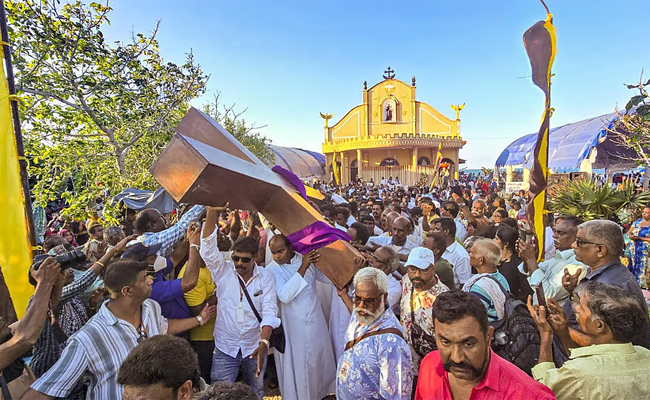
Rameswaram (Tamil Nadu) (PTI): Nearly 4,000 Indian pilgrims on Friday set sail for the uninhabited Katchatheevu islet to participate in the annual two-day festival, which will officially commence at 4 pm at the St Antony’s Church, officials said.
The festival marks a significant moment of shared cultural and religious heritage between India and Sri Lanka.
The first batch of devotees was flagged off from the Rameswaram fishing harbour at approximately 6 am by Ramanathapuram District Collector Simranjeet Singh Kahlon.
ALSO READ: Explosions and aircraft sounds heard in Kabul, hours after Afghanistan attacks Pakistan
According to official records, a total of 3,996 registered pilgrims -- comprising 3,033 men, 726 women, and 150 children -- are crossing the Palk Strait in a fleet of 118 boats, which includes 92 mechanised trawlers and 26 country boats.
The festival will officially commence with a traditional flag-hoisting ceremony. This will be followed by the 'Way of the Cross' procession and a late-night chariot festival, where the statue of the patron saint will be carried around the shrine by Sri Lankan Navy personnel, sources said.
Strict security measures are in place, with the Indian Coast Guard and Customs department conducting a three-tier verification process at the Rameswaram jetty. All pilgrims were required to produce their Aadhaar cards and a mandatory Police No Objection Certificate (NOC).
Authorities have strictly prohibited the carriage of plastic items, alcohol, and excessive jewellery.
According to official sources, all vessels are equipped with adequate life jackets and are being escorted by Coast Guard hovercrafts up to the International Maritime Boundary Line (IMBL).
The festivities will reach their peak on Saturday morning with a Special High Mass conducted by the Bishops of Jaffna and Colombo in both Tamil and Sinhala. The event will conclude with the lowering of the flag, after which the Indian pilgrims will begin their return journey.
To facilitate the event, the Tamil Nadu Fisheries Department has enforced a total fishing ban in the region until March 1, leaving over 1,000 local boats moored at the docks to ensure clear passage for the pilgrim fleet.
The islet was ceded to Sri Lanka by India by ways of two agreements in 1970s.
Let the Truth be known. If you read VB and like VB, please be a VB Supporter and Help us deliver the Truth to one and all.
Six foreign nationals held for alleged prostitution in Bengaluru

Bengaluru (PTI): Six foreign women were arrested after they were found to be allegedly engaged in illegal activities by soliciting men in a public place for prostitution, police said on Tuesday.
The arrests were made by the Women Protection Wing of the Central Crime Branch (CCB) on April 24, they said.
Police, however, have not disclosed the nationalities of the women in the statement.
According to police, the operation was carried out following a tip off that some foreign women were standing near the footpath of the bus stop close to Madiwala Check Post, within the jurisdiction of Koramangala Police Station here and were soliciting men passing by on the road for prostitution.
Based on this information, the officers and staff of the CCB Women Protection Wing immediately visited the spot and conducted a verification, they said.
During the operation, it was found that six foreign women were engaging in illegal activities by soliciting men in a public place for prostitution, a statement issued by the office of the police commissioner stated.
Acting swiftly, the officers and staff conducted a raid and secured all six foreign women. Upon inquiry regarding their passports and visas, they failed to provide valid and satisfactory information, it said.
"Subsequently, all six foreign women were produced before the Koramangala Police Station along with a report for further legal action. In this regard, a case has been registered at Koramangala Police Station, and further investigation is in progress," the police statement added.