Need to ensure arbitration institutions are not controlled by "self-perpetrating clique": CJI
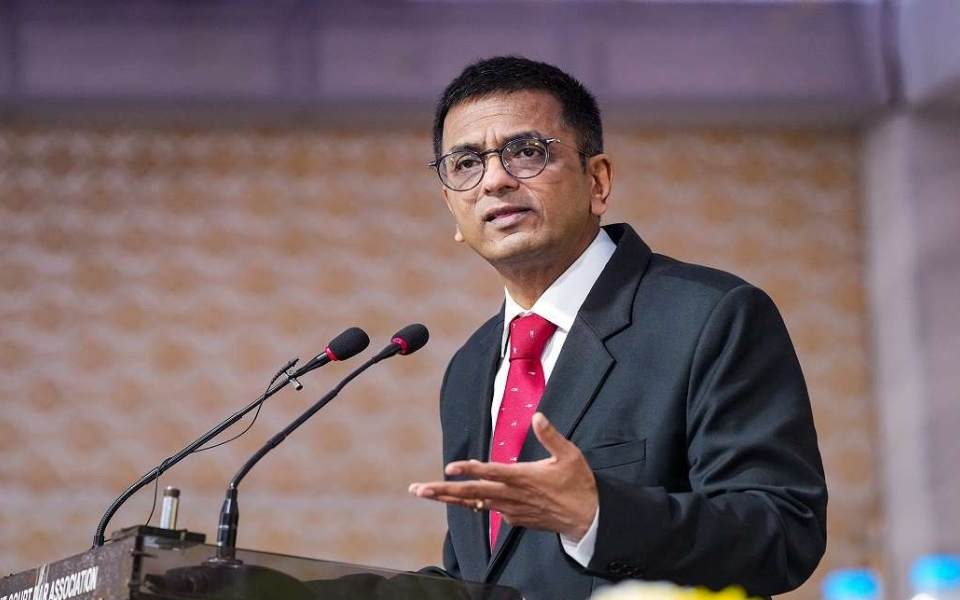
New Delhi (PTI): Speaking at the Supreme Court of the United Kingdom, Chandrachud said now is the time for countries such as India to step up to the occasion to create and promote a culture of commercial arbitration and the robust institutionalization of arbitration will further the culture of arbitration in the Global South.
He said arbitration is an alternative method of dispute resolution and it no longer an “alternative” but the preferred method of seeking commercial justice.
"In recent years, institutions such as India International Arbitration Centre and Mumbai and Delhi International Arbitration Centers have been set up and are seeing a steady flow of arbitration matters," the CJI said.
"But the mere creation of institutions is not sufficient. We have to ensure that these new institutions are not controlled by a self-perpetrating clique. These institutions must be based on the foundation of robust professionalism and the ability to generate consistent arbitral processes," he added.
The CJI said transparency and accountability, values by which the work of conventional courts is assessed and critiqued, cannot be alien to the world of arbitration.
"Arbitral institutions are uniquely placed to cooperate with other arbitral institutions around the world to adopt best international practices and procedures. This will create a global convergence of arbitral procedures, creating more uniform institutional rules and structures. I hope the Indian arbitral institutions emulate the success of their global counterparts in the years to come," he added.
Reiterating that substitution of courts should not result in the creation of opaque structures, Chandrachud said the plea for bringing greater diversity in the world of arbitration is based on the firm belief that bringing a diversity of viewpoints to the world of arbitration whether in terms of gender or from the Global South will make for a broad-based process.
Stressing on the role of technology in arbitration process, the CJI said technology plays a major role in how the arbitration proceedings are being carried out and offers cost-effective and time-effective solutions.
"You have instances where one party is based in Delhi, another in Bengaluru, while the arbitrators are in London, Mumbai and Singapore. Technology provides the digital environment allowing them to participate in arbitral proceedings virtually," the CJI said.
"As in law courts, Covid-19 provided an impetus to modernizing the arbitral process. Likewise, the world of arbitration impacted on the processes adopted by courts as well," he added.
Chandrachud said adoption of technology at all levels of arbitration proceedings will make the arbitration proceedings more efficient and, importantly, more accessible.
"Technology and artificial intelligence add value to the services provided by arbitral institutions in matters such as reviewing documents or transcribing the proceedings," he said.
The CJI said the courts in India are overburdened despite the High Courts disposing of 2.15 million cases and the District Courts disposing of 44.70 million cases in 2023.
"These figures show the trust that the people of India have in their judiciary. Our judiciary functions on the mantra that no case is small or big. Every aggrieved person who approaches the doors of the judiciary has the right to a just remedy," Chandrachud said.
"In attending to these grievances, the courts in India perform their plain constitutional duty. The width of our jurisdiction was designed to ensure the widest access to justice. But surely every case need not find a remedy before a court, with emerging forms of dispute resolution such as arbitration and mediation gaining acceptance," he added.
Let the Truth be known. If you read VB and like VB, please be a VB Supporter and Help us deliver the Truth to one and all.
AIITA welcomes Karnataka’s ban on obscene songs in school events

Bhatkal: The Karnataka unit of the All India Ideal Teachers Association (AIITA) has welcomed the Karnataka government’s decision to strictly ban school children from dancing to obscene songs during educational and cultural programmes in government, aided, and private schools across the state.
AIITA Karnataka State President M. R. Manvi congratulated the government for taking what he termed an important step to preserve the sanctity of education.
“Such decisions to safeguard the dignity of school children and uphold the values of education are the need of the hour. This rule should not be limited to government schools alone but must be strictly implemented in all private educational institutions as well,” he said.
He further urged the government to address other concerns within school programmes.
“The government should not only prohibit obscene dances in the name of school anniversaries, but also ensure that plays and dialogues that incite religious hatred are avoided. Schools should be centres of harmony, not platforms for spreading hatred,” he added.
According to a recent circular issued by the Department of School Education and Literacy, obscene dances are adversely affecting the mental health and moral values of students.
In this regard, schools have been advised to use songs that promote nationalism, positive thinking, the greatness of Kannada culture, and value-based traditions instead of inappropriate content during programmes.
The circular also emphasises that students should be dressed in decent attire.
AIITA also backed the department’s warning that disciplinary action would be taken against head teachers if such guidelines are violated. The association has further demanded that district Deputy Directors of Public Instruction strictly monitor the implementation of these rules.