Nehru sat through debate, requested more time for oppn: Cong slams Rijiju for 1954 comparison
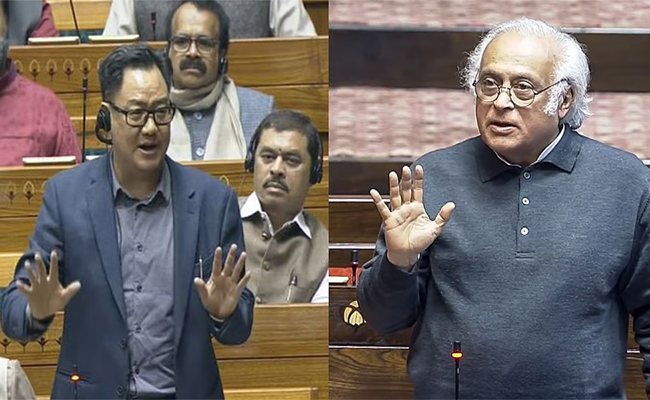
New Delhi (PTI): The Congress slammed Union Minister Kiren Rijiju on Wednesday for contrasting the 10 hours allocated for a debate on the resolution for the Lok Sabha speaker's removal with the two-and-a-half-hour debate on a similar resolution in 1954, saying Jawaharlal Nehru had then requested the bulk of the time be allotted to the opposition.
The debate is likely to conclude on Wednesday with Union Home Minister Amit Shah's response to the resolution.
Congress general secretary in charge of communications, Jairam Ramesh, said that in Tuesday's debate in the Lok Sabha on the motion for the removal of the Speaker, Minister of Parliamentary Affairs Rijiju proudly claimed that 10 hours had been allotted for the debate, whereas in December 1954, only 2.5 hours had been set aside for a similar motion.
"What he forgot to mention was that on December 18, 1954, the prime minister himself sat through and took part in the debate. While speaking, Jawaharlal Nehru requested the deputy speaker, who was presiding in the House, that the bulk of the time should be allotted to the opposition," Ramesh said on X.
When the motion was moved in the Lok Sabha on December 1, 1954, the Congress had 364 MPs in a House of 489 members, he pointed out.
"On December 18, 1954 (as on later occasions in 1966 and 1987), there was a deputy speaker in the Chair in the Lok Sabha while the motion against the Speaker was being debated. Since mid-2019, there has been no deputy speaker in the Lok Sabha, which is a clear violation of the Constitution," Ramesh said.
Intervening in the debate on the resolution for the removal of Om Birla from the Speaker's post, Rijiju on Wednesday slammed TMC's Saugata Roy for questioning the decision on who will preside over the proceedings during the discussion on the opposition's resolution.
"Such senior MPs should know that in 1954, when the opposition party brought a resolution against G V Mavalankar, a full day's time was demanded for discussion. Jawaharlal Nehru had allocated an hour and a half.
"There was a lot of debate over it, and finally, a consensus was reached on a two-hour discussion. Within that two-hour time, the minister had 15 minutes. Today, we are having a discussion for two days. This government is not going to run away. You are comparing a two-and-a-half-hour discussion with a two-day debate," Rijiju said.
Hitting back at the BJP leader, Ramesh shared on X a screenshot of the 1954 debate's transcript.
It quoted the prime minister Nehru as saying, "Normally you do adopt some kind of proportion, but I would like to submit that in this particular case, more time should be allowed to the opposition than to the government benches.
"We do not wish to take too much time, and I hope the hon. members on this side will not take up too much time of the House in their speeches. Naturally, we will have to say something, which we will do. But. I would submit for your consideration that the Opposition should have more time," Nehru had said.
The ruling NDA on Tuesday strongly defended Speaker Om Birla in the Lok Sabha, asserting that the resolution for his removal was brought only "to create spectacular headlines", while the opposition accused him of partisanship, claiming he made "baseless" allegations about certain women MPs and did not permit Leader of Opposition Rahul Gandhi to express his views on "critical issues".
Participating in the debate on the resolution, several opposition MPs said Birla has good relations with members but stressed that they want him to conduct the House proceedings "fairly" without succumbing to "pressure" from the government, as they questioned his decisions on the suspension of their colleagues.
Treasury bench members, however, insisted that Birla was impartial and that the opposition MPs faced action due to their improper conduct.
Though the Constitution allows the Speaker to be present in the House to defend himself or herself and to vote, Birla preferred to stay away from Tuesday's proceedings.
In yesterday's debate in the Lok Sabha on the motion for the removal of the Speaker, the Minister of Parliamentary Affairs proudly claimed that 10 hours has been allotted for the debate whereas in Dec 1954, only 2.5 hours had been set aside for a similar motion. What he forgot to… https://t.co/ZyLjtK4an7
— Jairam Ramesh (@Jairam_Ramesh) March 11, 2026
Let the Truth be known. If you read VB and like VB, please be a VB Supporter and Help us deliver the Truth to one and all.
Karnataka Speaker Khader finishes fourth in Dirt Prix event
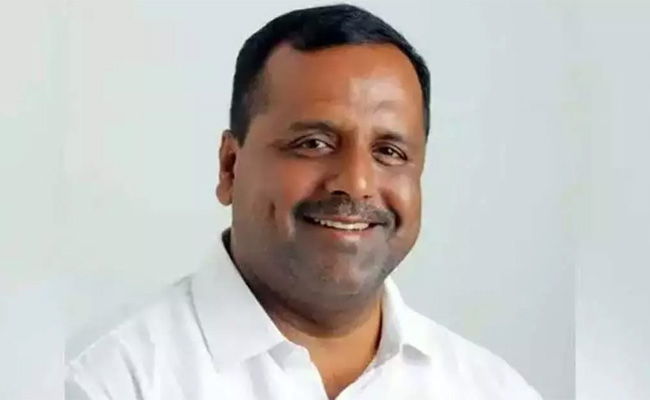
Mangaluru (PTI): Karnataka Legislative Assembly Speaker U T Khader on Sunday finished fourth in a dirt track racing event organised by the Indian Motor Sports Club here.
Driving a Volkswagen Polo GT, Khader narrowly missed a podium finish, ending just seconds behind the third-place finisher.
An avid motorsport enthusiast since his college days, Khader has participated in several racing events involving both motorcycles and cars.
Organisers said his performance on the dirt track was consistent with his previous racing record.
Speaking informally after the event, Khader said he continues to follow motorsport and enjoys driving, describing the experience as a "refreshing change" from his official responsibilities.
The Dirt Prix event saw participation from multiple racers and was aimed at promoting grassroots motorsport.