NEP, CUET: Universities, colleges see major changes in admission, teaching processes
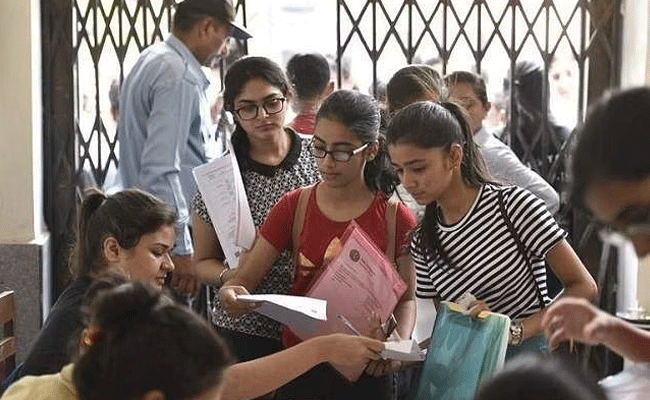
New Delhi (PTI): The admission process and teaching at universities and colleges in the national capital underwent a radical overhaul this year with the introduction of a common entrance test and adoption of the new national education policy.
Relinquishing the old practices of admitting students, universities either partially or wholly adopted the Common University Entrance Test from the 2022-23 academic session.
While the Delhi University (DU) used to admit students based on their Class 12 marks, the Jamia Millia Islamia (JMI) and the Jawaharlal Nehru University (JNU) used to have separate entrance tests for admissions to undergraduate courses.
The CUET has become the second-largest entrance test in the country, after the Joint Entrance Examination-Mains (JEE) for engineering colleges, with over 14.9 lakh aspirants taking it.
Conducted for the first time this year by the National Testing Agency, the CUET had its share of criticism with last-minute changes in exam centres, mass cancellation and postponement of exams, and delayed schedules putting candidates in a tight spot.
The Delhi University through the new admission process admitted students in 79 undergraduate programmes across 67 of its colleges, departments and centres. In September, it had also launched an online platform for those seeking admission through the common seat allocation system.
Through the CUET, JNU conducted admissions to 10 undergraduate courses, a majority being in its bachelor of arts (honours) courses in foreign languages.
However, some varsities, including JMI, partially adopted the CUET process. JMI through the common test admitted students in 10 courses while admission to other programmes was done through an exam conducted by the varsity.
These 10 courses included: bachelor of arts with honours in Turkish Language and Literature, Sanskrit, French and Francophone Studies, Spanish and Latin American Studies, History, Hindi and Economics, bachelor of science in biotechnology and physics, and bachelor of vocation in solar energy.
From this academic session, universities implemented the National Education Policy-2020 (NEP) that proposes reforms in school as well as higher education, including technical education, with stress on promoting multilingualism and Indian languages, holistic and multidisciplinary education with multiple entry and exit options.
The new policy replaces the 1986 National Policy on Education (NPE) and aims at universalisation of education from the pre-school to the secondary level with a 100 per cent gross enrolment ratio by 2030. It also targets to raise the ratio in higher education to 50 per cent by 2025.
The Delhi University became the first central university to adopt the four-year undergraduate curriculum prescribed by the NEP-2020. JMI and JNU are also implementing the policy.
During the beginning of the year, as the Covid situation improved across the country, calls for reopening universities grew louder.
Students' bodies held protests in Delhi demanding that major universities move from online mode to offline teaching.
They had claimed as campuses had been closed for almost two years and teaching was online, the "standard of education had gone down", and that students from lower-income groups and rural areas did not have access to devices for virtual learning.
In February, DU, JNU and JMI were among the varsities in the national capital that started classes in the physical mode for undergraduate and postgraduate courses.
The CUET coupled with the pandemic also delayed the academic calendar in varsities, including that of the Delhi University, drawing criticism.
In this year, JNU got its first women vice chancellor with Santishree Dhulipudi Pandit, a political science professor and an alumna of the university, appointed to the post. The 59-year-old had completed her M.Phil as well as Ph.D in international relations from JNU.
Pandit began her teaching career at the Goa University in 1988 and moved to the Pune University in 1993. She has held administrative position in various academic bodies and also been a member of the University Grants Commission, the Indian Council of Social Science Research and visitor's nominee to central universities.
The premier institute was under the spotlight for a clash between students in April and later in December, after walls of one of its buildings were defaced with "anti-Brahmin" slogans.
In April, clashes broke out at one of its hostels after the JNU Students' Union -- led by Left-backed All India Students' Association -- alleged that members of the Akhil Bharatiya Vidyarthi Parishad (ABVP) had stopped residents from eating non-vegetarian food. The ABVP was also accused of assaulting the mess secretary of the Kaveri Hostel.
The ABVP had denied the charges and claimed that "Leftists" obstructed a puja programme organised at the hostel on Ram Navami. Both sides accused each other of pelting stones and injuring their members.
In December, several walls of a JNU building had "anti-Brahmin" slogans written on them, the photos of which were widely shared on social media.
The year also witnessed a tussle between the Delhi University and its constituent college St Stephen's over its interview process for admissions.
While the college refused to do away with the interview, DU had said it is "firm" on its decision to declare "null and void" all admissions made by the college in violation of CUET guidelines.
In letters exchanged between the college and the varsity, St Stephen's said it will accord 85 per cent weightage to the CUET score and 15 per cent to physical interviews for "all categories of candidates".
The matter went to the Delhi High Court which in September ordered St Stephen's to follow the admission policy of the university. The college knocked on the doors of the Supreme Court then which refused to stay on the high court's order, bringing the tussle to an end.
This year, ad-hoc teachers also demanded that they be absorbed through one-time regulation.
Let the Truth be known. If you read VB and like VB, please be a VB Supporter and Help us deliver the Truth to one and all.
Bank account in Ramgarh tracked for fraudulent fund transactions across 24 states, 4 arrested

Ramgarh (Jharkhand) (PTI): Jharkhand police on Thursday said it has unearthed a network of interstate cyber frauds and arrested four miscreants for fraudulent transactions through a bank account in Ramgarh district after complaints of 274 suspected transactions in 24 states.
The states where complaints for fraudulent transactions were registered included Maharashtra, Karnataka, West Bengal, Uttar Pradesh, Telangana, Tamil Nadu, Kerala and Andhra Pradesh.
The action followed inputs received through 'Samanvaya portal', a centralised, web-based platform launched by the Union Home Ministry to curb cybercrime.
"We arrested four cyber miscreants after a current account with Kuju (Ramgarh) branch of the State Bank of India was found to have registered suspected financial transactions in 24 states with the help of the Pratibimba portal of the Home Ministry through the Samanvaya portal," Ramgarh Superintendent of Police Mukesh Kumar Lunayat said.
During the probe, police found that the account was opened under the MSME Udyam Registration scheme in the name of Shree Ganesh Enterprises, he said.
The account had been linked to as many as 274 complaints from different states related to cyber fraud and illegal fund transfers.
The registered proprietors of the enterprise were identified as Rahul Gupta (37), Ravi Kumar Verma (34), and Ajay Sharma (33), all residents of Ramgarh district, a statement from the Ramgarh police said.
During interrogation, Rahul Gupta and Ravi Kumar Verma revealed that they had opened multiple current accounts at the behest of Ritesh Agrawal alias Munna (40) and Sonu Kumar Jha (34).
They admitted receiving Rs 1.2 lakh in exchange for facilitating the opening of these accounts.
"The accused further confessed to sharing OTPs, activating mobile banking services, and handing over control of the accounts to the main operators through WhatsApp and Telegram groups. These accounts were then allegedly used to route fraudulent transactions.
Police said mobile data analysis of the accused led to the recovery of crucial digital evidence, including details of SIM cards, bank accounts, passbooks, ATM cards, QR code scanners, Aadhaar cards, and PAN cards shared through messaging platforms.
A total of four accused have been arrested so far and sent to judicial custody.
A case has been registered at the Cyber Crime Police Station under relevant sections of the Bharatiya Nyaya Sanhita (BNS) 2023 and Sections 66C and 66D of the Information Technology Act, 2000.
Further investigation is underway, the police said.