Network18's editor resigns alleging he was forced to stop his book on Rahul Gandhi
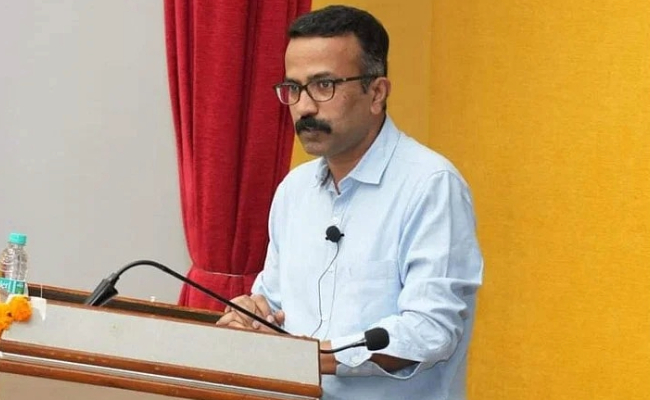
New Delhi: Senior digital journalist Dayashankar Mishra has reportedly submitted his resignation to the Network18 management, where he served as the Executive Editor (Digital). He has alleged that he had to resign because his employers were unhappy with him writing a book on Rahul Gandhi.
Dayashankar Mishra is currently in the spotlight for his upcoming book focused on Rahul Gandhi, scheduled for release in December. Mishra revealed on his 'X' handle that Network18 asked for his resignation if he intended to proceed with the book. He claimed that although he had the option to withdraw the book and save his job, he chose to stand with the truth and continue writing.
Making this revelation in a detailed note, Mishra expressed his surprise at the challenges associated with presenting the truth about Rahul Gandhi. He asked why, in a time when there is a competition to write about those in power, compiling and presenting the thoughts, vision, and determination of a public policy thinker would create such trouble.
“I had no idea how much trouble writing the truth on Rahul Gandhi would create. At a time when there is a competition to write epics on those in power, I thought why would anyone bother to compile and present the thoughts, vision and determination of a public policy thinker?” he added.
पहले इस्तीफ़ा, फिर किताब :
— Dayashankar Mishra (@DayashankarMi) November 22, 2023
राहुल गांधी पर सच लिखना कितनी मुश्किलें खड़ी करेगा, मुझे बिल्कुल अंदाज़ा नहीं था। ऐसे समय जब सत्ताधीशों पर गाथा-पुराण लिखने की होड़ लगी हो, मैंने सोचा था कि एक लोकनीतिक विचारक की सोच, दृष्टि और दृढ़ता को संकलित कर प्रस्तुत करना किसी को क्यों… pic.twitter.com/oEroAWRP1i
Responding to Mishra's claims, Network18 released a statement on Thursday, dismissing them as a publicity stunt. The company stated that Mishra violated company regulations by not seeking permission before writing a book or contributing outside the organization. According to Network18, Mishra was informed that he should adhere to the company's norms when he announced his book, scheduled for release in December.
Having been with Network18 for more than four and a half years, Mishra previously held the position of Editor (Languages) at the digital wing of the Zee Group, contributing to the expansion of the Hindi digital version of Zee News and other Indian languages during his two-year tenure.
Prior to his association with the Zee Group, Mishra served as an editor at the Hindi website of the NDTV Group. In 2016, while at NDTV, he initiated a series against war during the surgical strikes, earning appreciation from academicians, sociologists, and critics.
With nearly two and a half decades of experience in journalism, Dayashankar Mishra has worked in various regions, including Madhya Pradesh, Rajasthan, Delhi, and Jammu and Kashmir. His interests encompass study, travel, and communication. Mishra is recognized for his contributions to social and development journalism, having received the United Nations Population Fund award in 2008 for his research and study on manual scavenging societies. Additionally, he was granted a fellowship on the same subject from NFI, Delhi, in 2009.
News18 statement about the false and misleading claims by Mr Dayashankar Mishra: pic.twitter.com/Cuo5Jd5LRb
— News18 India (@News18India) November 23, 2023
Let the Truth be known. If you read VB and like VB, please be a VB Supporter and Help us deliver the Truth to one and all.
BJP using women's quota bill as front to pass Delimitation Bill that will break India: Mamata
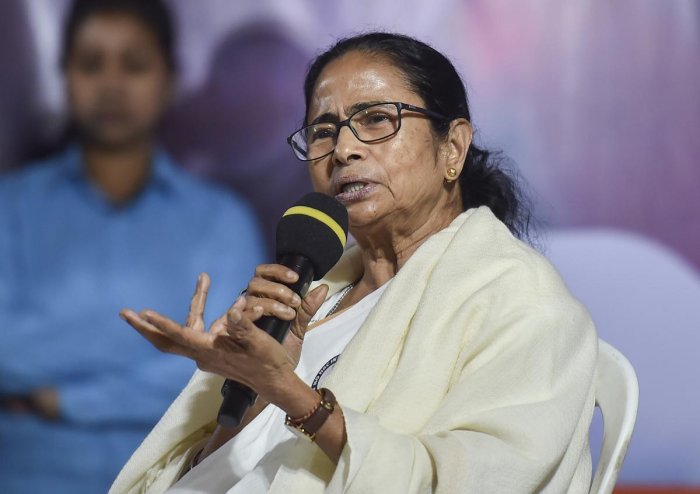
Cooch Behar (WB) (PTI): Chief Minister Mamata Banerjee on Friday alleged the BJP-led NDA government at the Centre was using the proposed amendment to the women's quota law in Parliament as a front for the Delimitation Bill that would "break the country into pieces".
The TMC will fight this Central government's move at every step, she asserted at her party's poll rally here.
The Constitution (131st Amendment) Bill to tweak the women's quota law, along with the Delimitation Bill and the Union Territories Laws (Amendment) Bill, to implement the proposed amended women's quota law, in the Union territories of Delhi, Puducherry and Jammu and Kashmir, were introduced in the Lok Sabha on Thursday.
According to the Constitution amendment bill, Lok Sabha seats will be increased to a maximum of 850 from the current 543 to "operationalise" the women's reservation law before the 2029 parliamentary polls, following a delimitation exercise based on the 2011 Census.
Seats will also be increased in state and Union territory assemblies to accommodate 33 per cent reservation for women.
Opposing the Centre's move, Banerjee alleged that "the BJP brought the Delimitation Bill while keeping the women's reservation bill at the front".
"The BJP is trying to increase the number of seats in the Lok Sabha to nearly 850 through the Delimitation Bill. It will break the country into pieces," the TMC supremo said.
She also alleged that Prime Minister Narendra Modi was not speaking the truth about the development of north Bengal at a BJP rally last week.
"The prime minister said nothing was done for the development of north Bengal. But we spent Rs 1.72 lakh crore on the development of the region," Banerjee said and asked Modi to cross-check data before making such remarks.