New Education Policy: Breakfast for school children besides mid-day meals
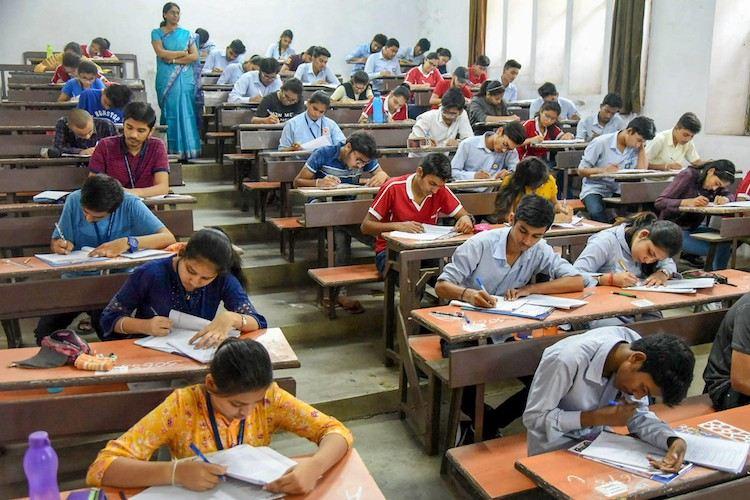
New Delhi: The mid-day meals provided to students in government or aided schools should be supplemented by breakfast, the new National Education Policy (NEP) has proposed.
The policy which was approved by the Union Cabinet earlier this week has noted that morning hours after a nutritious breakfast can be particularly productive for the study of cognitively more demanding subjects and hence recommended expansion of the mid-day meal scheme to include provisions for breakfast in schools.
"Children are unable to learn optimally when they are undernourished or unwell. Hence, the nutrition and health (including mental health) of children will be addressed, through healthy meals and the introduction of well-trained social workers, counsellors, and community involvement into the schooling system," the policy said.
"Furthermore, research shows that the morning hours after a nutritious breakfast can be particularly productive for the study of cognitively more demanding subjects and hence these hours may be leveraged by providing a simple but energizing breakfast in addition to mid-day meals," it added.
In locations where hot meals are not possible, a simple but nutritious meal-- groundnuts or chana mixed with jaggery and local fruits may be provided.
"All school children shall undergo regular health check-ups especially for 100 pc immunization in schools and health cards will be issued to monitor the same," the policy said.
The revised policy has proposed that prior to the age of 5 every child will move to a "preparatory class" or "balavatika".
"The learning in the preparatory class shall be based primarily on play-based learning with a focus on developing cognitive, affective, and psychomotor abilities and early literacy and numeracy. The mid-day meal programme shall also be extended to the preparatory Classes in primary schools.
"Health check-ups and growth monitoring that are available in the anganwadi system shall also be made available to preparatory Class students of anganwadi as well as of primary schools," the policy document said.
The National Programme of Mid-Day Meal in Schools, popularly known as the Mid-Day Meal Scheme (MDMS), is an on-going centrally-sponsored scheme which covers all school children studying in Classes 1 to 8 of government, government-aided schools, special training centres including 'Madarsas' supported under 'Samagra Shiksha'.
"As per the provisions of National Food Security Act, 2013, children studying in classes 1 to 8 or within the age group of 6-14 years are entitled to one mid day meal free of charge, every day except on school holidays, in all schools run by local bodies, government and government aided schools so as to meet nutritional standards specified in the Act," a senior HRD Ministry official said.
"However, some States and Union Territories provide additional items such as milk, egg and fruits to students from their own resources," the official added.
At least 11.59 crore elementary school students are beneficiaries under the mid-day meal scheme of the Human Resource Development (HRD) Ministry, while nearly 26 lakh cook-cum helpers are employed for the same.
The Ministry also advised states during lockdown to provide mid-day meals or food security allowance to students till schools are closed due to the novel coronavirus outbreak.
The NEP replaces the 34-year-old National Policy on Education framed in 1986 and is aimed at paving the way for transformational reforms in school and higher education systems to make India a global knowledge superpower.
Let the Truth be known. If you read VB and like VB, please be a VB Supporter and Help us deliver the Truth to one and all.
4 held for sexually assaulting woman, girl on moving bus after social media alert in UP's Agra

Agra (UP) (PTI): Four people were arrested, after a prompt response by police following a social media alert, for allegedly sexually assaulting a woman and a girl inside a moving bus here, officials said on Tuesday.
According to an official police statement, at 12:27 am on April 27, information was received on the social media platform X about an incident of sexual assault on a bus travelling from Kanpur to Ahmedabad, which was approaching Namner crossing in Agra.
Acting under the direction of Police Commissioner Deepak Kumar, the Agra Police social media team immediately alerted the Rakabganj police station within minutes and coordinated with the victims to confirm the incident and obtain the exact location, it stated.
Police teams launched intensive checking at Namner crossing and intercepted the bus as it reached the spot. The four accused involved in the incident were apprehended on the spot, and legal action was initiated against them, the statement said.
The police said the swift response and coordination between the social media team and field units ensured timely action, bringing relief to the victims and other passengers, who expressed gratitude towards the police, it added.