Nilufa Yasmin tops UGC NET JRF with 100 percentile, hopes to continue in academics
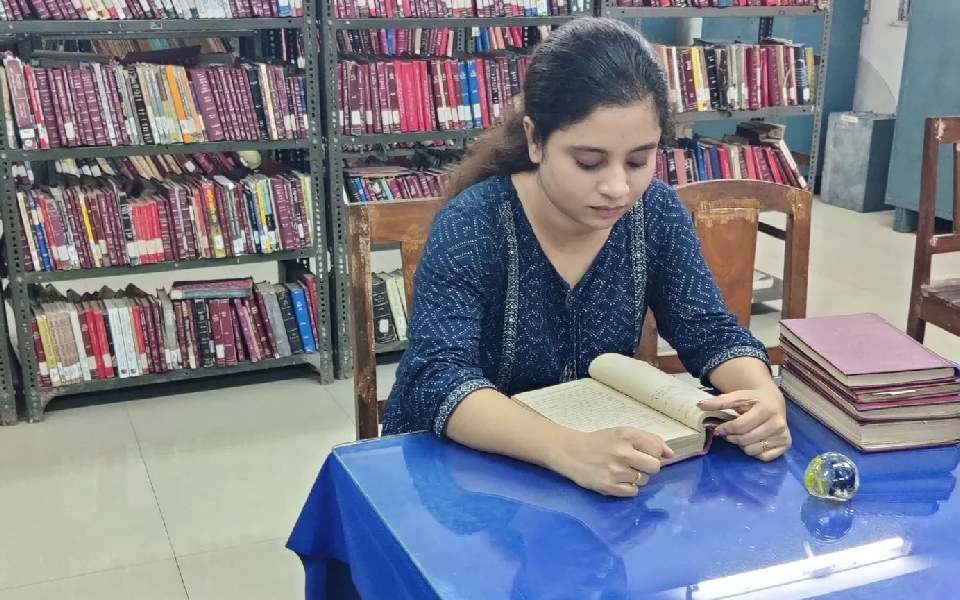
Kolkata: Nilufa Yasmin, a research scholar from Burdwan University in West Bengal, has topped the UGC NET JRF June 2025 exam with a perfect 100 percentile, reports The Indian Express.
A resident of Palita Road in Katwa, Purba Bardhaman district, Yasmin has been pursuing her research about the intersection of music and literature in the Middle Ages.
This was Yasmin’s third attempt at the exam. She told The Indian Express that she didn’t expect to be the national topper. “I am very happy. I had hoped I would do well but never thought I would top,” she said.
Quoting Yasmin, Indian Express reported that her guide, Professor Ramenkumar of the Bengali department, had been a main source of support and encouragement.
Reflecting on her journey, Yasmin mentioned that she found the first paper, especially the mathematics and English sections, challenging. “In the last two years, I faced problems with math and English because we lost touch, so I would advise everyone to practice English for the first paper. And for the second paper, text study is very important,” she told The Indian Express.
Yasmin has consistently ranked first in her academic career and comes from a family with a background in education. Her father, a retired high school teacher, and her mother, also a former schoolteacher, have been key influences in her life. She added that her entire family is celebrating the news. “My parents and sisters are calling me and telling me about all those who are calling them or visiting our home,” she said.
Yasmin also has a deep love for music and often uploads videos of her singing on social media. With this success, she now hopes to continue her path in academics and research.
West Bengal Chief Minister Mamata Banerjee also congratulated her on social media. “Congratulations to Nilufa Yasmin of Katwa in Purba Bardhaman for scoring 100 percentile and securing first position in India in UGC–NET June, 2025 (with) Bengali,” Banerjee posted, along with a note of appreciation for second rank holder Rikta Chakraborty from Kolkata.
Reacting to the Chief Minister’s message, Yasmin said, “I could not believe that the Chief Minister had congratulated me. I am so happy that she is so busy but she remembers us… that means a lot.”
The UGC NET is a national-level examination that qualifies candidates for Assistant Professorships, Junior Research Fellowships, and PhD admissions in Indian universities. In the June 2025 session, over 10 lakh candidates registered, with more than 7.5 lakh appearing for the test. Of these, 5,269 cleared both JRF and Assistant Professorship, while over 54,000 qualified for Assistant Professorship and PhD, and 1.28 lakh qualified for PhD admission only.
Let the Truth be known. If you read VB and like VB, please be a VB Supporter and Help us deliver the Truth to one and all.
AIITA welcomes Karnataka’s ban on obscene songs in school events
Bhatkal: The Karnataka unit of the All India Ideal Teachers Association (AIITA) has welcomed the Karnataka government’s decision to strictly ban school children from dancing to obscene songs during educational and cultural programmes in government, aided, and private schools across the state.
AIITA Karnataka State President M. R. Manvi congratulated the government for taking what he termed an important step to preserve the sanctity of education.
“Such decisions to safeguard the dignity of school children and uphold the values of education are the need of the hour. This rule should not be limited to government schools alone but must be strictly implemented in all private educational institutions as well,” he said.
He further urged the government to address other concerns within school programmes.
“The government should not only prohibit obscene dances in the name of school anniversaries, but also ensure that plays and dialogues that incite religious hatred are avoided. Schools should be centres of harmony, not platforms for spreading hatred,” he added.
According to a recent circular issued by the Department of School Education and Literacy, obscene dances are adversely affecting the mental health and moral values of students.
In this regard, schools have been advised to use songs that promote nationalism, positive thinking, the greatness of Kannada culture, and value-based traditions instead of inappropriate content during programmes.
The circular also emphasises that students should be dressed in decent attire.
AIITA also backed the department’s warning that disciplinary action would be taken against head teachers if such guidelines are violated. The association has further demanded that district Deputy Directors of Public Instruction strictly monitor the implementation of these rules.