Nirav Modi extradition sought from UK: V.K. Singh
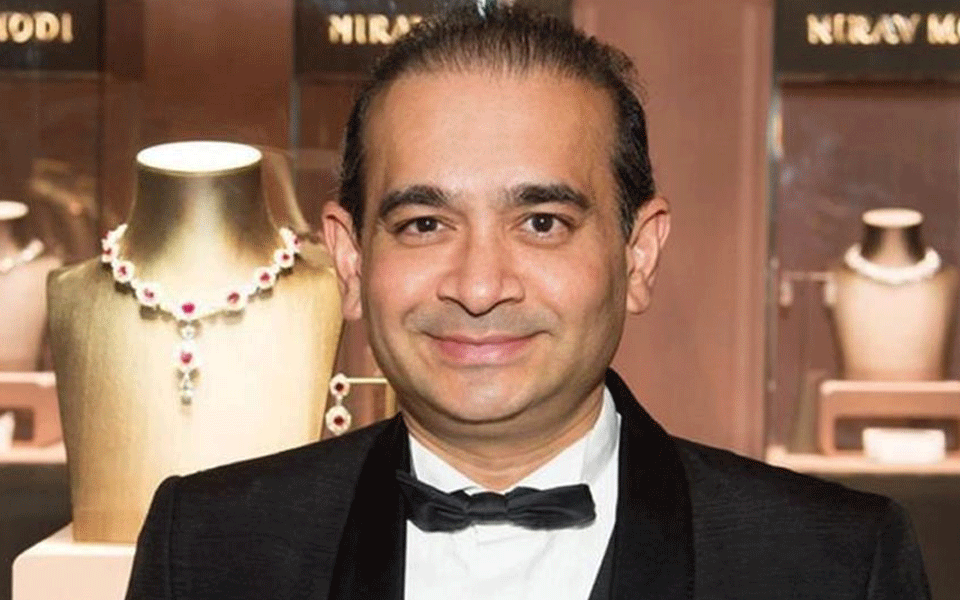
New Delhi, Aug 3: The government has sent a request to the UK for extraditing fugitive diamantaire Nirav Modi, who is wanted in the Rs 13,500 crore Punjab National Bank (PNB) fraud case, parliament has been informed.
"An extradition request has been received in the Ministry of External Affairs (MEA) from the Ministry of Home Affairs (MHA) for the extradition of Nirav Modi from the UK," Minister of State for External Affairs V.K. Singh told the Rajya Sabha on Thursday.
"The request has been sent by a Special Diplomatic Bag to the High Commission of India (HCI), London for onward transmission to the UK authorities," he said.
Singh said that the MEA revoked the passport of Modi as per the provisions of Section 10(3)(c) of the Passports Act, 1967, on February 16, 2018.
"This information was conveyed to the Central Bureau of Investigation (CBI) for onward transmission to the Interpol," he said.
He also said that the Ministry has no means to verify the travels, if any, of Nirav Modi, and the passport used for such travels by him.
Nirav Modi along with his uncle Mehul Choksi of the Gitanjali group are being probed in the fraud scam by the CBI and the Enforcement Directorate (ED).
The ED had, on May 24 and May 26, filed prosecution complaints or charge-sheets against Choksi and Modi.
The court has taken cognizance of the charge-sheets and issued non-bailable warrants against both of them.
On request of the ED and the CBI, the Interpol had earlier issued Red Corner Notice against Nirav Modi on July 2.
Nirav Modi left India along with his family in the first week of January, weeks before the scam was reported to the CBI. His wife Ami, a US citizen, left on January 6 and Choksi on January 4.
Let the Truth be known. If you read VB and like VB, please be a VB Supporter and Help us deliver the Truth to one and all.
Indian startup's 'Drishti' satellite launched aboard SpaceX rocket
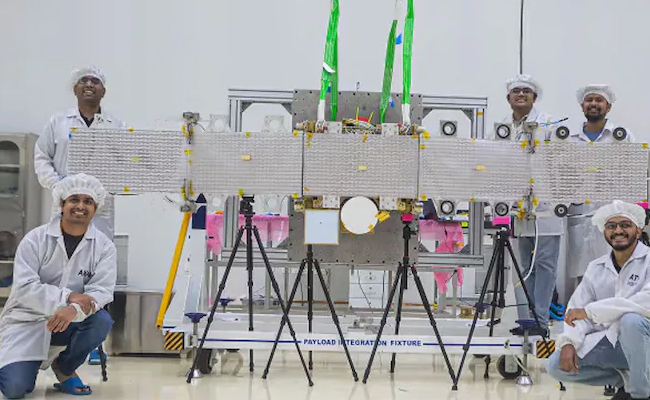
New Delhi (PTI): Bengaluru-based space start-up GalaxEye's Mission Drishti satellite was launched on Sunday aboard SpaceX's Falcon 9 rocket from California.
Mission Drishti is the world's first OptoSAR satellite, integrating electro-optical (EO) and synthetic aperture radar (SAR) sensors into a single operational platform, according to the company.
While EO sensors capture high-resolution images during sunlight and clear skies, SAR sensors provide all-weather and all-time images, using radar pulses.
In a statement, Suyash Singh, founder and CEO of GalaxEye, said, "With the satellite (Mission Drishti) now successfully in orbit, our immediate focus is on completing its commissioning. As we move through this phase, we are already witnessing strong global interest in the differentiated datasets enabled by our OptoSAR payload."
The satellite will help address long-standing limitations of conventional systems and enable more reliable and consistent data acquisition across diverse environmental conditions, the company said.
As a dual-use Earth observation satellite, the mission will support use cases across defence, agriculture, disaster management, maritime monitoring, and infrastructure planning.
The satellite is also expected to complement India's broader initiatives, including the 29 active Earth Observation satellites outlined in ISRO's recent annual report.
The launch came after five years of indigenous research and development, and extensive environmental testing and performance validation of the Mission Drishti.
In a statement, Lt Gen AK Bhatt (Retd), director general of Indian Space Association (ISpA), said, "GalaxEye has achieved what only a few global players have, which is seamlessly combining optical and SAR capabilities on a single platform to enable persistent, all-weather intelligence."
What stands out is not just the technology, but its broader impact on how downstream applications will increasingly define value in the space economy, particularly in Earth observation, where timely, decision-grade insights are critical," he added.
ISpA is the premier industry association of space and satellite companies in the country.
Union Minister Jitendra Singh also took note of the Mission Drishti launch, saying the development marked a significant milestone in India's space journey.
In a post on X, the minister said, "The successful launch of the world's first OptoSAR satellite, and the largest privately-built satellite in the country, reflects the immense potential of our young innovators driving nation-building."
GalaxEye aims to scale up Mission Drishti to a constellation of 10 satellites by 2030, developing a robust and sovereign Earth observation infrastructure for India.