Nirbhaya case: Death row convict claims mental illness in SC, Centre says he has sound mind
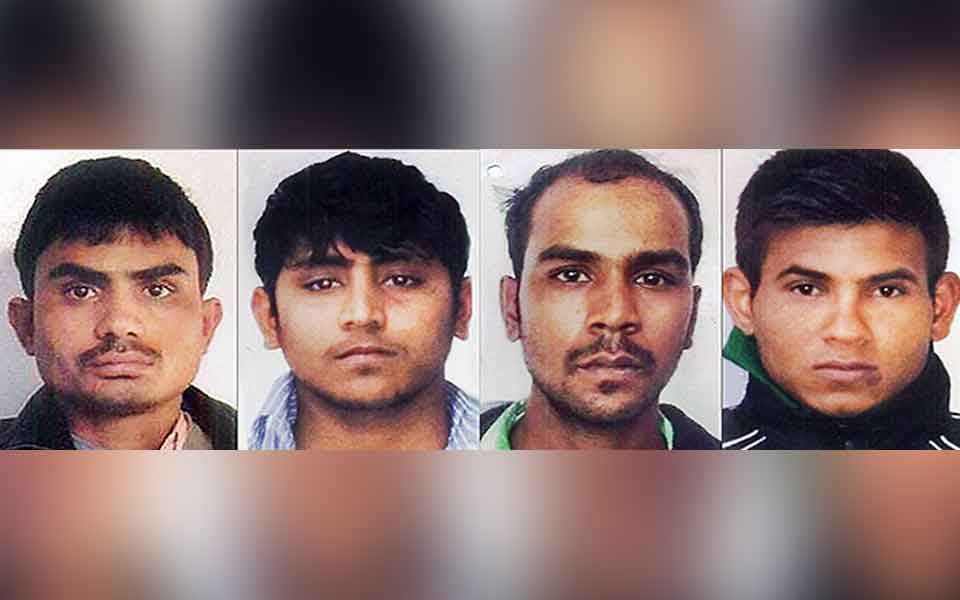
New Delhi: One of the four death row convicts in the Nirbhaya gang rape and murder case claimed in the Supreme Court on Thursday that while rejecting his mercy plea the President did not consider his mental illness following torture in jail, an allegation denied by the Centre saying "he is fit and has sound mind".
Vinay Sharma through his counsel made a last ditch effort to escape from the gallows claiming that all the relevant records were not brought before the President including that he had been subjected to torture and ill-treatment in jail due to which he had developed mental illness.
The Centre however opposed his claim and produced a medical report dated February 12 which said he was fit and had a sound mind.
A bench of Justices R Banumathi, Ashok Bhushan and A S Bopanna, which reserved its order on Sharma's plea challenging the rejection of his mercy petition by President said it will pronounce the verdict on Friday at 2 PM.
The top court also rejected Sharma's counsel A P Singh's request to peruse the original file of recommendation made by the Lieutenant Governor and Delhi home minister Satyendra Jain for rejection of his mercy petition.
"Though the Court has informed counsel that Home Minister of Government of NCT of Delhi and Lieutenant Governor have signed the proposal on the mercy petition, counsel insisted upon on looking into the original files. Request for perusal of the original files by learned counsel appearing for the petitioner-Vinay Sharma is declined," the bench said in its order.
Singh contended that signatures of Delhi home minister and LG were not obtained on the original files recommending rejection of mercy petition of Sharma.
Solicitor General Tushar Mehta, appearing for the Centre and NCT of Delhi, opposed the arguments of Singh and said that signatures were obtained on the original files and submitted the documents for the perusal of the court.
"The contention of Dr AP Singh, counsel appearing for the petitioner-Vinay Sharma, is that Home Minister of Government of NCT of Delhi and LG have not signed the recommendation rejecting the mercy petition of the petitioner and, therefore, counsel wanted to look into the original file and make submission on that aspect," said the bench.
It said, "The concerned files have been produced before us which we have perused and on perusal it is seen that Home Minister of Government of NCT of Delhi and Lieutenant Governor have signed the same".
The bench after rejecting the request of Singh asked him to continue with his arguments while making him clear that judicial review of rejection of mercy petition by President has a very limited scope and the court has only to see whether there was proper application of mind.
Singh said that all relevant materials were not before the President, who rejected the mercy petition within 48 hours of filing of the plea.
"The President did not consider that Sharma has been subjected to torture and ill-treatment in prison, as a result of which he experienced grave mental trauma and even developed mental illness for which he has received psychiatric treatment in prison," Singh said, adding that mental illness is one of the ground to commute his death sentence.
He said that Sharma was also kept in solitary confinement by the jail authorities and subjected in-human treatment, which was against the guidelines of apex court.
Singh argued that there was history of physical assaults on Sharma and his medical records establishes the fact that he was taken for psychiatric treatment several times.
Mehta opposed the arguments saying all due process of law was followed and read out the file noting made by Union home minister Amit Shah, on the recommendation sent to the President which said that his case fall in rarest of rare category and does not deserve clemency.
Mehta said that prison records suggest that he was not kept in solitary confinement.
The apex court had earlier dismissed a plea filed by Mukesh Kumar Singh, another death row convict in the case, challenging the rejection of his mercy petition by the President.
The trial court had on January 31 stayed "till further orders" execution of the four convicts in the case -- Mukesh Kumar Singh (32), Pawan Gupta (25), Vinay Kumar Sharma (26) and Akshay Kumar (31), who are lodged in Tihar Jail.
Pawan has not yet filed a curative petition -- the last and final legal remedy available to a person which is decided in-chamber. Pawan also has the option of filing a mercy plea.
The mercy petition of Akshay was also rejected by the President.
The 23-year-old physiotherapy intern, who came to be known as 'Nirbhaya' (fearless), was gang-raped and savagely assaulted on the night of December 16, 2012, in a moving bus in South Delhi. She died of her injuries a fortnight later in a Singapore hospital.
Six people including the four convicts, Ram Singh and a juvenile -- were named as accused.
The trial of the five adult men began in a special fast-track court in March 2013.
Ram Singh, the prime accused, allegedly committed suicide by hanging himself in Tihar jail days after the trial began. The juvenile, who was said to be the most brutal of the attackers, was put in a correctional home for three years.
The juvenile was released in 2015 and sent to an undisclosed location amid concerns over a threat to his life. He, when released, was 20 years
Let the Truth be known. If you read VB and like VB, please be a VB Supporter and Help us deliver the Truth to one and all.
How Indian AI Is Booming with GEOX AI Leading the Next Wave of Geolocation Intelligence
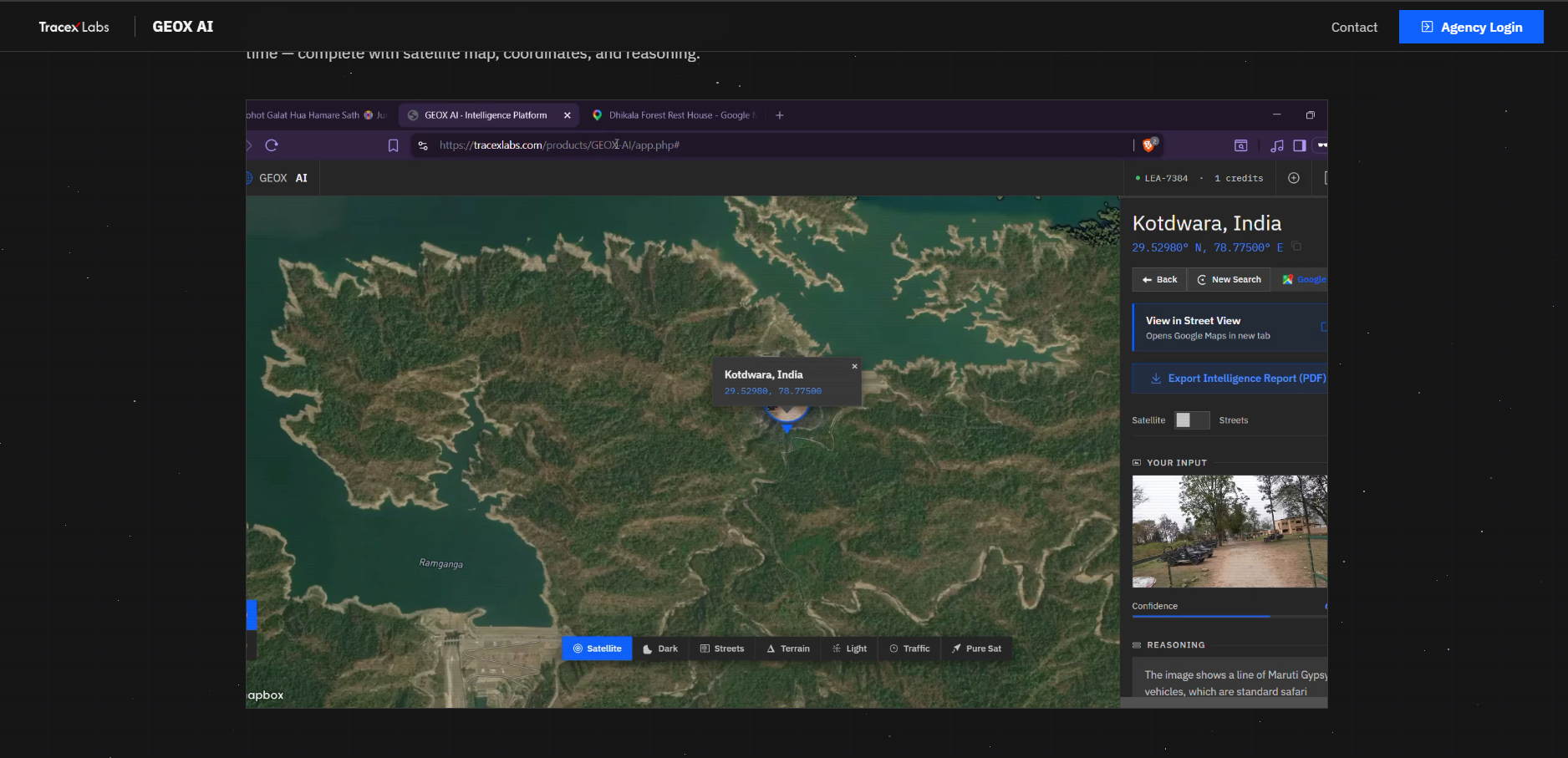
TraceX Labs has announced the launch of GEOX AI, an advanced artificial intelligence platform capable of identifying the real-world location where a photograph or video was taken using only the visual content within the media.
Positioned as an enterprise-grade intelligence solution, GEOX AI leverages advanced computer vision and multi-agent AI to analyze pixel-level details such as architecture, road patterns, vegetation, signage, lighting, and environmental context. By interpreting these visual clues, the system can estimate—and in many cases precisely determine—the origin of an image or video.
AI-Powered Geolocation Intelligence
Marketed under the concept of “Locate Anywhere From Any Image,” GEOX AI is designed for intelligence operations where speed, accuracy, and reliability are critical. The platform currently supports:
- 400+ analyses available
- <10 seconds average response time
- Up to 99% accuracy on landmark-based identification
- Global coverage across diverse terrains and environments
Core Capabilities
GEOX AI integrates multiple intelligence features into a single platform:
- Precise Geolocation:
Identifies exact geographic coordinates using visual landmarks, architecture, vegetation, and cultural indicators. - Satellite Map View:
Results are plotted on live satellite imagery with 2D/3D viewing options and multiple map styles for deeper analysis. - AI Reasoning Analysis:
Provides a detailed explanation of how the system arrived at a conclusion, including confidence scoring. - Multi-Result Analysis:
Returns multiple possible locations ranked by confidence, enabling cross-verification. - Intelligence PDF Export:
Allows one-click generation of professional reports containing maps, coordinates, analysis, and structured findings. - Credit-Based Access:
Agencies are allocated credits, with each analysis consuming one credit. Additional credits can be requested directly.
Speed Meets Intelligence
GEOX AI is designed to balance rapid processing with analytical depth:
- Fast Mode: Delivers results within seconds for clear and high-context images
- Advanced Mode: Performs deeper multi-step analysis for complex or ambiguous visuals
- Built for real-time decision-making in high-pressure environments
How GEOX AI Works
The platform follows a simple and efficient workflow:
- Upload any image or video frame
- AI analyzes visual clues such as structures, terrain, and environment
- The system identifies location with coordinates, confidence score, and reasoning
- Results are displayed on an interactive satellite map
- Export a professional intelligence report in one click
A Breakthrough for Investigations
GEOX AI is expected to have wide-ranging applications across multiple domains:
- Tracking the origin of images from social media and open sources
- Supporting digital forensics and cyber investigations
- Assisting law enforcement and intelligence operations
- Helping journalists and OSINT analysts verify visual content
- Providing support in missing person cases and threat intelligence scenarios
Enterprise Access and Deployment
GEOX AI is available to verified law enforcement agencies, intelligence organizations, and authorized enterprises. Access is provided through a structured system where organizations can request credentials and define their operational use cases.
Interested users can request access via tracexlabs.com or contact contact@tracexlabs.com, with response times typically within 24–48 hours.
Privacy Debate Intensifies
The launch of GEOX AI has also sparked renewed discussion around digital privacy. By demonstrating how location data can be extracted purely from visible elements within images, the platform highlights the potential risks associated with sharing photos online without considering what those visuals may reveal.
Conclusion
With GEOX AI, TraceX Labs is entering the rapidly evolving geolocation intelligence space with a platform that combines speed, precision, and real-world usability. As artificial intelligence continues to advance, tools like GEOX AI are expected to play a critical role in shaping the future of investigations, security, and digital intelligence.