Nirbhaya: SC clears way for execution of Vinay, dismisses petition against rejection of mercy plea
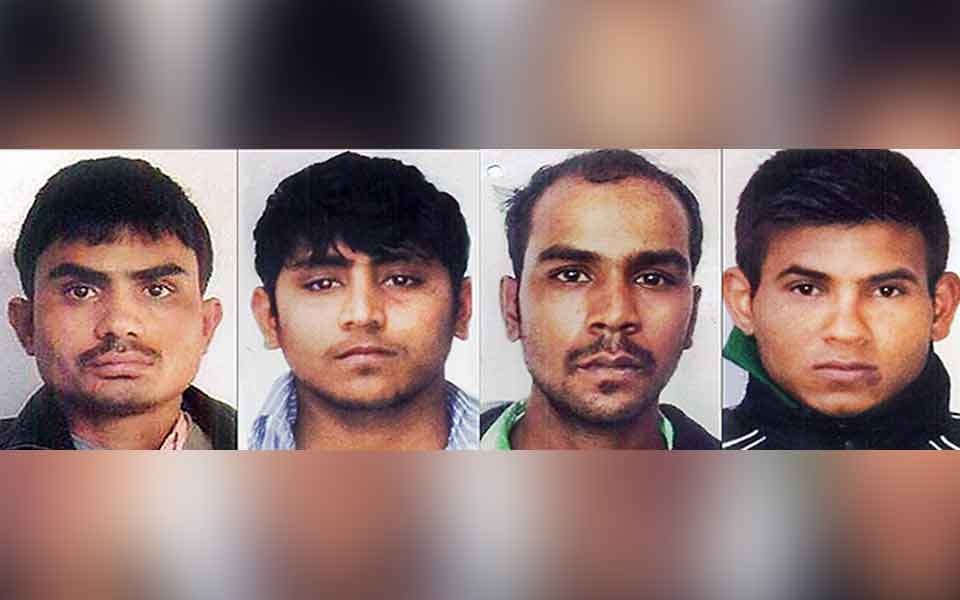
New Delhi: Clearing the way for execution of Vinay Sharma, one of the four convicts in the Nirbhaya gang rape and murder case, the Supreme Court on Friday dismissed his plea against the rejection of his mercy petition by the President.
The top court refused to accept Sharma's contention that the President did not apply his mind while rejecting the mercy plea and it was done in a "mala fide" manner.
"When the highest constitutional authority, upon perusal of the note and the various documents placed along with mercy petition, has taken a decision to reject the mercy petition, it cannot be contended that the highest constitutional authority had not applied its mind to the documents," it said.
A bench of Justices R Banumathi, Ashok Bhushan and A S Bopanna said, "In the result, we do not find any ground for exercise of judicial review of the order of the President of India rejecting the petitioner's mercy petition and this writ petition is liable to be dismissed. The writ petition is dismissed accordingly."
The apex court had earlier dismissed a similar plea filed by another death row convict in the case, Mukesh Kumar Singh (32).
The mercy petition by the third convict -- Akshay Kumar (31) -- has also been rejected, but he is yet to challenge the rejection.
The fourth convict Pawan Gupta (25) is yet to exhaust his legal remedies such as filing curative petition -- the last legal remedy available to person and the mercy plea.
A trial court had on January 31 stayed "till further orders" execution of the four convicts on the ground that they are yet to avail of all their legal remedies.
The Delhi High Court has said that all the four convicts in the Nirbhaya case have to hanged together and not separately.
The top court Friday dealt with various grounds raised by Sharma (26) through his advocate A P Singh including that all relevant records were not placed before the President by the authorities.
The bench said the Delhi government had forwarded Sharma's mercy petition to Ministry of Home Affairs (MHA) on January 30 along with the necessary documents which included recommendation of NCT of Delhi, copies of judgments, case records, latest medical report of the prisoner, present status of pending petition and others.
"Before placing the note file before the President of India, the MHA had placed the matter before the Union home minister, who applied his mind and by a speaking order, recommended for rejection of the mercy petition," it said.
The bench further said, "By perusing the note put up before the President of India, we have seen that all the documents enclosed along with mercy petition of the petitioner and the submissions made by him in the mercy petition were taken into consideration".
The top court also dealt with mental illness claim made by Sharma that due to torture and ill-treatment in jail, he had to seek psychiatric treatment and these records were not placed before the President.
It said that by perusal of the file produced before the court, it is seen that the medical report of Sharma along with the treatment and his latest medical report dated January 30, 2020 was placed before the concerned authorities which in turn, was placed before the President.
"In the medical status report, Dr. Akash Narade has referred to the details of the treatment of the petitioner and certified that the petitioner is psychologically well adjusted and he was
being provided with regular therapy sessions by specialized therapists and the general condition of the petitioner is stable" the bench said.
It said that the alleged suffering of the petitioner (Sharma) in the prison cannot be a ground for judicial review of the executive order passed under Article 72 of the Constitution of India rejecting his mercy petition.
The bench relied upon the affidavit filed by Director General (Prison), Tihar Jail which stated that for security reasons, Sharma was placed in one ward having multiple single rooms and barracks.
The bench also rejected the ground of bias raised by Sharma that ministers of Delhi government and Union government had led to pre-judging the outcome of mercy petition.
"The public statements said to have been made by the Ministers, cannot be said to have any bearing on the aid and advice tendered by the council of ministers of Delhi to the Lieutenant Governor or by council of ministers in the Central Government to the President," it said.
The 23-year-old physiotherapy intern, who came to be known as 'Nirbhaya' (fearless), was gang-raped and savagely assaulted on the night of December 16, 2012, in a moving bus in South Delhi. She died of her injuries a fortnight later in a Singapore hospital.
Six people including the four convicts, Ram Singh and a juvenile -- were named as accused.
The trial of the five adult men began in a special fast-track court in March 2013 and four were sentenced to death by the court on September 13, 2013. The trial court decision was upheld by the High Court and the Supreme Court.
Ram Singh, the prime accused, allegedly committed suicide by hanging himself in Tihar jail days after the trial began. The juvenile, who was said to be the most brutal of the attackers, was put in a correctional home for three years.
The juvenile was released in 2015 and sent to an undisclosed location amid concerns over a threat to his life. He, when released, was 20 years old.
Let the Truth be known. If you read VB and like VB, please be a VB Supporter and Help us deliver the Truth to one and all.
How Indian AI Is Booming with GEOX AI Leading the Next Wave of Geolocation Intelligence
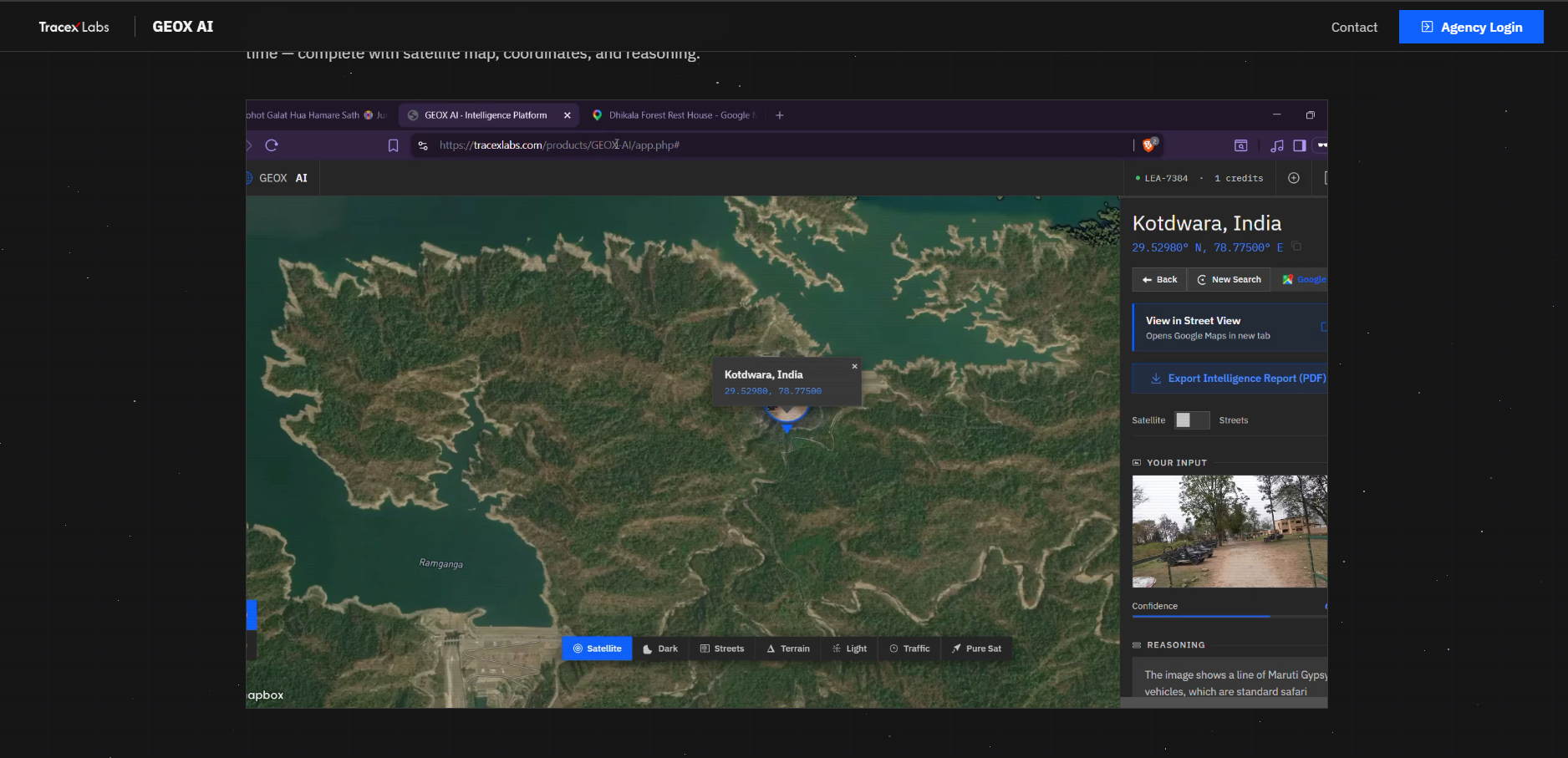
TraceX Labs has announced the launch of GEOX AI, an advanced artificial intelligence platform capable of identifying the real-world location where a photograph or video was taken using only the visual content within the media.
Positioned as an enterprise-grade intelligence solution, GEOX AI leverages advanced computer vision and multi-agent AI to analyze pixel-level details such as architecture, road patterns, vegetation, signage, lighting, and environmental context. By interpreting these visual clues, the system can estimate—and in many cases precisely determine—the origin of an image or video.
AI-Powered Geolocation Intelligence
Marketed under the concept of “Locate Anywhere From Any Image,” GEOX AI is designed for intelligence operations where speed, accuracy, and reliability are critical. The platform currently supports:
- 400+ analyses available
- <10 seconds average response time
- Up to 99% accuracy on landmark-based identification
- Global coverage across diverse terrains and environments
Core Capabilities
GEOX AI integrates multiple intelligence features into a single platform:
- Precise Geolocation:
Identifies exact geographic coordinates using visual landmarks, architecture, vegetation, and cultural indicators. - Satellite Map View:
Results are plotted on live satellite imagery with 2D/3D viewing options and multiple map styles for deeper analysis. - AI Reasoning Analysis:
Provides a detailed explanation of how the system arrived at a conclusion, including confidence scoring. - Multi-Result Analysis:
Returns multiple possible locations ranked by confidence, enabling cross-verification. - Intelligence PDF Export:
Allows one-click generation of professional reports containing maps, coordinates, analysis, and structured findings. - Credit-Based Access:
Agencies are allocated credits, with each analysis consuming one credit. Additional credits can be requested directly.
Speed Meets Intelligence
GEOX AI is designed to balance rapid processing with analytical depth:
- Fast Mode: Delivers results within seconds for clear and high-context images
- Advanced Mode: Performs deeper multi-step analysis for complex or ambiguous visuals
- Built for real-time decision-making in high-pressure environments
How GEOX AI Works
The platform follows a simple and efficient workflow:
- Upload any image or video frame
- AI analyzes visual clues such as structures, terrain, and environment
- The system identifies location with coordinates, confidence score, and reasoning
- Results are displayed on an interactive satellite map
- Export a professional intelligence report in one click
A Breakthrough for Investigations
GEOX AI is expected to have wide-ranging applications across multiple domains:
- Tracking the origin of images from social media and open sources
- Supporting digital forensics and cyber investigations
- Assisting law enforcement and intelligence operations
- Helping journalists and OSINT analysts verify visual content
- Providing support in missing person cases and threat intelligence scenarios
Enterprise Access and Deployment
GEOX AI is available to verified law enforcement agencies, intelligence organizations, and authorized enterprises. Access is provided through a structured system where organizations can request credentials and define their operational use cases.
Interested users can request access via tracexlabs.com or contact contact@tracexlabs.com, with response times typically within 24–48 hours.
Privacy Debate Intensifies
The launch of GEOX AI has also sparked renewed discussion around digital privacy. By demonstrating how location data can be extracted purely from visible elements within images, the platform highlights the potential risks associated with sharing photos online without considering what those visuals may reveal.
Conclusion
With GEOX AI, TraceX Labs is entering the rapidly evolving geolocation intelligence space with a platform that combines speed, precision, and real-world usability. As artificial intelligence continues to advance, tools like GEOX AI are expected to play a critical role in shaping the future of investigations, security, and digital intelligence.