Nirmala Sitharaman announces Rs 70,000 cr package for exports, real estate sectors to boost growth
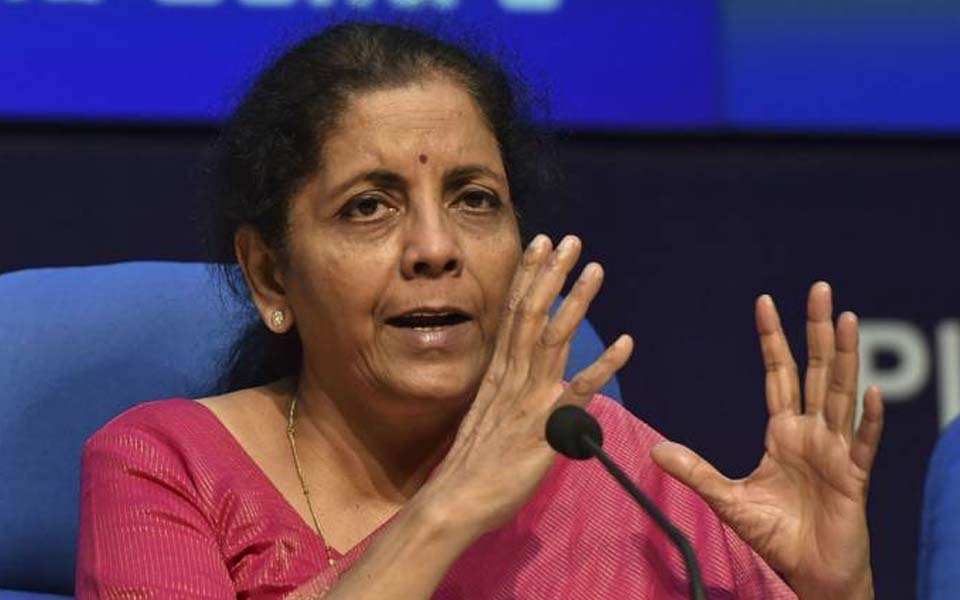
New Delhi, Sep 14: Finance Minister Nirmala Sitharaman on Saturday announced an over Rs 70,000 crore package for the exports and real estate sectors, including setting up of a stressed asset fund, as the government continued with firefighting measures to pull the economy out of a six-year low growth rate.
A Rs 20,000 crore fund, with government putting in half of the amount, will be set up to provide last-mile funding for housing projects that are not in bankruptcy court or already tagged as bad debt, she said at a press conference here to announce the third set of measures to address stress in specific sectors and boost the economy.
Also, housing finance companies have been allowed to borrow funds abroad at relaxed rules while interest rate on housing building advance has been lowered, benefiting government servants who make up for a major component of demand for houses.
The stressed asset fund will benefit around 3.5 lakh homebuyers, Sitharaman said, adding that buyers stuck in bankruptcy-bound projects will get relief through the NCLT.
For exporters, a new scheme for reimbursement of taxes paid on exports, called the Remission of Duties or Taxes on Export Product (RoDTEP), will come into effect from January 2020 to replace existing dispensations.
The new RoDTEP "will more than adequately incentivise exporters than existing schemes put together," she said, adding the revenue government will forego on the scheme is projected at Rs 50,000 crore. The government is already providing Rs 40,000-45,000 crore refunds under existing schemes.
Besides, a Rs 1,700 crore annual dole will allow Export Credit Guarantee Corp (ECGC) to offer higher insurance cover to banks lending working capital for exports, she said. This will enable reduction in the overall cost of export credit including interest rate, especially for MSMEs, she added.
Priority sector lending tag for export credit is under consideration of the Reserve Bank, which will release an additional Rs 36,000 crore to Rs 68,000 crore as export credit.
Other measures for exporters included fully electronic refund of input tax credit from month end, action plan to reduce time to export or turnaround time at airports and ports by December and a special FTA utilisation mission that will work with export houses to utilise concessional tariffs in each free trade agreement (FTA) India has with different nations.
She also announced a mega shopping festival on the likes of the world-famous Dubai Shopping Festival, will be conducted at four places in India in March on themes of gems and jewellery, handicraft/yoga/tourism, textiles and leather.
The finance minister said the measures together with the ones announced on the previous two occasions will help lift the economy and growth rate will improve in the second quarter.
Inflation, she said, has been kept "very much" below the 4 per cent mark and there are "clear signs" of revival in the economy, as witnessed in an uptick in industrial production and fixed investment.
Measures are being taken to improve credit outflow from banks, which have also begun to transmit interest rate cuts to borrowers, she said. Sitharaman will meet heads of public sector lenders on September 19 to review the transmission.
The Reserve Bank of India has since February cut the benchmark interest rate by 110 basis points but banks have lagged in transmitting the lower rates to borrowers.
The government has been pressing banks to offer external benchmark linked loans to speed up the transmission of rate cuts.
India's GDP growth decreased for the fifth consecutive quarter in April-June 2019 to 5 per cent, the lowest in six years. This was on the back of faltering domestic demand, with both private consumption and investment proving lackluster.
The government's previous policy measures to stimulate the economy included support for the automobile sector, reduction in capital gains tax, and additional liquidity support for shadow banks. Accompanying structural reforms included a further easing of the foreign direct investment (FDI) regime and consolidation of the public banking sector.
Let the Truth be known. If you read VB and like VB, please be a VB Supporter and Help us deliver the Truth to one and all.
AIITA welcomes Karnataka’s ban on obscene songs in school events

Bhatkal: The Karnataka unit of the All India Ideal Teachers Association (AIITA) has welcomed the Karnataka government’s decision to strictly ban school children from dancing to obscene songs during educational and cultural programmes in government, aided, and private schools across the state.
AIITA Karnataka State President M. R. Manvi congratulated the government for taking what he termed an important step to preserve the sanctity of education.
“Such decisions to safeguard the dignity of school children and uphold the values of education are the need of the hour. This rule should not be limited to government schools alone but must be strictly implemented in all private educational institutions as well,” he said.
He further urged the government to address other concerns within school programmes.
“The government should not only prohibit obscene dances in the name of school anniversaries, but also ensure that plays and dialogues that incite religious hatred are avoided. Schools should be centres of harmony, not platforms for spreading hatred,” he added.
According to a recent circular issued by the Department of School Education and Literacy, obscene dances are adversely affecting the mental health and moral values of students.
In this regard, schools have been advised to use songs that promote nationalism, positive thinking, the greatness of Kannada culture, and value-based traditions instead of inappropriate content during programmes.
The circular also emphasises that students should be dressed in decent attire.
AIITA also backed the department’s warning that disciplinary action would be taken against head teachers if such guidelines are violated. The association has further demanded that district Deputy Directors of Public Instruction strictly monitor the implementation of these rules.