Nitish Kumar inducts 8 new ministers in Bihar cabinet
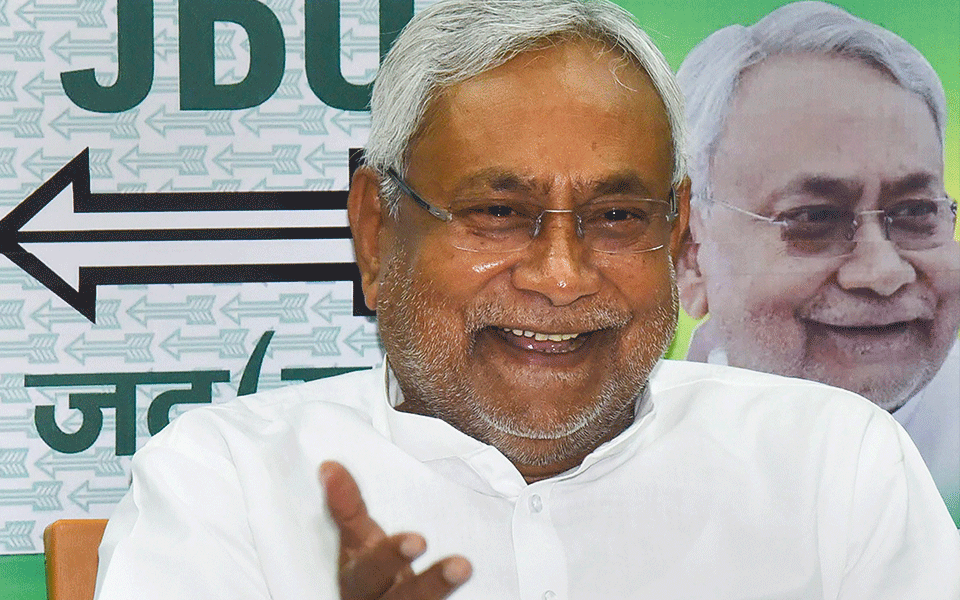
Patna: Bihar Chief Minister Nitish Kumar Sunday expanded his cabinet with the induction of eight new faces -- all from his Janata Dal (United).
Members of allies, the BJP and LJP, were left out from the cabinet expansion. Kumar, after the cabinet expansion, said the BJP was offered a berth in his cabinet, but the saffron party was not too keen.
Seconding Kumar, Deputy Chief Minister and BJP's senior leader Sushil Kumar Modi said the party was offered a ministerial berth, but it opted out of it for now.
"Nitish Kumar has offered BJP to fill the vacant ministerial seat. The BJP decided to fill it in future," the deputy chief minister tweeted.
The new ministers - Narendra Narayan Yadav, Shyam Rajak, Ashok Choudhary, Bima Bharti, Sanjay Jha, Ram Sewak Singh, Niraj Kumar and Lakshmeshwar Rai - were administered the oath of office and secrecy at a function at the Raj Bhavan here by Governor Lalji Tandon.
Kumar said the vacancies were majorly created by JD(U) ministers, who resigned from their posts for various reasons.
Tension seems to have been brewing between the alliance partners over allotment of berth in the Narendra Modi cabinet, although Kumar asserted that there was "no unease" between the partners.
The JD(U), he had said, decided against joining the Modi ministry as allies were not given "proportional representation" in the cabinet. Three seats in the Nitish Kumar cabinet fell vacant following the election of JD(U) ministers to the Lok Sabha.
The three ministers who were elected to the Lower House of Parliament included Water Resources Minister Rajiv Ranjan Singh alias Lalan Singh, Disaster Management Minister Dinesh Chandra Yadav and LJP's Bihar unit chief and Animal and Fisheries Resources Minister Pashupati Kumar Paras.
One post fell vacant last year after Manju Verma resigned as Social Welfare Minister in the wake of the Muzaffarpur shelter home case.
Among those who attended Sunday's swearing-in ceremony were Sushil Kumar Modi, Bihar Assembly Speaker Vijay Kumar Choudhary, RJD Bihar unit president Ram Chandra Purbey and several ministers of the Nitish KUmar government.
This is the second time in two years when Nitish Kumar expanded his cabinet.
On July 29, 2017, he has inducted 27 ministers from all three NDA constituents, the JD(U), the BJP and the LJP.
Let the Truth be known. If you read VB and like VB, please be a VB Supporter and Help us deliver the Truth to one and all.
Trump says EU has until July 4 to approve last year's trade deal or it will face higher tariffs
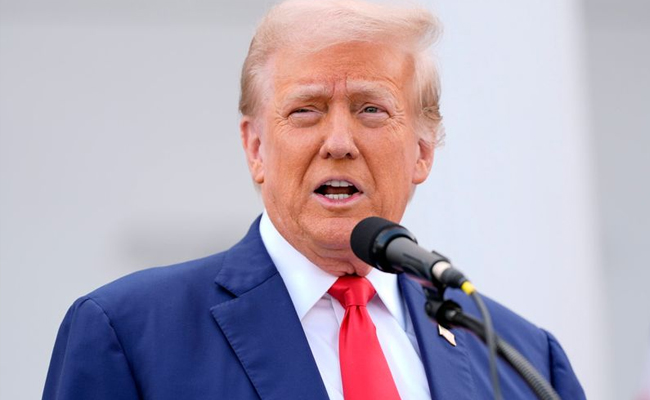
Washington (AP): President Donald Trump has said in a social media post that goods from the European Union would face higher tariff rates if the 27-member bloc fails to approve last year's trade framework by July 4.
The announcement on Thursday appeared to be a deadline extension after the president said last Friday that EU autos would face a higher 25 per cent tariff starting this week. Trump made the updated announcement after what he described as a "great call" with European Commission President Ursula von der Leyen.
Still, the US president was displeased that the European Parliament had yet to finalize the trade arrangement reached last year, which was further complicated in February by the US Supreme Court ruling that Trump lacked the legal authority to declare an economic emergency to impose the initial tariffs used to pressure the EU into talks.
"A promise was made that the EU would deliver their side of the Deal and, as per Agreement, cut their Tariffs to ZERO!" Trump posted. "I agreed to give her until our Country's 250th Birthday or, unfortunately, their Tariffs would immediately jump to much higher levels."
It was unclear from the post whether Trump was implying that the tariff rates would jump on all EU goods or the increase would only apply to autos.
His latest statement indicates he might be backing away from his earlier threat on EU autos by giving the European Parliament several more weeks to approve the agreement.
Under the original terms of the framework, the US would charge a 15 per cent tax on most goods imported from the EU.
But since the Supreme Court ruling, the administration has levied a 10 per cent tariff while investigating trade imbalances and national security issues, aiming to put in new tariffs to make up for lost revenues.