No action from Canada on India's request to arrest Lawrence Bishnoi gang members: MEA
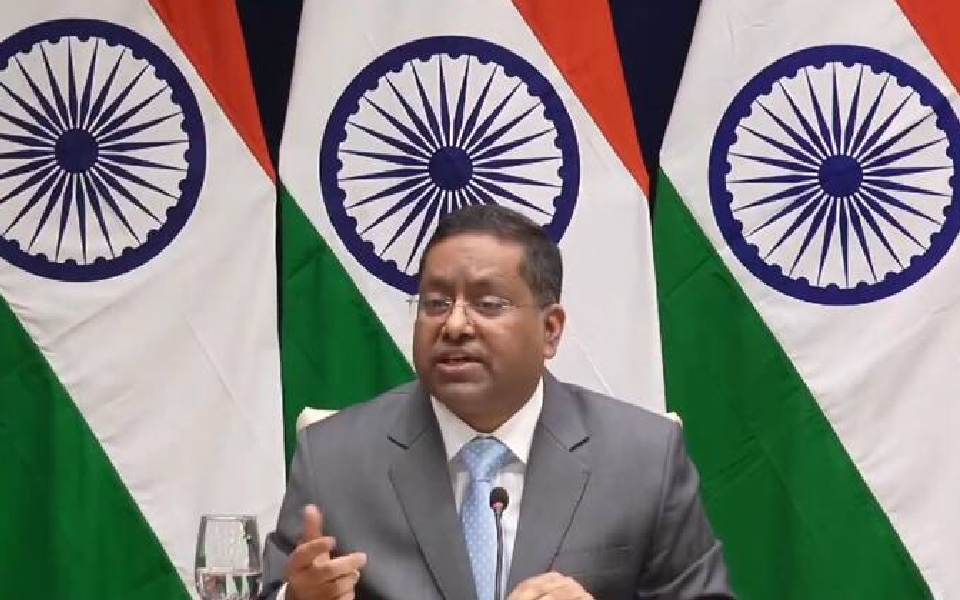
New Delhi, Oct 17: India on Thursday said it had shared with the Canadian government security-related information regarding members of the Lawrence Bishnoi gang and other gangs, seeking their arrest, but so far "no action" has been taken by Ottawa.
"They have taken no action so far, which are our core concerns. And, there is a political motive behind it, which you know... No action taken on our security concern," Ministry of External Affairs (MEA) spokesperson Randhir Jaiswal told reporters.
He said this in response to a query during his weekly briefing here as he fielded a volley of questions on India-Canada ties, a day after Canadian Prime Minister Justin Trudeau testified before a Commission of Inquiry.
Jaiswal, in response to another query, said "as far as my information is concerned, there are 26 extradition requests (from India) pending with the Canadian side" over the last decade or more.
The MEA spokesperson said the current diplomatic row with Canada has been precipitated by the Trudeau government's "baseless" allegations, and reiterated that "no evidence" has been shared in support of Ottawa's charges against New Delhi.
"We will say that as far as the allegations are concerned, PM Trudeau's own admission yesterday would indicate the value as regards our stance on the allegations. We will naturally reject false imputations against our diplomats," he said.
Testifying before the public inquiry into foreign interference in federal electoral processes and democratic institutions, Trudeau on Wednesday acknowledged that he had only intelligence and no "hard evidentiary proof" when he alleged the involvement of Indian government agents in the killing of Khalistani separatist Hardeep Singh Nijjar last year.
The MEA early on Thursday reacted to this and said what it has heard only "confirms" New Delhi's consistent stand that Canada has "presented us no evidence" in support of the serious allegations Ottawa chose to level against India and Indian diplomats.
"So far, Canada has not given evidence in support of the very serious allegations levelled against India and Indian diplomats," Jaiswal said.
The MEA spokesperson's comments assumes significance given the claims made by Canadian prime minister during the inquiry.
Testifying before the public inquiry, Trudeau claimed the Indian diplomats were collecting information on Canadians who are in disagreement with the Narendra Modi government and passing it to the highest levels within the Indian government and criminal organisations like the Lawrence Bishnoi gang.
On a query on extradition requests from India, the MEA spokesperson said that besides the 26 extradition requests, there are several "provisional arrest requests of several criminals, which are also pending with the Canadian side".
"Some of the notable ones who have been charged with terror and related crimes, I would like to name them. They are, Gurjeet Singh, Gurjinder Singh, Gurpreet Singh, Lakhbir Singh Landa and Arshdeep Singh Gill. They are wanted in terror charges, as I told you. And also some related charges," Jaiswal said.
Provisional arrest information has been sought by India under the Mutual Legal Assistance Treaty.
The five criminals (named during the briefing) are fugitives whose extradition "we have sought", he said.
To a query on whether Nijjar's name was on the extradition list, Jaiswal clarified that it wasn't.
He added that New Delhi had shared "security-related information with the Canadian government regarding gang members, including those of Lawrence Bishnoi gang, and requested them to arrest them and/or to take due action as per the law".
While India had exchanged and given this information, "so far no action has been taken by the Canadian side on our request. This is very serious," the MEA spokesperson said.
Jaiswal said it is really strange how "the people who we asked to be deported, on whom we asked that action be taken, we are being told that they are the ones...or the RCMP (Royal Canadian Mounted Police) is blaming the Indian side, that these people are committing crimes in Canada, for which you are to be blamed. So this is a contradiction in terms, which we don't understand".
India has been maintaining that the main issue between the two countries is that of Canada giving space to pro-Khalistan elements operating from Canadian soil with impunity.
"On Lawrence Bishnoi gang, other gangs, syndicates, a few years ago and recently too, have told Canada and requested for their provisional arrests. So, far no action has been taken, neither any arrest made," the MEA spokesperson said.
And, New Delhi has repeatedly said this, these people who are indulging in anti-India activities over there, encouraging separate forces, and strictest of actions should be taken against them, Jaiswal said.
"But, in this matter, they have brought forth the idea of freedom of speech and said, they can't do anything in this regard. This is baseless from our side," he added.
During the briefing, he was also asked if India has reached out to its allies including the US, the UK, Australia on this issue, to which he said, "no talks with them yet".
Asked where he saw this bilateral relationship going, Jaiswal said, "Well, to tell you very frankly, India-Canada economic ties are very strong and vibrant. We have a lot of Canadian pension funds... invested here, we have a large Indian diaspora in Canada, which is a bridge through which we maintain very strong people-to-people links with Canada".
"We have a large, possibly the largest cohort of international students in Canada as well. This particular crisis has been precipitated by Trudeau government's baseless allegations," he said.
And, Canada is a major beneficiary of all these linkage, "strong linkages that we have", the MEA spokesperson said.
On a query about reports that the Indian high commissioner and five other diplomats were asked to leave Canada, Jaiswal said subsequent to India's decision to withdraw its envoy and other diplomats, "we saw that there was a communication from the Canadian side, asking them to leave by 11:59 pm on October 19. But, we had withdrawn our diplomats before their decision".
India on Monday expelled six Canadian diplomats and also announced withdrawing its high commissioner from Canada after dismissing Ottawa's allegations linking the envoy to a probe into the killing of Nijjar.
Nijjar, who was declared a terrorist by India, was shot dead outside a gurdwara in Surrey, British Columbia on June 18 last year.
Let the Truth be known. If you read VB and like VB, please be a VB Supporter and Help us deliver the Truth to one and all.
Oath-taking ceremony of first BJP govt in Bengal on May 9; Modi, Shah likely to attend
Kolkata (PTI): The oath-taking ceremony of the first BJP government in West Bengal will be held at Brigade Parade Ground here on May 9, marking the saffron camp’s arrival in power in a state after decades on the political fringes.
The ceremony, scheduled to begin at 10 am, is expected to witness the presence of Prime Minister Narendra Modi, Union Home Minister Amit Shah, BJP president Nitin Nabin, several Union ministers and chief ministers of BJP- and NDA-ruled states, party sources said.
“The new BJP government will take oath on May 9 at 10 am at Brigade Parade Ground,” state BJP president Samik Bhattacharya announced on Wednesday.
Even as the BJP leadership kept its cards close to the chest on the chief ministerial face, Leader of the Opposition Suvendu Adhikari has emerged as a frontrunner in internal discussions after cementing his position as the party’s principal mass leader in Bengal politics.
Adhikari, once among Mamata Banerjee’s closest lieutenants and a key architect of the TMC’s rural expansion in districts such as Purba Medinipur, crossed over to the BJP ahead of the 2021 assembly elections and went on to defeat Banerjee in Nandigram in one of Bengal’s fiercest political battles.
Five years later, he again found himself at the centre of Bengal’s political churn by beating Banerjee in her own turf at Bhabanipur by over 15,000 votes.
Other names for the CM post doing the rounds include Bhattacharya, Union minister Sukanta Majumdar and former Rajya Sabha MP Swapan Dasgupta, though party insiders indicated that the leadership was inclined towards projecting a “bhumiputra” face rooted in Bengal’s linguistic and cultural ethos.
During the campaign, Shah repeatedly asserted that the BJP’s chief minister in Bengal would be a “son of the soil”, born and educated in the state, in an attempt to blunt the TMC’s sustained attack that the BJP represented an “outsider” political culture alien to Bengal’s social and intellectual traditions.
The BJP bagged 207 of the 294 assembly seats in the recently concluded elections, ending the Trinamool Congress’s uninterrupted 15-year rule and scripting the saffron party’s biggest breakthrough in a state where it once struggled to open its electoral account.
Significantly, the swearing-in ceremony will be held on the 25th day of Baisakh in the Bengali calendar — observed across the state as Rabindra Jayanti, the birth anniversary of Rabindranath Tagore — lending the event a deeper cultural symbolism.
According to BJP leaders, the choice of the date is aimed at embedding the party’s historic rise within Bengal’s cultural imagination and countering the long-standing perception battle over identity and belonging.
Over the last decade, the BJP has steadily attempted to appropriate and reinterpret icons of Bengal’s cultural nationalism — from Tagore and Swami Vivekananda to Netaji Subhas Chandra Bose and Syama Prasad Mookerjee — as part of a broader ideological effort to expand its emotional and political footprint in the state.
Party insiders said the leadership was also conscious of the need to balance Bengal’s competing regional aspirations while choosing the chief ministerial face, with discussions also taking place around whether greater representation should be accorded to north Bengal, a region where the BJP has made substantial electoral gains over successive elections.
A meeting of the newly elected BJP MLAs has been convened on May 8 evening, party sources said, though the leadership remained tight-lipped over the final choice.
The Brigade Parade Ground ceremony is expected to mark not merely a transfer of power, but a defining moment in Bengal’s political history, the culmination of the BJP’s long ideological and organisational march from the margins to the centre of power in a state that had for decades resisted the saffron surge seen elsewhere in India.