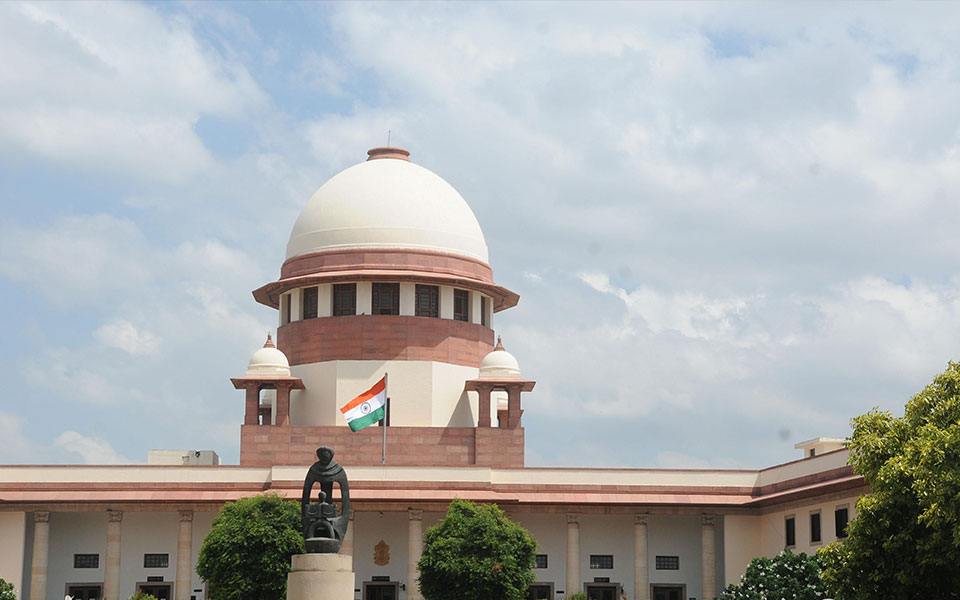
New Delhi, July 23 : The Supreme Court on Monday said there cannot be any "blanket ban" on holding protests at Delhi's historic Jantar Mantar located at the periphery of Parliament Street and the Boat Club on Rajpath.
Emphasising on the need to balance between the right to protest and the security considerations, a bench of Justice A.K. Sikri and Justice Ashok Bhushan said that the Delhi Police will have to frame guidelines to regulate protests at both spots.
Directing the guidelines to be framed "very soon", the bench also noted that as it is there was need for police permission for holding protests or demonstrations.
The court ruling came while deciding on a challenge to the green tribunal's order prohibiting protests at Jantar Mantar and a plea by NGO Majdoor Kisan Shakti Sangathan and the Indian Ex-Servicemen's Movement and others challenging the perennial imposition of prohibitory orders (Section 144) in the central Delhi area wherein all important government offices including Parliament House is located.
Let the Truth be known. If you read VB and like VB, please be a VB Supporter and Help us deliver the Truth to one and all.
New Delhi (PTI): To love someone is to care for them not just in times of joy, but in their saddest and darkest hours, the Supreme Court on Wednesday said while hailing the parents and siblings of Harish Rana, who is in coma for more than 13 years, for their unwavering support to him.
In its first-ever order allowing passive euthanasia, the top court permitted the withdrawal of artificial life support to 32-year-old Rana noting that prospects of his recovery are negligible.
Passive euthanasia is the intentional act of letting a patient die by withholding or withdrawing life support or the treatment necessary to keep him alive.
Rana, who was a student of Panjab University, suffered head injuries after falling from the fourth floor of his paying guest accommodation in 2013 and has been in a coma since.
A bench of justices J B Pardiwala and K V Viswanathan, which allowed the plea filed by Rana through his father Ashok Rana, said throughout the adjudication of this matter, it has been gripped by profound sadness.
"The issues in this matter have once again brought to the fore the fragility and transient nature of the life we live, and how swiftly the tide can turn for the worse. For the past thirteen years, the applicant has lived a life defined by pain and suffering. A suffering made all the more cruel by the fact that, unlike most of us, he was stripped of the ability to even give voice to his anguish.
"However, while this case highlights how unforgiving life can be, it is easy to lose sight of another vital fact. We note with immense respect that the applicant's parents and siblings have stood as unyielding pillars of support. They have exhausted every effort to care for him and continue to do so with unwavering dedication. We can only place on record our deepest appreciation for their boundless love, endurance, and kindness in the face of such adversity," the bench said.
The top court said among the manifold truths about human existence that this case reveals, the most enduring is the resilience of love.
"In our considered opinion, the greatest tragedy in life is not death, but abandonment. Despite the catastrophic tragedy that struck the applicant, his family never left his side. He has been cared for, protected, and cherished at every moment. To us, this unwavering vigil is a testament to the true meaning of love.
"To love someone is to care for them not just in times of joy, but in their saddest and darkest hours. It is to care for them even when the horizon is devoid of hope. It is to stand by them as they prepare to cross the threshold into the beyond. Ultimately, to love is nothing but to care deeply, softly, and endlessly," the bench said.
Observing that its decision does not neatly fit "within logic and reason" but between "love, loss, medicine and mercy", the bench said its order is not about choosing death, but is rather one of not artificially prolonging life.
"It is the decision to withdraw life sustaining treatment when that treatment no longer heals, restores, or meaningfully improves life. It is allowing nature to take its course when medicine can only delay the inevitable because survival is not always the same as living.
"To Harish's family, we want to acknowledge the deep emotional weight this decision carries. This decision can feel like an act of surrender, but we believe it is, in truth, an act of profound compassion and courage. You are not giving up on your son. You are allowing him to leave with dignity. It reflects the depth of your selfless love and devotion towards him," the bench said.