No case made out for granting special category status to Bihar: Govt in Lok Sabha
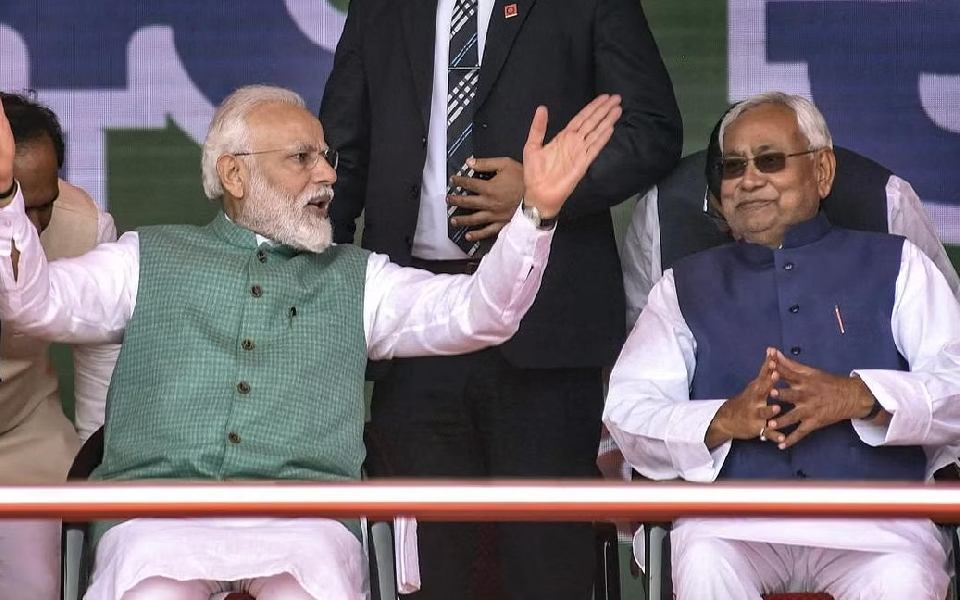
New Delhi, Jul 22: The government on Monday cited an inter-ministerial group report prepared in 2012 to assert that a case for granting special category status to Bihar is not made out; a stand which came a day after BJP's allies from Bihar demanded the status for the backward state.
In a written reply in the Lok Sabha on the first day of the Monsoon session, Minister of State for Finance Pankaj Chaudhary said special category status was granted in the past by the National Development Council (NDC) to some states which were characterised by a number of features necessitating special consideration.
These included hilly and difficult terrain, low population density or sizeable share of tribal population, strategic location along borders with neighbouring countries, economic and infrastructural backwardness and non-viable nature of state finances, he said in reply to a question asked by JD(U) member Rampreet Mandal.
The decision was taken based on an integrated consideration of all the factors listed above and the peculiar situation of a state, the minister said.
"Earlier, the request of Bihar for Special Category Status was considered by an Inter-Ministerial Group (IMG) which submitted its Report on 30th March 2012. The IMG came to the finding that based on existing NDC criteria, the case for Special Category Status for Bihar is not made out," the minister said.
The Congress-led UPA was in power at the time.
JD(U) leader Sanjay Kumar Jha had voiced his party's demand for the status at an all-party meeting on Sunday. The Lok Janshakti Party (Ram Vilas), also a BJP ally, and the opposition RJD echoed the same demand at the meeting.
The JD(U), though, has already conveyed to the Centre that it is willing to settle for a special financial package in case the status cannot be granted to the state.
The BJD and the YSR Congress had made the same demand for Odisha and Andhra Pradesh respectively in the meeting.
The government has in the past also argued that the 14th Finance Commission report has ruled out the possibility of any more states being granted the status, which includes tax relief and higher central funding for the beneficiary states.
Let the Truth be known. If you read VB and like VB, please be a VB Supporter and Help us deliver the Truth to one and all.
Mandaviya opens ESIC hospital in Doddaballapur, lays foundation for facility in Ballari
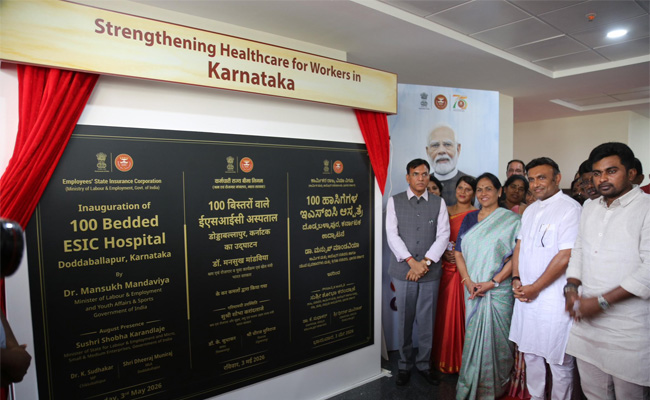
Bengaluru (PTI): Union Minister Mansukh Mandaviya on Sunday inaugurated the newly constructed 100-bedded ESIC Hospital at Doddaballapur near here.
He also laid the foundation stone for a 100-bedded ESIC Hospital at Ballari, remotely from Doddaballapur.
Union Minister of State for Labour and Employment Shobha Karandlaje, Chikkaballapura MP K. Sudhakar, and Doddaballapur MP Dheeraj Muniraju were among those present.
These healthcare facilities mark a significant milestone in strengthening healthcare delivery under the Employees’ State Insurance (ESI) Scheme in the region, officials said at the event.
As a special gesture, the union minister of labour and employment also honoured construction workers who contributed to the development of the hospital and disbursed cash benefits to ESI beneficiaries during the event.
The Doddaballapur facility will serve over 1,42,037 insured workers and their families, benefiting approximately 5.5 lakh beneficiaries across Bengaluru Rural, Chikkaballapur, Tumakuru, and Kolar districts, according to a release.
The Ballari facility, upon completion, will cater to the medical needs of around 64,000 workers and their families, benefiting over 2 lakh beneficiaries in the Ballari division, it said.
The ESIC Hospital at Doddaballapur in Bengaluru Rural is a 100-bedded multi-speciality secondary care facility built over 5 acres at Rs 101.14 crore.
It has 32 staff quarters and offers key services such as general medicine, surgery, obstetrics and gynaecology, paediatrics, orthopaedics, emergency care, and comprehensive diagnostic facilities, including radiology, laboratory, and blood bank.
The proposed ESIC Hospital at Ballari will be developed on 5.21 acres at an estimated cost of Rs 150 crore and will provide modern healthcare services to insured persons and their families under the ESI Scheme.