No disputed structure should be called mosque: UP CM Adityanath
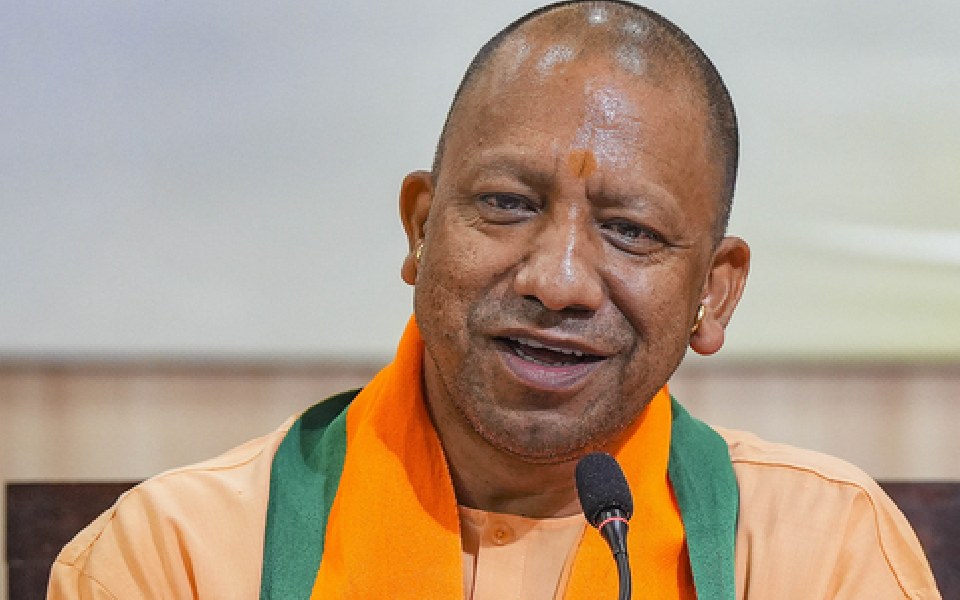
Mahakumbh Nagar (UP), Jan 11: Chief Minister Yogi Adityanath on Friday said no controversial structure should be referred to as "a mosque", asserting that tenets of Islam are "against constructing a mosque-like structure" at disputed sites.
Adityanath made the remarks while referring to the Shahi Jama Masjid dispute in Sambhal that sparked violence in November last year, according to an official statement.
The chief minister, while speaking at an event of a private news channel here, also said that worship at disputed sites is neither acceptable to God nor in line with Islamic principles, it said.
"We must never call a controversial structure a mosque. The day we stop calling it (a mosque), people will stop going there. Islam itself teaches against hurting anyone's faith or constructing a mosque-like structure at such places," the chief minister said.
"If God disapproves, why should we engage in such futile worship?" he questioned.
Adityanath emphasized that Islam does not require the construction of specific structures for worship, unlike Sanatan Dharma, where temples are central to religious practice, the statement said.
He called for a shift towards unity and progressive thinking, saying, "This is time to embrace the vision of a new India."
On the Sambhal violence over a court-ordered survey of the Shahi Jama Masjid, he said that Sambhal was prophesied as the birthplace of Kalki, the tenth incarnation of Lord Vishnu, long before the advent of Islam.
The chief minister further stated that historical documents like Ain-i-Akbari mention the demolition of a Shri Hari Vishnu temple in 1526 to erect the Jama Masjid, calling for the site to be voluntarily returned, the statement said.
He also suggested that the issue of disputed religious sites, such as the Shahi Jama Masjid, should not require judicial intervention. Instead, he advocated for mutual reconciliation, urging "followers of Islam to acknowledge the truth and extend a gesture of goodwill", according to the statement.
On the matter of the Places of Worship Act, Adityanath expressed confidence that the courts would ensure justice and respect for faith.
The Mughal-era Shahi Jama Masjid in Sambhal came into spotlight after a local court accepting a plea that it has been built over a temple ordered survey in November last year. During the second survey of the mosque on November 24, violence broke out in Sambhal in which four people were killed.
On the historical significance of Ayodhya, Adityanath also expressed gratitude for the installation of Ram Lalla's idol in 2024, noting that it ended a 500-year-long wait. He stated that the Maha Kumbh-2025 was being held at an auspicious time.
Reflecting on his slogan "Ek hain to nek hain, batenge to katenge", Adityanath highlighted the importance of unity, saying, "History has shown us that division weakens us. If we learn from the mistakes of the past, such situations will never arise again."
The chief minister also attacked the opposition INDIA bloc, saying, "Those who once strangled the Constitution now hold its copy to mislead the public."
He also pointed out that terms like "secular" and "socialist" were added to the Constitution during the Emergency, the statement said.
Let the Truth be known. If you read VB and like VB, please be a VB Supporter and Help us deliver the Truth to one and all.
China confirms its support to Pakistan during four-day conflict with India

Beijing (PTI): China, for the first time, has confirmed that it provided on-site technical support to Pakistan during the four-day conflict with India last year, official media reports here said.
China's state broadcaster CCTV on Thursday aired an interview with Zhang Heng, an engineer from the Aviation Industry Corporation of China's (AVIC) Chengdu Aircraft Design and Research Institute, a key developer of China’s advanced fighter aircraft and unmanned aerial vehicle design.
Zhang had provided technical support to Pakistan during the four-day war last May, Hong Kong-based South China Morning Post reported, quoting CCTV.
Pakistan's air force operates a fleet of Chinese-made J-10CE jets, produced by an AVIC subsidiary.
"At the support base, we frequently heard the roar of fighter jets taking off and the constant wail of air-raid sirens. By late morning, in May, the temperature was already approaching 50 degrees Celsius (122 degrees Fahrenheit). It was a real ordeal for us, both mentally and physically,” Zhang said.
What drove his team was the "desire to do an even better job with on site support” and to ensure their equipment could “truly perform at its full combat potential”, Zhang told CCTV.
“That wasn’t just a recognition of the J10CE; it was also a testament to the deep bond we formed through working side by side, day in and day out,” he said.