No issue can be resolved through military conflict: PM Modi
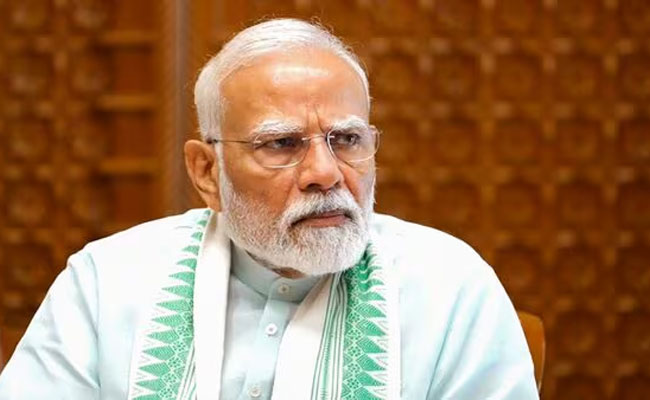
New Delhi (PTI): Prime Minister Narendra Modi on Thursday called for a "swift end" to the conflicts in West Asia and Ukraine, saying no issue can be resolved through military confrontation.
Modi made the remarks after holding wide-ranging talks with Finnish President Alexander Stubb.
"India and Finland, both, believe in the rule of law, dialogue, and diplomacy. We are in agreement that no issue can be resolved through military conflict alone," he said. "Be it Ukraine or West Asia, we will continue to support the swift end of conflicts and every effort towards peace," Modi said in his media statement.
ALSO READ: Baramati plane crash: CID questions VSR Ventures owner
In the talks, the two sides also agreed to accord India-Finland relations in digitalisation and sustainability as a strategic partnership.
"This partnership, from AI to 6G telecom, from clean energy to quantum computing, will give momentum and energy to our cooperation in many high-tech areas," he said. Modi said the India-EU free trade agreement will bolster trade ties between India and Finland.
"This agreement will further strengthen trade, investment, and technology cooperation between India and Finland," he said.
Finnish President Stubb began a four-day visit to India on Wednesday with an aim to shore up bilateral cooperation across a wide spectrum of areas, including trade, investment and critical technology.
Let the Truth be known. If you read VB and like VB, please be a VB Supporter and Help us deliver the Truth to one and all.
PM leads mega roadshow in Sikkim, to attend celebrations marking 50 years of statehood on Tuesday
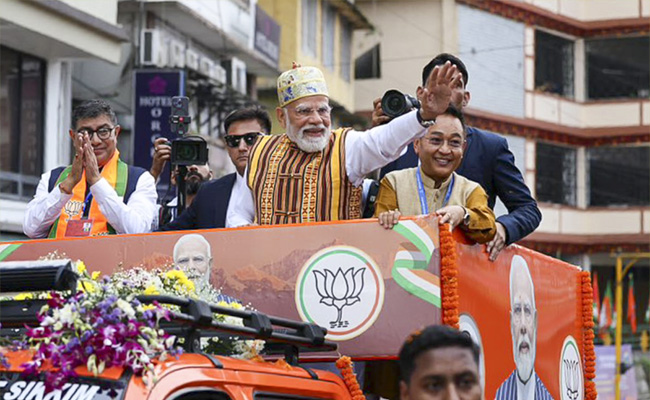
Gangtok (PTI): Prime Minister Narendra Modi led a mega roadshow in Gangtok on Monday evening after arriving in Sikkim to attend the closing ceremony of 50 years of statehood celebrations.
Modi, who wore a traditional Bhutia cap and a Lepcha coat, was received at the Libing helipad by Governor Om Prakash Mathur and Chief Minister Prem Singh Tamang.
From the helipad, the PM began the roadshow, which concluded at Lok Bhavan, where he will stay overnight.
On the open vehicle, Modi was flanked by CM Tamang on his left and state BJP president D R Thapa on his right.
Large crowds lined the roads for hours, waving national flags and waiting to catch a glimpse of the Prime Minister.
As his convoy moved slowly through the city, people broke into celebrations. Some enthusiastic supporters chanted "Modi, Modi, Modi", while a few women were seen showering flower petals in his direction.
Modi acknowledged the cheering crowds by waving continuously.
Tamang was also seen urging the gathered people to cheer for the PM during the roadshow.
The route of the roadshow was decorated, with arch gates erected at several points and large cut-outs of Modi placed along the roads.
On Tuesday, Modi will visit the Orchidarium in Gangtok. To commemorate the golden jubilee of Sikkim's statehood and showcase the state's ecological and floral heritage, the 'Swarnajayanti Maitri Manjari' Park has been developed as a world-class Orchid Experience Centre.
The PM will also participate in the closing ceremony of Sikkim's 50th statehood celebrations at Paljor Stadium, where he will unveil development projects worth over Rs 4,000 crore.
The projects cover several sectors, including infrastructure, connectivity, healthcare, education, power, urban development, environment, tourism and agriculture.
Modi is also scheduled to address the gathering on the occasion.
He was expected to attend the opening ceremony of the year-long celebrations last year, but could not reach the venue due to inclement weather. However, he addressed the event virtually from Siliguri in neighbouring West Bengal.
Tamang later thanked the people for giving the grand reception to the PM during the hour-long roadshow in the state capital.
"With immense fervour and heartfelt enthusiasm, the people of Sikkim accorded a grand and resounding welcome to Hon’ble Prime Minister Shri Narendra Modi ji on his arrival in Gangtok," he said in a social media post.
Tamang said people from all walks of life gathered in large numbers to greet him, reflecting the deep respect and warm affection the people of Sikkim hold for his leadership.
"It was indeed an honour to join him during the roadshow and witness the overwhelming love and support of the people firsthand," he said.