No major impact on normal life due to one-day nationwide strike call
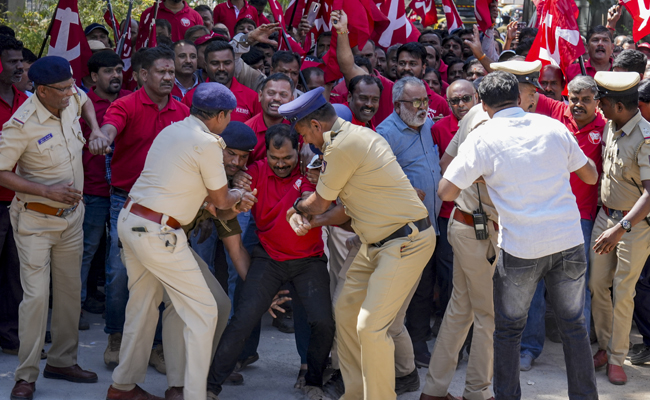
New Delhi (PTI): Normal life largely remained unaffected by the strike call given by a joint forum of central trade unions across the country on Thursday to protest against the alleged "anti-worker, anti-farmer and anti-national pro-corporate policies of the central government".
According to reports, a mixed response was seen in states including Odisha, Kerala, Tamil Nadu, Goa, Jharkhand, Chhattisgarh, Madhya Pradesh and Punjab.
Normal life was affected in Odisha due to a 12-hour nationwide agitation, as per reports.
Public transport, markets, educational institutions, and business establishments were affected as major roads, including national and state highways, were blocked.
The bandh's impact was felt in all major urban areas, including Bhubaneswar, Cuttack, Balasore, Berhampur and Sambalpur.
In Jharkhand, banking, insurance and coal sectors have been affected by the strike, Bank of India (BOI) Employees' Union state Deputy General Secretary Umesh Das said.
Left parties and the Congress have also extended their support to the strike in the state.
In Chhattisgarh, several nationalised banks remained closed as employees joined the strike. Staff of insurance companies, post offices, along with labourers and farmers, also participated in the agitation, affecting operations in their respective sectors. Mining activities in the mineral-rich state were partially hit.
However, transport services in the state functioned normally, and shops, markets and most business establishments remained open.
Normal life was largely unaffected in many areas, including Durg district in Chhattisgarh, where operations at the Bhilai Steel Plant continued as usual.
Normalcy was affected in port operations in Tamil Nadu, and workers staged protests. Port operations in Thoothukudi and Chennai bore the brunt of the agitation.
The industrial hub of Sriperumbudur also witnessed significant activity as workers from several manufacturing units held gate meetings and demonstrations in solidarity with the strike.
While production in some major automobile and electronic facilities continued with reduced manpower, the movement of goods in the Sriperumbudur-Oragadam industrial belt faced delays due to the scarcity of transport vehicles.
In Kerala, though the state government declared a dies-non (a day when no legal business is carried on) for government employees, attendance at offices was expected to remain low as transport vehicles remained off the roads.
Apart from government offices, shops and businesses were also likely to remain closed due to the nationwide 24-hour strike.
Travellers were among the worst affected, with KSRTC and private buses remaining off the roads.
Auto-rickshaw unions also announced that they would not operate during the strike.
Punjab's ruling party, AAP, has extended support to the nationwide strike.
The party announced that its cadre across Punjab and the rest of the country would join the shutdown shoulder-to-shoulder with workers and farmers.
The agitation drew a mixed response in Goa, with banking operations affected while essential services remained undisrupted. Nationalised banks and offices of many insurance companies remained shut in the coastal state.
Over 25,000 civilian employees working with defence establishments across Madhya Pradesh reported to work an hour late on Thursday to support the strike. Markets, schools and colleges remained open across the state.
The strike call failed to evoke any response in West Bengal as vehicles plied normally and state government and private offices recorded usual turnout.
Similarly, the strike call failed to evoke much response in Tripura. Government offices, banks, educational institutions, and markets remained open, while road transport and train services operated as usual across the state.
It had little impact in Gujarat, with most services and commercial establishments functioning as usual across the state.
Normal life remained largely unaffected in major cities, including Ahmedabad, Surat, Vadodara and Rajkot.
Markets, shops, industrial units and educational institutions operated without disruption, while public transport services and autorickshaws ran without any problem.
The joint forum of trade unions has claimed that 30 crore workers are being mobilised for a "general strike" to protest against the new Labour Codes, among other issues.
All India Trade Union Congress General Secretary Amarjeet Kaur told PTI that the general strike has started across the country on Thursday morning, and that she has received reports of agitation from states, including Assam, Tamil Nadu, Pondicherry, Kerala, Odisha and Bihar.
She also informed about the processions in the industrial areas of New Delhi and that traffic on the roads is relatively light.
Kaur said banking, insurance, postal, transport, health, coal and non-coal mines, gas pipeline and electricity sectors will be affected by the strike.
She further said the farmers’ unions are also holding protests in their respective areas.
The trade unions’ immediate demands include the scrapping of four Labour Codes and rules, withdrawal of the Draft Seed Bill and Electricity Amendment Bill, and the ''Sustainable Harnessing and Advancement of Nuclear Energy for Transforming India (SHANTI) Act''.
The unions are also demanding the restoration of MGNREGA and the scrapping of the Viksit Bharat – Guarantee for Rozgar and Ajeevika Mission (Gramin) Act, 2025. The joint forum includes INTUC, AITUC, HMS, CITU, AIUTUC, SEWA, AICCTU, LPF and UTUC.
Let the Truth be known. If you read VB and like VB, please be a VB Supporter and Help us deliver the Truth to one and all.
Delhi: Father, son held for killing 19-year-old woman in suspected honour killing

New Delhi (PTI): The Delhi Police has arrested a man and his son for allegedly murdering his 19-year-old daughter in west Delhi's Hari Nagar area, an official said on Friday.
The case first came to light on April 1 after a PCR call was received around 2 pm, alleging that a woman had been killed by her family members and her body was being taken for last rites, he said.
The accused, identified as Mohammad Maneer (55), a vegetable vendor, and his son Meraj Ali (19), were arrested in connection with the case, the officer said.
The victim had been in a relationship with a man from her native place for the past two years, which was opposed by her father, Maneer and brother Meraj, he said.
"When the girl did not end the relationship despite objections, the family killed her," the officer said.
On April 1, the police said that when their team reached the spot, they found that the woman's body was being taken for burial.
Acting on the input, the burial process was stopped over suspicion of honour killing.
"Police intercepted the family members and took possession of the body," he said.
Police said that the man who had made the PCR told them that the woman was in love with his cousin.
During the inquiry, police also interacted with the PCR caller, who said his cousin, a friend of the deceased, had informed him about the situation and suspected foul play, prompting him to alert the police control room.
The body of the woman was subsequently shifted to the mortuary of Deen Dayal Upadhyay Hospital for preservation and postmortem.
Police said that both the crime team and the forensic science laboratory (FSL) team were called to inspect the scene and collect evidence.
Police said that, as per the postmortem report, the cause of death was identified as smothering, indicating that the woman was suffocated.
A preliminary inquiry also revealed that the family had initiated preparations for the last rites soon after the woman's death, raising suspicion about the circumstances.
Initial investigation pointed to the family's opposition to the woman's relationship.
"The family members of the woman saw her with the man, and she was taken back home. We got to know that she was beaten up and even locked inside the house for some days," a source said.
Further investigation into the matter is underway, police added.