No monopoly over 'Chur Chur Naan', 'Amritsari Chur Chur Naan' as they are generic: Delhi High Court
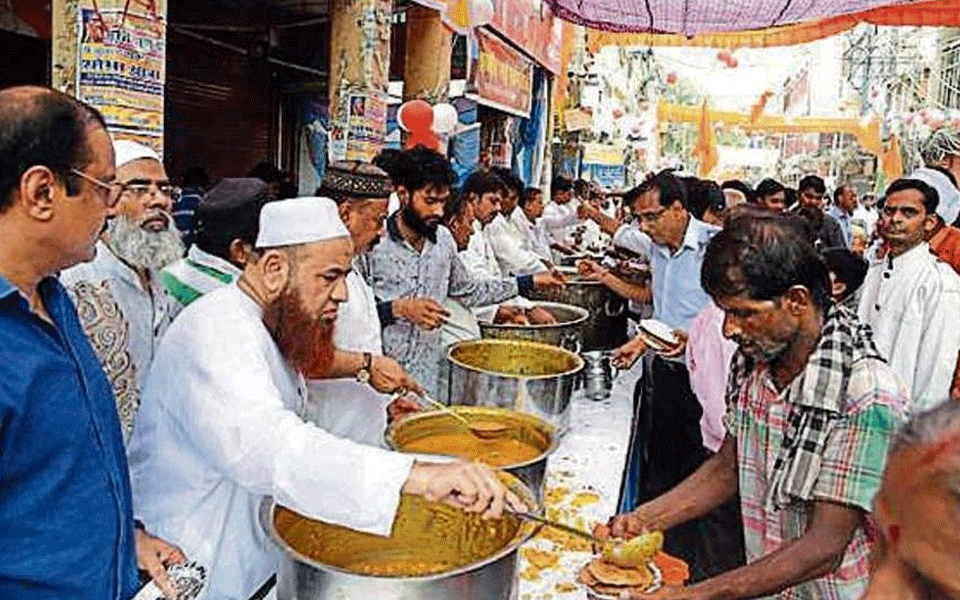
New Delhi: There cannot be any monopoly over the terms 'Chur Chur Naan' and 'Amritsari Chur Chur Naan' as they are "completely generic", the Delhi High Court has held.
The court said the word 'Chur Chur' merely means "crushed" and 'Chur Chur Naan' means "crushed Naan" and nothing more, and it is incapable of acquiring trademark signification.
Justice Prathiba M Singh passed the order while hearing a plea filed by Praveen Kumar Jain, the owner of an outlet in Paharganj here that sells naan and other food items.
He had claimed exclusive rights on the expression 'Chur Chur Naan' as he had the registration for it. Jain had filed the suit for alleged trademark infringement against another outlet which uses a similar expression.
The court said if registrations are wrongly granted or applied for such generic expressions, it cannot ignore it. It said these terms are used in normal conversational language and there cannot be any monopoly in respect of such an expression.
"'Chur Chur' is a terminology which is used in normal conversational language and there cannot be any monopoly in respect of an expression such as 'Chur Chur'.
"The plaintiff has obtained registration of the marks 'Chur chur Naan, Amritsari Chur Chur Naan', but the same would not in any manner prevent the bonafide description of the character of the naan which is crushed, that is, 'chur chur'," the court said.
The counsel for the defendants, against whom the suit was filed, contended that no monopoly can be granted to such generic expressions as there were a large number of outlets which use the name 'Chur Chur Naan' and they also submitted that the trademarks of Jain are liable to be rectified as they lack basic distinctiveness.
The court said the defendants have been able to show entries on various websites such as Zomato, Justdial and Eattreat where third parties are using 'Chur Chur Naan' and 'Amritsari Chur Chur Naan' with several prefixes and suffixes.
"The defendants have also shown on record that it is the common practice in the trade for food outlets to use names such as Chandni Chowk Ke Mashoor, Dilli Ke Mashoor, Delhi Walo Ki Mashoor etc.
"The same are very common to the trade and are used by a large number of parties as is evident from the entries from third party websites which are placed on record. Thus, there cannot be any monopoly on the terms 'Chur Chur Naan and Amritsari Chur Chur Naan as the same are generic," Justice Singh said.
The court, at the outset, observed in the order that delicacies sold on the streets of Delhi are legendary.
Whether it is Chandni chowk for its Paranthewali Gali, Paharganj and Karol Bagh for their eateries, Kamla Nagar for its chaat, Connaught Place and Pandara road for their restaurants, Jama Masjid and Nizamuddin areas for their Mughlai cuisine, regional food at the various bhavans - these food outlets have been catering to consumers from all walks of life.
The defendants, who were present in the court, agreed to change the name of their outlets to 'Paharganj seth ke mashoor chur chur naan and Paharganj Seth Ke Mashoor Amritsari Naan.
The court permitted them 30 days time to change over to the new names.
It then posted the matter for September 11 for further hearing.
Let the Truth be known. If you read VB and like VB, please be a VB Supporter and Help us deliver the Truth to one and all.
UP man gets life term for electrocuting mentally challenged wife to death in Bareilly

Bareilly (UP) (PTI): A local court here has sentenced a man to life imprisonment for murdering his mentally challenged wife by repeatedly electrocuting her while she was tied to a cot, lawyers said on Thursday.
Additional district government counsel Harendra Singh Rathore said Additional Sessions Judge Avinash Kumar Singh on Wednesday convicted Vinod Kumar (45) for killing his wife, Satyavati, in Chaina village of Bareilly district and imposed a fine of Rs 15,000 on him.
According to the prosecution, he was allegedly frustrated with his wife Satyavati's mental illness and often assaulted her.
Rathore said the prosecution examined nine witnesses to establish the charges against him.
As per court records, on the night of May 1-2, 2022, when Satyavati was asleep, Vinod tied her hands and legs to a cot using ropes and then connected an aluminium cable to an electric board to repeatedly administer electric shocks to her.
"She writhed in pain, but the accused continued to electrocute her until she died," the prosecution said.
The court observed that the murder was carried out in an inhuman manner.
After committing the crime, the accused threw the rope and cable on the roof and left for work at a brick kiln around 2 am to create a false alibi.
He later tried to mislead the police and the victim's family by claiming that Satyavati, whose mental condition was unstable, had accidentally died by suicide after grabbing a live electric wire.
However, the victim's brother, Sanjeev, a resident of Shahjahanpur district, suspected foul play and lodged an FIR under sections 498A (husband subjecting wife to cruelty) and 302 (murder) of the Indian Penal Code at Nawabganj police station.
During the trial, the prosecution relied on the post-mortem report prepared by Dr Faraz Anwar, who stated that multiple electrocution marks found on different parts of the victim's body could not have been self-inflicted.
The police also recovered the rope and electric wire used in the crime on the accused's identification, officials said.