No written exams till class 2, assessment should not cause additional burden for children: Draft NCF
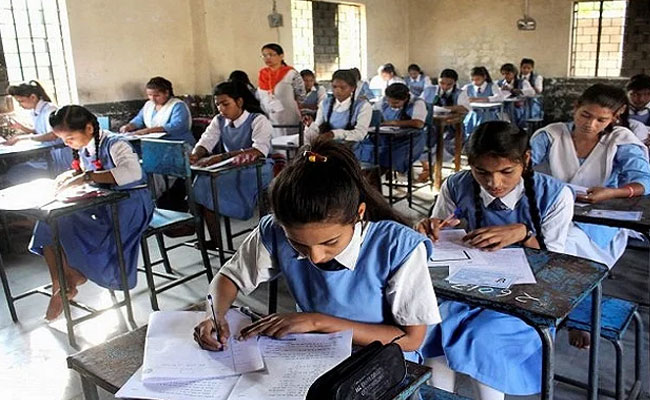
New Delhi (PTI): Explicit tests and exams are completely inappropriate assessment tools for children up to class 2 and written tests should be introduced from class 3 onwards, the draft National Curriculum Framework (NCF) has recommended stressing that assessment methods should be such that they do not contribute to any additional burden for the child.
The framework which is being developed on the lines of new National Education Policy (NEP) suggests that two important methods of assessment that are appropriate for the foundational stage are observations of the child and analysing artefacts that the child has produced as part of their learning experience.
The draft notes that explicit tests and examinations are completely inappropriate assessment tools for the Foundational stage (preschool to class 2).
"Assessment should allow for diversity among children and in their learning. Children learn differently and express their learning differently too. There might be many ways to assess the achievement of a learning outcome or competency. The teacher should have the ability to design different kinds of assessment for the same learning outcome and use each assessment appropriately.
"Assessment should enable recording and documentation. Children's progress should be described and analysed through systematic collection of evidence. Assessment should not contribute to any additional burden for the child. Assessment tools and processes should be designed such that they are a natural extension of the learning experience for the child," it adds.
Describing the assessment for preparatory stage (class 3 to 5), the draft recommends that "written tests should be introduced at this stage".
"A variety of assessment methods should be used to promote learning. Portfolios can be used to capture student progress holistically through their work. This could also provide a reliable picture of their learning to parents. Peer and self-assessments could also be introduced to help students monitor the trajectory of their own learning.
"At the end of the preparatory stage, there should be a comprehensive summative assessment of the student's readiness to enter the middle stage where several new curricular areas are introduced," it adds.
The education ministry released a "pre-draft" of the NCF for school education on Thursday and invited suggestions from stakeholders such as students, parents, teachers and scholars.
The draft prepared by a panel headed by K Kasturirangan, former ISRO chief, suggests that at the middle stage (class 6 to 8), the focus of the curriculum should move to conceptual understanding and higher order capacities.
"Therefore, classroom assessment techniques such as projects, debates, presentations, experiments, investigations, role plays, journals and portfolios should be used to assess learning. Regular summative assessments at this stage will help students synthesize their learning at logical intervals such as year-end, term-end, unit-end. Summative assessments comprising multiple-choice questions and constructed responses like short and long answer, may be used periodically," it says.
In the secondary stage (class 9 to 12), the panel has asserted that comprehensive classroom assessments should be effectively practised for facilitating meaningful learning and constructive feedback. Regular summative assessments should be conducted for recording students learning against competencies.
"Self-assessment will play a key role in student learning at this stage. Students should be facilitated to monitor what they are learning and use the feedback from this monitoring to adjust, adapt, and decide their own strategies for learning.
"Summative assessments can be designed using case-based questions, simulations, and essay-type questions to enable assessment of competencies. At this stage, students should also be prepared to undertake the board examinations and other selection tests to gain access to higher education and livelihood opportunities," the draft adds.
According to ministry officials, the textbooks as per the new NCF will be introduced from next year.
The Education Ministry has designed four NCFs based on the 5+3+3+4 curricular and pedagogical' structure that NEP 2020 has recommended for school education.
The ministry launched the NCF for foundational stage (NCF-FS) for children between ages 3-8 years in October 2022. In continuation of that policy, the next NCF for school education is being prepared.
Revamping class 10 and 12 board exams, aligning the shift from 10+2 structure to 5+3+3+4 structure and emphasis on developmental perspectives suggesting curricular and pedagogical shifts at different stages - foundational, preparatory, middle and secondary - are among the recommendations made in the pre-draft.
The NCF has been revised four times - in 1975, 1988, 2000 and 2005. The new proposed revision will be the fifth of the framework.
Let the Truth be known. If you read VB and like VB, please be a VB Supporter and Help us deliver the Truth to one and all.
Mass funeral of four brothers leaves UAE community in mourning after fatal road accident
Report: Thufail Muhammad Abudhabi
Dubai: The funeral of four young brothers who died in a tragic road accident near Abu Dhabi drew hundreds of mourners to the Al Qusais cemetery on Tuesday evening, leaving the UAE’s expatriate community in deep shock and grief.
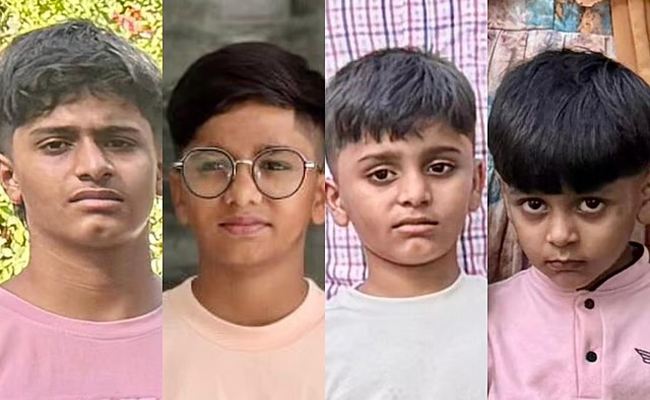
The children Ashaj (14), Ammar (12), Azaam (8) and Ayyash (5) were the sons of Abdul Latheef and Ruksana, natives of Kerala’s Malappuram district. The family was returning to their Dubai residence after attending the Liwa Festival on the outskirts of Abu Dhabi when their car met with a fatal accident early Sunday morning.
Three of the children died on the spot, while Azaam succumbed to his injuries on Monday evening during treatment. The family’s domestic helper, Bushra Fayaz (49), also lost her life in the crash. Her body was repatriated to India on Monday night, and funeral rites were held in Kerala on Tuesday.
Abdul Latheef, who sustained injuries in the accident, arrived at the cemetery from Abu Dhabi in a wheelchair, his hand in a sling, to attend the burial of his sons. Mourners described the scene as one of the most heartbreaking they had ever witnessed.
“I have never seen the mass burial of children from the same family. It was devastating for everyone present,” said a social worker who assisted the family.
The couple’s only daughter, Izza (10), survived the accident with minor injuries and is undergoing treatment. Unaware of the loss of her brothers, she was seen playing on a mobile phone from her hospital bed.
Relatives said informing the parents about the tragedy was handled with extreme care. Abdul Latheef was told late on Sunday night, while Ruksana who had undergone surgery for an injury to her hand was informed only on Tuesday after counsellors were brought in to break the news professionally.
Before the burial, the parents were allowed to see their children one last time. Ruksana was taken by ambulance to the mortuary, while Abdul Latheef obtained special permission for temporary discharge from hospital to attend the funeral. Ruksana remained hospitalised with her daughter.
Though the family holds Ras Al Khaimah visas, special permission was obtained to conduct the burial in Dubai, where the family resides and where most relatives are based. Community members expressed gratitude to the Dubai authorities for facilitating the process.
Abdul Latheef runs a business in Ras Al Khaimah, while Ruksana works as a property consultant in Dubai. All five children were students of Arab Unity School in Dubai, following the British curriculum. The school management issued a circular to parents outlining measures to support students and families affected by the tragedy and advising on how to discuss the loss sensitively with children.
The cause of the accident has not yet been officially confirmed by Abu Dhabi Police. Public discussions have pointed to possible factors such as dense winter fog and overspeeding, though authorities are yet to release findings.