Not all disputes suited for courtrooms; mediation is mode for redressal: CJI
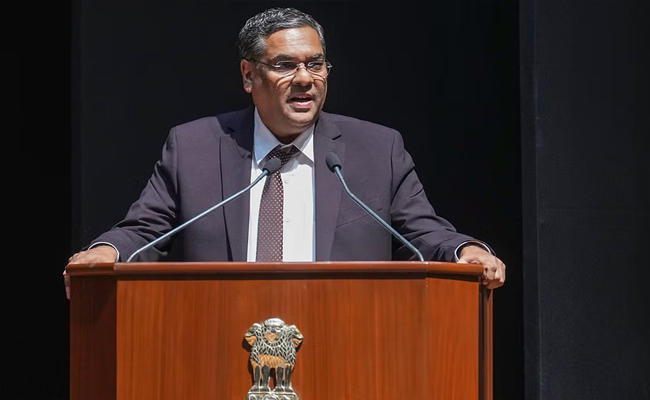
Mumbai (PTI): Chief Justice of India (CJI) Sanjiv Khanna on Saturday said not all disputes are suited for courtrooms and litigations, and asserted that mediation is the mode for redressal as it offers creative solutions and strengthens relationships.
Speaking at the third convocation ceremony of the Maharashtra National Law University (MNLU) in Nagpur, he said each case has to be seen not from the eyes of legal issues but as a human story.
Indian legal aid structure is perhaps the most robust in the world where assistance is given to all the stakeholders, he noted.
"Not all disputes are suited for courtrooms, litigation or even arbitration. Mediation is the mode for redressal that offers us more than just dispute resolution," the CJI said.
It opens doors to creative solutions beyond simple yes or no answers, he said.
By choosing this path, we not only resolve conflicts efficiently, but also strengthen relationships between people and businesses, he said.
CJI Khanna added that lawyers are the problem solvers who have to come up with creative solutions that address both the legal and human dimensions of the problem.
"Just as problems cannot be fixed into boxes, neither can their solutions. As our problems keep becoming more dynamic, the need for their solutions has to be more flexible. The road to justice itself cannot be a hurdle to achieve it," he said.
The CJI urged everyone to think beyond the convention and broaden their horizons to make justice delivery cost-effective and time-bound.
He said the generation today faces challenges that our predecessors hardly imagined, like climate change that threatens not only our environment but the very fabric of human rights and social justice, and digital evolution that raises unprecedented questions about privacy, security and nature of human interaction.
Democracy is itself being reshaped by new technologies and social dynamics, the CJI said.
"These aren't just abstract problems. They are very fundamental challenges to humanity, human dignity and liberty that require innovative solutions," he said.
The Indian legal aid structure is perhaps the most robust in the world where assistance is given to all the stakeholders - the accused and the victims, he said.
Combination of a robust legal aid framework and the energy of young lawyers has the potential to make India a world leader in accessibility, the Chief Justice said.
Also speaking at the event, Supreme Court judge Justice B R Gavai, also the Chancellor of the MNLU, expressed gratitude for the support extended by the state government to establish the university.
"I must place on record my appreciation for the valuable assistance provided by Devendra Fadnavis, the then Chief Minister of Maharashtra and also the present as well as Uddhav Thackeray, who was also the chief minister of Maharashtra," Justice Gavai said.
Let the Truth be known. If you read VB and like VB, please be a VB Supporter and Help us deliver the Truth to one and all.
Over 17,000 people went missing in Delhi in 2024: NCRB
New Delhi (PTI): A total of 23,058 people, comprising 9,482 men and 13,576 women, were reported missing in Delhi in 2024, according to the latest National Crime Records Bureau (NCRB).
Of the total, 5,491 were children below the age of 18 — 1,571 boys, 3,920 girls.
The city recorded 17,567 fresh adult missing persons cases in 2024, comprising 7,911 men and 9,656 women.
According to the NCRB data, released on Wednesday, 14,637 men, 18,238 women and six transgender persons were still missing from previous years.
At the latest count, in 2024, Delhi had a total of 55,939 missing persons cases — 24,119 men, 31,814 women and six transgender persons.
In 2024, police traced or collected 28,392 missing persons, including 12,182 men, 16,208 women and two transgender persons.
Only half of the men and half of the women who went missing could be traced.
A total of 27,547 missing persons – 11,937 men, 15,606 women, four transgender persons — were yet to be untraced by the end of the year, the data showed.
The data also revealed that 5,352 children from previous years remained untraced at the beginning of 2024.
The number of still missing boys was 1,621, and the number of missing girls was 3,729. Two transgender children were yet to be found.
After adding the pending cases from previous years, the total number of missing children cases handled in 2024 rose to 10,843.
The police traced or recovered 6,762 missing children — 2,030 boys, 4,732 girls.
The recovery rate stood at 63.6 per cent for boys and 61.9 per cent for girls, while no transgender child was traced.
By the end of 2024, a total of 4,081 children remained untraced, 1,162 of them boys, 2,917 girls, and two transgender children.