‘Not allowing’ Nitish to speak at NDA's manifesto release insult to Bihar, claims Congress
Patna, Oct 31 (PTI): The Congress on Friday slammed NDA leaders for “not allowing” Chief Minister Nitish Kumar to speak at the release of the ruling coalition’s manifesto for the state assembly polls, claiming it was “an insult to Bihar and Biharis”.
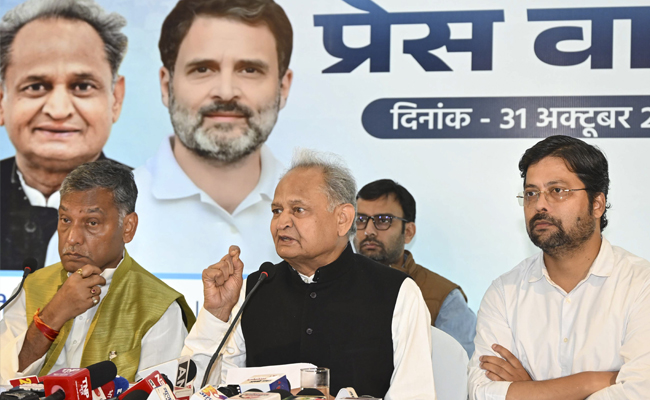
Talking to reporters here, senior Congress leader Ashok Gehlot also claimed that the NDA’s manifesto release programme lasted only “26 seconds”, as the leaders were afraid of facing questions from journalists about their 20-year rule.
CM Nitish Kumar, his deputy Samrat Choudhary, BJP president JP Nadda, Union ministers Dharmendra Pradhan, Jitan Ram Manjhi, Chirag Paswan and other leaders of alliance partners released the NDA’s manifesto in less than a minute.
All then left the venue, except the deputy CM who remained and answered a few questions from journalists.
An announcement was made from the dais that the leaders had to leave as they had poll-related engagements.
"The NDA leaders came to the press conference which lasted merely 26 seconds. They were afraid to face questions from journalists on the manifesto, as well as on their governance,” Gehlot said.
The CM was “not allowed” to speak at the release of the manifesto, Gehlot claimed, and wondered whether he was "not in a position" to speak about it.
Congress Rajya Sabha MP Akhilesh Prasad Singh, who is also present at Gehlot’s press meet, said, “Nitish Kumar was not allowed to speak on the manifesto. It was disrespect for Bihar and Biharis.”
In the manifesto, the NDA promised jobs to one crore youth, making of one crore 'Lakhpathi Didi', metro train services in four more cities and seven international airports in the state. Seven expressways, 10 industrial parks, free quality education from KG to PG and Rs 2000 aid per month for SC students pursuing higher education are some of the other features of the manifesto.
“The NDA's manifesto is a string of lies. We will highlight this in our public rallies, and demand a report card of the 20 years of NDA rule," Gehlot said.
The NDA leaders should have begun their press conference with the report card, he said.
Let the Truth be known. If you read VB and like VB, please be a VB Supporter and Help us deliver the Truth to one and all.
Annpurna Devi expresses anguish over girl's rape in TN, urges NCW to act
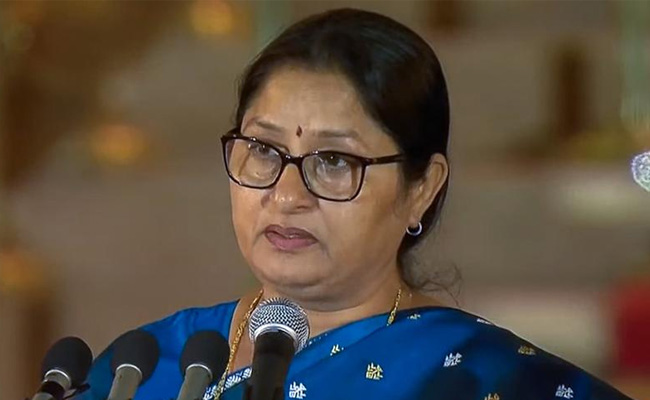
New Delhi (PTI): Union Minister for Women and Child Development Annpurna Devi on Tuesday expressed her anguish over the alleged gang rape of a girl in Tamil Nadu and urged the National Commission for Women to take immediate cognisance of the matter.
In a post on X, Devi said, "Deeply anguished by this horrific incident. I urge the NCW to take immediate cognisance and act swiftly in coordination with the concerned authorities to ensure the strictest action against all culprits."
Devi said, "Justice must be swift and unsparing — the accused must be brought to book without delay," adding, "the safety, dignity, and justice of every daughter of India remain our highest priority."
"We stand firmly with the survivor and her family in this difficult hour," she said.
Reacting to a post by former Tamil Nadu BJP president K Annamalai, who flagged concerns over the law and order situation in the state, Devi said such incidents "expose grave concerns" under the Dravida Munnetra Kazhagam government.
Annamalai, in his post, alleged that a 15-year-old girl from Kanchipuram, who had come to participate in a temple festival near Seyyaru in Tiruvannamalai district, was gangraped.
He said the incident was "deeply shocking and enraging" to him and alleged that such crimes point to a "complete failure" of law and order in Tamil Nadu.
Annamalai demanded immediate arrest of all those involved and the "harshest punishments" for the accused.
He also called for full protection and mental health counselling for the survivor and her family.