'Not as fragile as flowers': SC raps BJP Nishikant Dubey for 'scandalous' remarks on judiciary, CJI
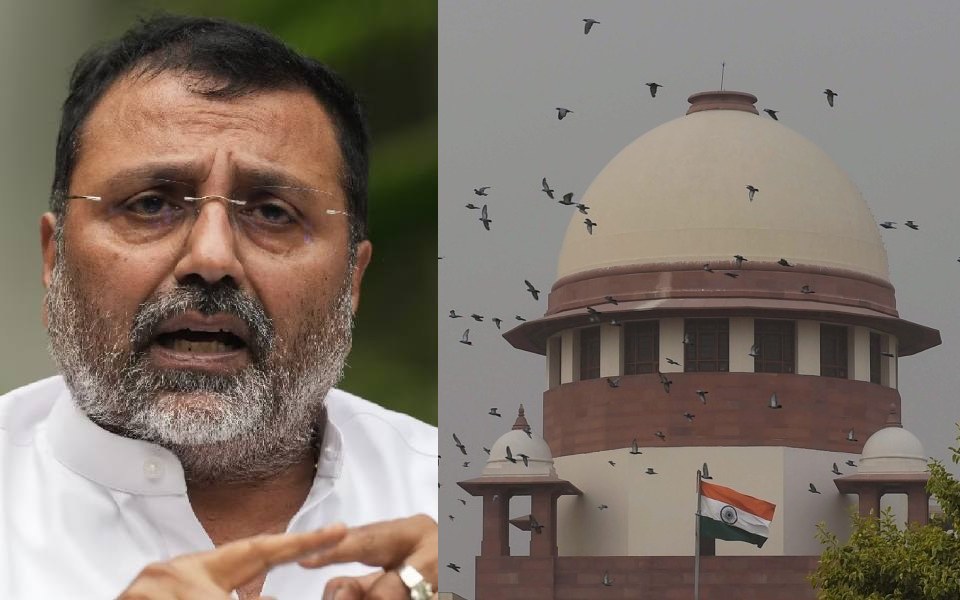
New Delhi, May 8 (PTI): The Supreme Court has rapped BJP MP Nishikant Dubey for his remarks against it and Chief Justice of India Sanjiv Khanna, saying they tend to “scandalise” and lower the authority of apex court.
The top court, in a way, put an end to recent political debates as to who is supreme whether Parliament or the judiciary.
“It is the Constitution that is higher than all of us. It is the Constitution which imposes limits and restrictions on the powers vested in the three organs. The power of judicial review is conferred by the Constitution on the judiciary. Statutes are subject to judicial review to test their constitutionality as well as for judicial interpretation. Therefore, when the constitutional courts exercise their power of judicial review, they act within the framework of the Constitution,” a bench of CJI and Justice Sanjay Kumar said.
The top court, which spared the lawmaker from the contempt proceedings by dismissing a PIL, made scathing observations against Dubey for his remarks against it and the CJI following the hearings on a batch of petitions challenging the validity of 2025 Waqf law.
Dubey sparked a row when he said, “(the) Supreme Court is taking the country towards anarchy” and that “Chief Justice of India Sanjiv Khanna is responsible for the civil wars taking place in the country”.
“We have examined the contents of the assertions made by respondent 4 (Dubey), which no doubt tend to scandalise and lower the authority of the Supreme Court, if not interfere or tend to interfere with the judicial proceedings pending before this Court, and have the tendency to interfere and obstruct the administration of justice,” the CJI said in the order.
The bench further said, “We are of the firm opinion that courts are not as fragile as flowers to wither and wilt under such ludicrous statements.”
The comments were stated to be "highly irresponsible", reflecting a penchant to attract attention by casting aspersions on the Supreme Court of India and its judges.
The bench on May 5 heard a plea for contempt action against Dubey over his remarks and said they were the ones who heard the petitions against the amended Waqf law.
The court found a clear intent to impute motives to the bench by naming the CJI as responsible for "all the civil wars happening in India in order to incite religious wars in this country, it is only and only the Supreme Court that is responsible".
Judicial pronouncements result in a decision which may aggrieve a party or sometimes a section of the public, it clarified.
The top court, however, acknowledged critical analysis and objective criticism of an order's reasoning or even its outcome was protected under the fundamental right to free speech and expression under Article 19(1) of the Constitution.
The bench said Dubey's utterances showed his ignorance about the role of the constitutional courts and the duties and obligations bestowed on them under the Constitution.
“We do not believe that the confidence in and credibility of the courts in the eyes of the public can be shaken by such absurd statements, though it can be said without the shadow of doubt that there is a desire and deliberate attempt to do so,” it said.
Justifying its decision to dismiss the PIL filed by lawyer Vishal Tiwari against the lawmaker, the bench said, “judges are judicious”.
The bench went on, “Courts believe in values like free press, fair trial, judicial fearlessness and community confidence. Thus, courts need not protect their verdicts and decisions by taking recourse to the power of contempt. Surely, courts and judges have shoulders broad enough and an implicit trust that the people would perceive and recognise when criticism or critique is biased, scandalous and ill-intentioned."
Each branch of the state in a democracy, be it the legislature, executive or the judiciary, especially in a constitutional democracy, acts within the framework of the Constitution, it added.
“The judiciary, as an institution, is accountable to the people through various mechanisms....Judgments are put to scrutiny and critique. Decisions are debated and if required, corrected by exercise of right of appeal, review, in curative jurisdiction and by reference to a larger bench,” the top court said.
To deny the power of judicial review to the courts would be to rewrite and negate the Constitution, it added.
“While we are not entertaining the present writ petition, we make it clear that any attempt to spread communal hatred or indulge in hate speech must be dealt with an iron hand,” it noted.
The bench said hate speech couldn't be tolerated as it led to loss of dignity and self-worth of the targeted group members, contributed to disharmony among groups and eroded tolerance and open-mindedness -- must for a multi-cultural society committed to the idea of equality.
Any attempt to cause alienation and humiliation of the targeted group is a criminal offence and must be dealt with accordingly, it added.
Let the Truth be known. If you read VB and like VB, please be a VB Supporter and Help us deliver the Truth to one and all.
EAM Jaishankar meets Jamaican PM, gifts over 10 BHISHM Cubes

Kingston (PTI): External Affairs Minister S Jaishankar on Monday met Jamaican Prime Minister Andrew Holness and discussed ways to further deepen "political, economic and people-to-people cooperation."
Jaishankar also conveyed greetings from Prime Minister Narendra Modi to Holness.
"Pleased to call on Prime Minister @AndrewHolnessJM in Kingston. Conveyed the greetings of PM @narendramodi," Jaishankar posted on X.
"Discussed deepening our political, economic and people-to-people cooperation. Value his commitment towards further strengthening India-Jamaica relations," the post further read.
Also, the external affairs minister handed over 10 BHISHM (Bharat Health Initiative for Sahyog Hita & Maitri) Cubes as a gift to Jamaica.
"Formally handed over 10 BHISHM Cubes as a gift from India to Jamaica, in the presence of PM @AndrewHolnessJM, Health Minister @christufton and FM @kaminajsmith," Jaishankar posted on X.
"The BHISHM Cube mobile hospital system, designed for rapid deployment, will help Jamaica during disasters and emergencies. The gift of these cubes is a statement of friendship, a commitment to disaster preparedness, and an outcome of innovation," the post said.
Jaishankar arrived in Kingston on Saturday evening, marking the first leg of his nine-day tour of Jamaica, Suriname, and Trinidad and Tobago, aimed at further strengthening India's strategic and cultural ties with the Caribbean nations.
Earlier in the day, he interacted with the Indian diaspora and discussed India's ongoing transformation in infrastructure, human development and technology-driven governance and entrepreneurship with them.
He also highlighted the cricket bond between both countries as India gifted a scoreboard to Jamaica.
A scoreboard was dedicated at Sabina Park in Kingston. It is the home of the Jamaica cricket team and is the only Test cricket ground in the Caribbean island nation.
The minister expressed hope that the new scoreboard would witness many memorable innings, including those symbolising the enduring friendship between the two countries.
Cricket has long been a strong cultural bridge between India and Jamaica, which is part of the West Indies cricket team.
Jamaican players, including Chris Gayle, Courtney Walsh and Michael Holding, have played a major role in shaping the legacy of West Indies cricket in the international arena, contributing to its dominance in earlier decades and its continued global appeal.