Not situation, leader's mindset leads to Emergency: Shah
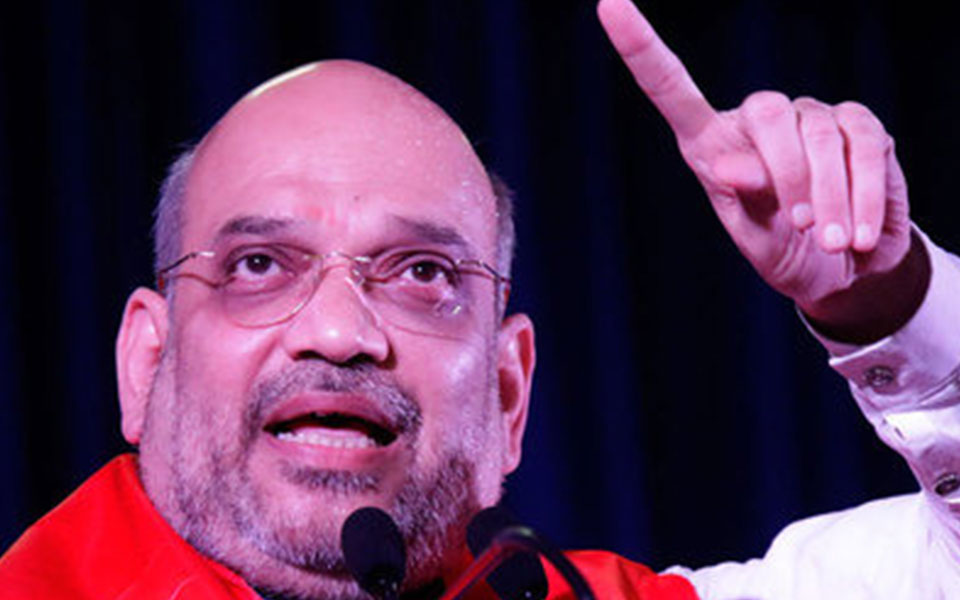
Ahmedabad, June 26: Marking the 43rd anniversary of Emergency imposed by then Prime Minister Indira Gandhi in 1975 as a "Black Day", BJP President Amit Shah on Tuesday said mindset of the leaders and not the prevailing situations lead to an Emergency.
"Emergency does not come because of situations and ordinances, it comes due to the mindset of the leader. Ordinance is just the clothing in which it comes. Only those who do not believe in democracy can think about Emergency," he said addressing party workers here.
Shah said BJP governments too came and went away but the thought of Emergency never crossed their mind.
"We have lost our government for one vote, lost our government in 13 days but never thought about an Emergency. And, when Congress leaders raise concerns about freedom of speech, I urge them to look back when their forefathers crushed democracy in the country," he said.
Congress, which killed internal democracy for dynastic politics, is in no position to promote democracy in the country, Shah said, adding that the party introduced three evils in the country's politics - dynasty, casteism and appeasement - and these led to the Emergency.
"I strongly feel Congress and family members of Indira Gandhi do not have any right to talk about freedom of speech. They jailed 140,000 people for 19 months, put restrictions on all newspapers, Akashwani (All India Radio) had become Sarkarwani (government's mouthpiece)."
Shah said India gave the first republic to the world and it was Congress' Indira Gandhi who first attempted to destroy the country's democracy by imposing Emergency, by using Article 356 to topple opposition governments in the states and by muzzling media and people's voices.
"Emergency is remembered in many ways including as a struggle against the mindset to scuttle democracy. But I wish to say democracy is so deep-rooted in the country that even 100 Indira Gandhis would have failed to wipe out democracy from the country," he said.
Congress leaders who raise questions about freedom of speech should read about the history of June 26, 1975 to understand how their party misused power to destroy the constitutional institutions of the country and what led to the fall of Congress, once a large party, he said.
Shah said it was the responsibility of all who want to protect the country's democracy to strengthen the BJP which is neither a party that follows dynastic politics nor casteism or appeasement.
Let the Truth be known. If you read VB and like VB, please be a VB Supporter and Help us deliver the Truth to one and all.
AIITA welcomes Karnataka’s ban on obscene songs in school events
Bhatkal: The Karnataka unit of the All India Ideal Teachers Association (AIITA) has welcomed the Karnataka government’s decision to strictly ban school children from dancing to obscene songs during educational and cultural programmes in government, aided, and private schools across the state.
AIITA Karnataka State President M. R. Manvi congratulated the government for taking what he termed an important step to preserve the sanctity of education.
“Such decisions to safeguard the dignity of school children and uphold the values of education are the need of the hour. This rule should not be limited to government schools alone but must be strictly implemented in all private educational institutions as well,” he said.
He further urged the government to address other concerns within school programmes.
“The government should not only prohibit obscene dances in the name of school anniversaries, but also ensure that plays and dialogues that incite religious hatred are avoided. Schools should be centres of harmony, not platforms for spreading hatred,” he added.
According to a recent circular issued by the Department of School Education and Literacy, obscene dances are adversely affecting the mental health and moral values of students.
In this regard, schools have been advised to use songs that promote nationalism, positive thinking, the greatness of Kannada culture, and value-based traditions instead of inappropriate content during programmes.
The circular also emphasises that students should be dressed in decent attire.
AIITA also backed the department’s warning that disciplinary action would be taken against head teachers if such guidelines are violated. The association has further demanded that district Deputy Directors of Public Instruction strictly monitor the implementation of these rules.