Nothing wrong in promoting Hindi, other Indian languages in place of English: C T Ravi
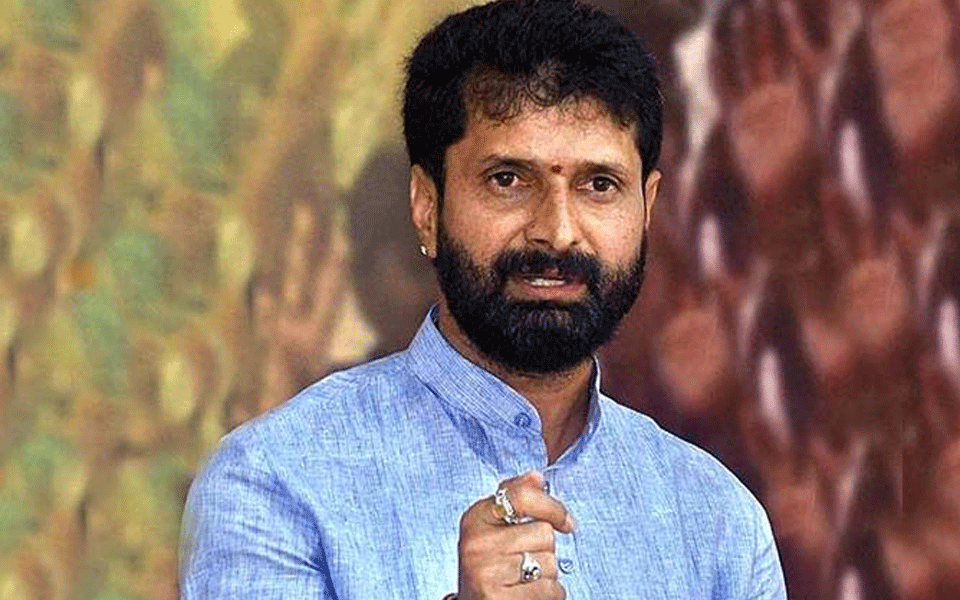
New Delhi, Oct 13: BJP leader C T Ravi on Thursday said there is nothing wrong in encouraging Hindi and regional languages instead of English and claimed that the Narendra Modi-led government has been promoting mother tongues in different parts of the country.
The party's national general secretary, who hails from Karnataka and is in charge of the BJP's affairs in Tamil Nadu, refuted criticism from opposition leaders Kerala Chief Minister Pinarayi Vijayan and Tamil Nadu CM M K Stalin that the Centre was imposing Hindi on non-Hindi speaking states.
He said people should come out of this "colonial mindset" and linked such a mentality to the use of English.
"There is nothing wrong in getting rid of this mindset and behaving like free individuals," Ravi added.
Vijayan had recently taken exception to the recommendations of a parliamentary panel which suggested that the medium of instruction in central technical and non-technical higher education institutes such as IITs in Hindi-speaking states should be Hindi and in the respective local languages elsewhere.
It further said the use of English should be made optional.
The Kerala CM had sought Prime Minister Modi's intervention in the matter.
Ravi said the recommendations promote Hindi in place of English but not in the place of regional languages such as Malayalam, Tamil, Telugu, Kannada or Marathi.
If a leader writes for the "pride of Malayalam or the pride of Tamil", our party welcomes it but if he writes in favour of English, then this is not appropriate, he said.
The BJP leader said leaders like Mahatma Gandhi and Jawaharlal Nehru, too, supported the promotion of Hindi and regional languages.
He also noted that the National Education Policy 2020 finalised by the Centre envisages promotion of Hindi and all other Indian languages.
Let the Truth be known. If you read VB and like VB, please be a VB Supporter and Help us deliver the Truth to one and all.
Gold, silver soar as US-Iran deal hopes lift bullion demand

New Delhi (PTI): Gold prices rebounded by Rs 2,900 to Rs 1.55 lakh per 10 grams in the national capital on Wednesday, while silver climbed to Rs 2.54 lakh per kilogram as easing geopolitical tensions triggered a pullback in oil rates, boosting demand for precious metals.
According to the All India Sarafa Association, the yellow metal of 99.9 per cent purity jumped by Rs 2,900, or nearly 2 per cent, to Rs 1,55,400 per 10 grams (inclusive of all taxes) from Tuesday's closing level of Rs 1,52,500 per 10 grams.
Traders attributed the surge in bullion prices to reports that Washington and Tehran are close to finalising a framework agreement to end months of conflict, raising the prospects of smoother flows through the Strait of Hormuz and easing inflation concerns tied to energy markets.
"Gold rallied strongly on Wednesday as easing geopolitical tensions triggered a sharp reversal in key macro drivers that had recently pressured precious metals," Saumil Gandhi, Senior Analyst - Commodities at HDFC Securities, said.
Silver prices also advanced for the third straight session by rising Rs 3,500, or 1.4 per cent, to Rs 2,54,500 per kg (inclusive of all taxes). The metal had settled at Rs 2,51,000 per kg in the previous session, as per the Association.
"The prospect of a diplomatic breakthrough triggered a steep decline in oil prices and the US dollar, easing concerns about inflation while boosting demand for precious metals," Gandhi said.
Globally, spot gold increased by USD 106.15, or 2.33 per cent, to USD 4,663.70 per ounce while silver gained USD 3.40, or 4.68 per cent, to USD 76.24 per ounce.
"Gold witnessed a sharp rally as markets reacted positively to reports that the US and Iran are moving closer to a one-page agreement framework aimed at ending the conflict," Jateen Trivedi, VP Research Analyst - Commodity and Currency, LKP Securities, said.
Despite strong international gains, rupee strength limited the upside in domestic gold prices. The market is now highly focused on final confirmation and execution of the proposed deal, he added.
Any negative surprise or breakdown in negotiations could trigger a sharp sell-off in gold, while a successful agreement and sustained ceasefire could push the bullion prices higher in the near-term, Trivedi said.