Now you can see what’s 'cooking' in Rail kitchens live
New Delhi, June 15: Union Railway and coal minister Piyush Goyal likes to implement innovative ideas to bring transparency in the system.
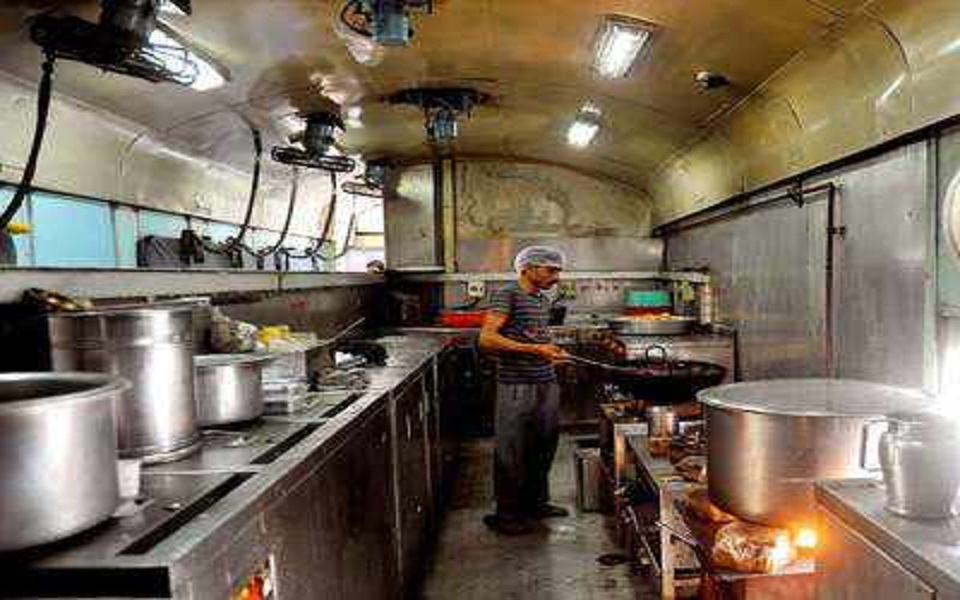
In yet another move, the railway minister has decided to live-stream footage of railway’s ‘base kitchens’ to check cooks from cutting corners and serving poor quality food, a commonplace complaint.
Speaking to the reporters Goyal said that passengers can go to the IRCTC website and watch the live stream. We will develop an app so that passengers can keep an eye on the kitchen while travelling.
So far, cameras have been installed in 16 of the 200 base kitchens of IRCTC, the main caterer for the railways. These include kitchens in Delhi, Mumbai and Bhubaneswar.
Railways Minister also said that a mobile app will also be developed so that passengers travelling in a train can see how food is being cooked in the kitchen. The move has been initiated to keep a check on how the food is cooked.
According to the report, the system implemented by the Indian Railways has the capability to track any discrepancy in the kitchen. While it will help in checking the uniforms worn by kitchen staff members, it will also detect rodents and mopping across kitchens.
Let the Truth be known. If you read VB and like VB, please be a VB Supporter and Help us deliver the Truth to one and all.
Women BJP MLAs protest against opposition in UP assembly premises
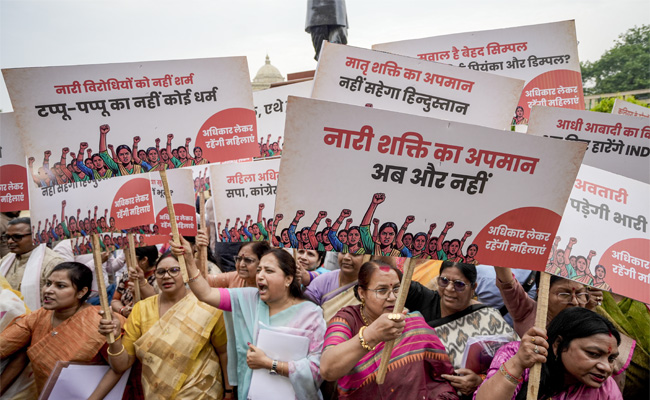
Lucknow (PTI): Women BJP MLAs held a protest in the Vidhan Bhawan complex before the one-day special session of Uttar Pradesh assembly, slamming the opposition for defeating the passage of a bill, which would have led to implementation of the Women's Reservation Law, in the Lok Sabha.
This followed another demonstration by Samajwadi Party MLAs, who alleged that the BJP was misleading public in the name of women's reservation.
The women BJP legislators assembled in front of Chaudhary Charan Singh's statue in the assembly premises, holding banners inscribed with the slogan "Insult to Matrushakti (women's power), India will not tolerate it". The protesting members entered the main hall of Vidhan Bhawan carrying the banners.
Participating in the protest, the state Minister for Women Welfare and Child Development, Baby Rani Maurya, told reporters that all opposition parties, including the Samajwadi Party and the Congress, had opposed the women's reservation, a stance for which they would have to pay a heavy political price.
"On this issue, all of us women stand united. We will ensure that we secure our reservation," she said.
BJP MLA Ketki Singh remarked that their protest represents the collective outrage of millions of women across the state.
Singh asserted that the opposition has betrayed women by creating hurdles in the path of women's reservation. The current demonstration is merely the beginning, and very soon, women from every street, intersection and household will join the protest movement, she said.
Minister Vijaylakshmi Gautam said, "We strongly condemn the despicable act committed by the Samajwadi Party and the Congress in an attempt to hold back 'half the population' (women). Their action was directed against the very bill that Prime Minister Narendra Modi had introduced to empower and strengthen Nari Shakti (women's power), and which he strived to pass expeditiously."
Uttar Pradesh assembly is holding a one-day special session on Thursday. During the session, the government is set to move a censure motion against the opposition parties over their failure to pass the Constitution Amendment Bill, which would have led to implementation of the Women's Reservation Act, in the Lok Sabha.