NPCI blames Cosmos Bank for malware attacks

Mumbai, Aug 15: The National Payments Corp of India (NPCI) on Wednesday held the Cosmos Cooperative Bank Ltd's "own IT environment" responsible for the unprecedented cyber loot which left the Pune-based bank poorer by Rs 94.42 crore.
In a statement here, the NPCI's Head Risk Management, Bharat Panchal, said: "The NPCI's systems are fully secure and this particular issue has occurred within the (Cosmos Bank's) own IT environment.
"This has happened due to malware-based attack on the bank's IT system which has caused a fraud. Under the attack, maximum transactions have been reported from outside India."
He reiterated that the systems of NCPI - the umbrella organisation for operating retail payments and settlement systems in India - "were absolutely secure and it was continuously monitoring the situation arising out of the Cosmos Bank episode".
The Indian banking industry went in shudders on Tuesday after the Cosmos Bank admitted that it had fallen victim to an international group of hackers who siphoned off a total of Rs 94.24 crore in two cyber attacks on August 11 and August 13.
In the first cyber hit, the bank lost Rs 80.50 crore through multiple ATM swipes in 28 countries.
In the second malware assault, the hackers gobbled up Rs 13.92 crore by initiating SWIFT transfers.
Cosmos Bank Chairman Milind A. Kale said that after the malware attack on the critical communication system between various payment gateways was hacked, the hackers' gangs were informed simultaneously in 28 countries and they immediately started the withdrawals, in many cases small amounts of around $100, to avoid rousing suspicions.
He said normally, the Core Banking System (CBS) receives debit card payment requests via its 'Switching System'. But during the malware attack, a proxy switch was created and all the fraudulent payment approvals were passed through the proxy switching system.
Kale said the bank's own servers and other systems were inspected annually by the Reserve Bank of India Audit and System Audit and the bank was ensuring all the measures for data security and this security system was fully operational.
Banking experts and industry players fear this could be a 'pilot run' unless the authorities take it seriously.
Meanwhile, pending investigations, the country's second oldest and second largest cooperative bank (in terms of deposits and advances) has now shut all its ATMs across the country for two days till Thursday to prevent any further incidents.
The consolation was the Kale's assurance that none of the bank's 20 lakh customer accounts across 140 branches in the country have been affected nor would they bear any loss.
Let the Truth be known. If you read VB and like VB, please be a VB Supporter and Help us deliver the Truth to one and all.
TN polls: TVK pushes DMK behind with leads in 83 seats, AIADMK ahead in 54
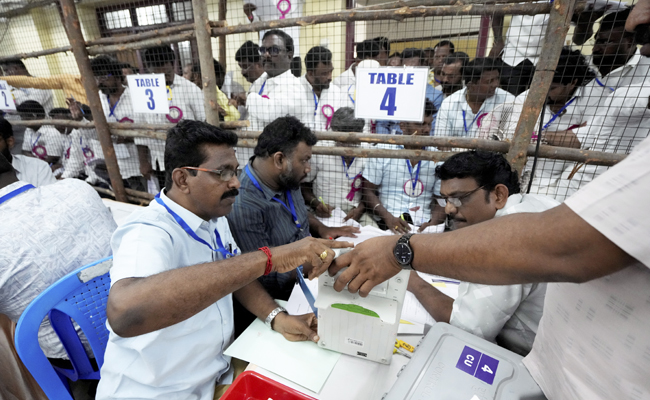
Chennai (PTI): New entrant TVK, led by actor-politician Vijay, was leading in as many as 83 constituencies on Monday when counting of votes polled in the April 23 Assembly polls was on across Tamil Nadu. The AIADMK was leading in 58 seats while the ruling DMK was ahead in 34, EC data showed.
About two hours after the postal ballots were counted and EVMs opened for multi-round counting, Vijay's Tamilaga Vettri Kazhagam surged ahead of its Dravidian rivals-- the DMK and the AIADMK, with the ruling party struggling to catch up.
If the trends maintain, Vijay could as well ensure the biggest electoral upset, something in lines with the "1967,1977" wins he had referred to in his campaign speeches.
While the Dravidian stalwart CN Annadurai brought the first non-Congress government in Tamil Nadu post-independence in 1967, the charismatic MG Ramachandran (MGR) installed the maiden AIADMK government 10 years later, unseating then DMK government under M Karunanidhi. TVK was leading in most Chennai segments, all considered DMK strongholds and currently represented by the party in the 234-member House.
A poor show by DMK could belie most exit polls giving an edge to it, riding on the number of populist measures Chief Minister M K Stalin had implemented in his five year "Dravidian model," inclusive governance.
According to EC and TV reports, 15 cabinet ministers, including Stalin were trailing. His son and deputy CM Udhayanidhi was also behind in his incumbent Chepauk-Tirvuvallikeni seat, according to a number of reports.
Stalin was trailing behind TVK's VS Babu by 1234 votes in Kolathur segment. Vijay was ahead in Tiruchirappalli East by over 3,000 votes at the end of two rounds of counting, according to EC data.
BJP is trailing in 26 constituencies and it is ahead in Thali segment alone. TVK is ahead in constituencies including Ponneri, Tiruvallur, Poonamalle, and Avadi.
AIADMK is leading in segments including Katpadi, and Guidyattam and party chief Edappadi K Palaniswami is ahead in Edappadi segment by 7003 votes.
DMK was leading in segments including Vellore, Anaikattu and Rishivandiyam.