NSE co-location case: Court denies anticipatory bail to Chitra Ramkrishna, pulls up CBI

New Delhi(PTI): A Delhi court on Saturday denied anticipatory bail to the former chief executive officer of National Stock Exchange (NSE), Chitra Ramkrishna, in the NSE co-location case and disapproved of the CBI's "lackadaisical" conduct, saying no action seems to have been taken against the main scam beneficiaries for last four year.
Special Judge Sanjeev Aggarwal observed that the accused were facing grave allegations and the investigation was at the most nascent stage. He also pulled up market regulator Securities and Exchange Board of India (SEBI), saying it had been "too kind and gentle" with the accused.
It has to follow a path towards a journey which has just begun, at the same time the conduct of the investigating agency i.e. CBI is most lackadaisical, to say the least;
"As no action seems to have been taken against main beneficiaries of the present co-location scam, (the names of some of whom are mentioned in the FIR itself) and others for almost four full years, who seems to be enjoying merrily at the expense of common citizenry for the reasons best known, the judge said.
Further even SEBI despite being the capital market watchdog has been too kind and gentle qua the accused persons in the present FIR /RC, the judge noted.
The court rejected the pre-arrest bail application, saying economic offences had deep-rooted conspiracies involving huge loss of public funds.
Since in the present case huge loss of public money may be involved, it needs to be viewed seriously and considered as grave offence(s) affecting the economy of the country as a whole and thereby causing serious threat to the financial health of the country;
"'And since economic offences constitute a class apart, therefore, it needs to be visited with a different approach in the matter of bail as economic offence(s) have deep-rooted conspiracies involving huge loss of public funds, the court said.
It said that the chances of the accused fleeing from justice were remote. However, being in pole position in the NSE earlier, there were strong chances that she may influence and tamper with the evidence, as she was the joint MD as well as MD and CEO of the National Stock Exchange, the role of which is under investigation under the present co-location scam.
There are many facets of the investigations which have to be excavated by the investigating agency after removing the dust of time over them, the judge said.
He said that the magnitude of the present case may be huge, as due to this financial skulduggery, a huge loss may have been caused to adherent stockbrokers, institutional investors, foreign institutional investors and honest investors, whose faith in this premier financial institution, i.e. NSE may have been severely shaken and dented.
Considering the overall facts and circumstances of the case and in view of the grave and serious allegations against the applicant/accused as above, no ground for anticipatory bail is made out at this stage. The same stands dismissed, the judge said.
The CBI had recently questioned Ramkrishna in the matter. The Income Tax (IT) Department earlier raided various premises linked to Chitra Ramkrishna in Mumbai and Chennai.
Ramkrishna has also been on the radar of the SEBI.
Recently the CBI court had sent Anand Subramanian, former Group Operating Officer and advisor to Ramkrishna, to CBI custody.
He was arrested by the CBI from Chennai in connection with the NSE case.
The arrest was made in the case related to the co-location scam, the FIR for which was registered in May 2018, amid fresh revelations about irregularities at the country's largest stock exchange.
The CBI is probing the alleged improper dissemination of information from the computer servers of the market exchanges to the stockbrokers.
Earlier, the SEBI had penalised the NSE, its former CEOs Ramakrishna and Ravi Narayan and two other officials for lapses in recruitment at the senior level.
Ravi Narain was the MD and CEO of the National Stock Exchange from April 1994 till March 2013, while Ramkrishna was the MD and CEO of the NSE from April 2013 to December 2016.
The market regulator observed that the NSE and its top executives violated securities contract norms relating to the appointment of Anand Subramaniam as group operating officer and advisor to the managing director.
Let the Truth be known. If you read VB and like VB, please be a VB Supporter and Help us deliver the Truth to one and all.
Delhi court sentences CBI joint director to 3 months' imprisonment in IRS officer assault case
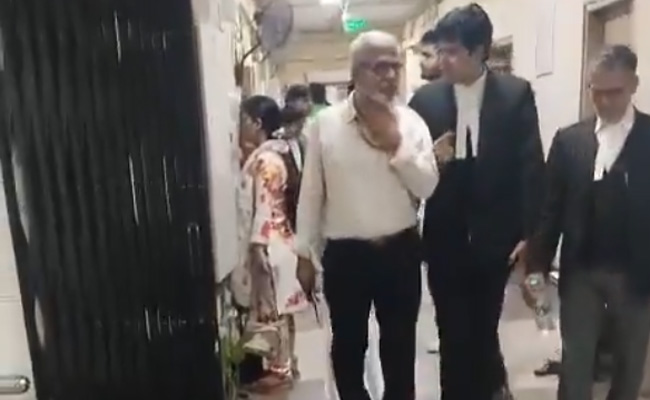
New Delhi (PTI): A Delhi court has sentenced two CBI officers to three months' imprisonment for assaulting and trespassing into the residence of an Indian Revenue Service (IRS) officer during a raid over two decades ago.
Judicial Magistrate Shashank Nandan Bhatt was hearing the arguments on the sentence against the convicted retired police officer V K Pandey and Ramneesh, who was serving as a superintendent of police when the raid was conducted in 2000.
Ramneesh is at present a joint director at the Central Bureau of Investigation (CBI).
The court also fined Rs 50,000 each to both the accused.
Both were accused under IPC sections 323 (voluntarily causing hurt), 427 (mischief) and 448 (criminal trespass) in a complaint filed by IRS officer Ashok Kumar Aggarwal.
The case pertained to an incident on October 19, 2000, when a CBI team carried out a search and arrest operation at Aggarwal's residence in Paschim Vihar.
Aggarwal alleged that the officials forcibly entered his house in the early hours, assaulted him and violated legal procedures during the arrest.
#WATCH | Delhi | Former IRS officer assault case. | Tis Hazari Court sentenced CBI joint director Ramneesh and Retired ACP Vivek Pandey to 3 months sentence in an assault case filed by former IRS officer Ashok Agarwal. The court has granted them bail to challenge the judgment.… https://t.co/RwAxjMrWDK pic.twitter.com/2FlkG4rDs0
— ANI (@ANI) April 28, 2026