Odisha may witness 42,000 more deaths annually by 2100 due to extreme heat: Study
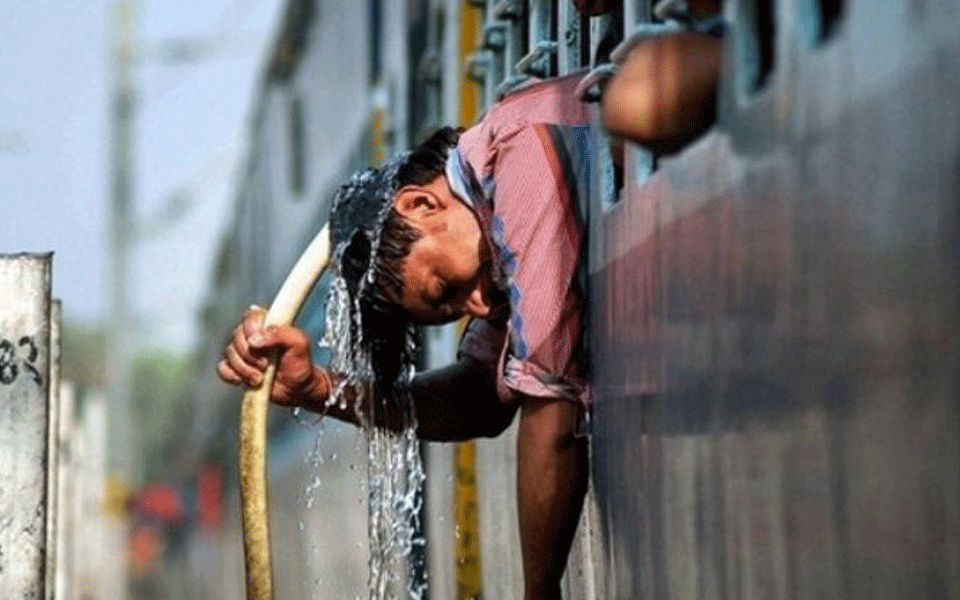
Bhubaneswar: Odisha may witness 42,334 more deaths every year due to extreme heat by 2100, a new study study has said. It will be almost five times more than the total deaths the state records due to cardiac arrest every year. The spike in average summer temperature and number of extremely hot days has an impact on mortality, the study revealed.
The number of extremely hot days in Odisha has been projected to increase by 30 times from 1.62 in 2010 to 48.05 by 2100 if greenhouse gas emissions continue to grow at current rates till the end of the century, the report said.
The study is the first in a series of findings estimating the human and economic costs of climate change and weather shocks in India, conducted by the Climate Impact Lab in collaboration with the Tata Centre for Development at UChicago.
Punjab is likely to continue to be the country's hottest state in 2100 with average annual temperature around 36 degree Celsius. "Odisha is projected to see 42,334 excess climate- related deaths due to increase in temperature," it said.
India, as a whole, will see the number of extremely hot days per year increasing by more than eight times from 5.1 in 2010 to 42.8 by 2100, the study released here on Monday said.
The presentation of the report was followed by a panel discussion on the impact of climate change in Odisha.
Odisha's average summer temperature may witness a 3.32 degree Celsius rise from 28.87 degree Celsius in 2010 to 32.19 degree Celsius by 2100.
It will be far higher than the national average increase from about 24 degree Celsius to about 28 degree Celsius by the end of the century, the report said.
Neighbouring Andhra Pradesh is close behind, which is likely to see a temperature rise of 3.07C, it said.
"Odisha has a history of experiencing extreme heat related fatalities. In 1998, as many as 2,042 people had died due to excessive heat wave," Pradeep Kumar Nayak, chief general manager, Odisha State Disaster Management Authority, said.
Though extensive awareness campaigns have largely reduced the number of casualties during post 1998 period, still a number of casualties are being reported each year, he said.
Between 2010 and 2018, over 6,100 people have died in the country due to heat wave, with Odisha, Andhra Pradesh, Telanganaand West Bengal together reporting more than 90 per cent of the total deaths, the study said.
Michael Greenstone, faculty director at the Tata Centre for Development at UChicago and a co-founder of the Climate Impact Lab said, "Reliance on fossil fuels globally will greatly harm the well-being of people in the coming years and decades.
"Managing climate and air pollution risks is perhaps the challenges of our generation."
The impact of carbon emissions is going to be more pronounced on societies across the globe, including India, which has already seen 2,500 deaths due to a heat wave in 2015, said Amir Jina, assistant professor at the Harris Public Policy and researcher at the Climate Impact Lab.
"The future will be more worrying if a course correction is not embarked upon at the earliest and investments are not made towards mitigating the harmful effects of climate change," Jina said.
Let the Truth be known. If you read VB and like VB, please be a VB Supporter and Help us deliver the Truth to one and all.
Ayush signs off with silver at Badminton Asia Championships
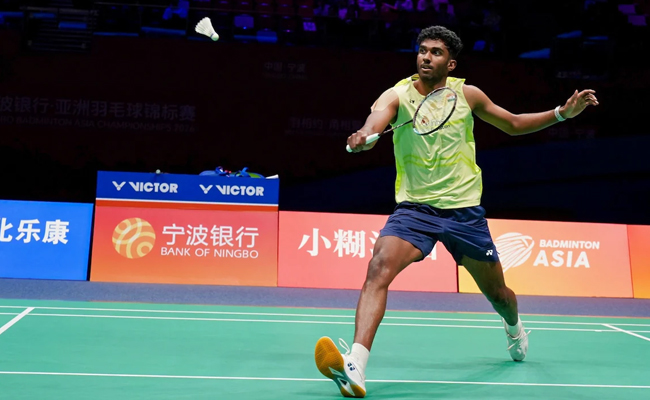
Ningbo (China) (PTI): India's Ayush Shetty signed off with a silver medal after his giant-killing run ended in a straight-game loss to world No. 2 Shi Yu Qi in the final of the Badminton Asia Championships here on Sunday.
The 20-year-old from Mangalore struggled to find his rhythm, going down 8-21, 10-21 to the reigning world champion from China, as India's 61-year wait for a men's singles gold at the event continued.
Despite the loss, it was a creditable campaign from the unseeded youngster, who became only the second Indian men's singles player after Dinesh Khanna to reach the final of the continental showpiece.
Khanna remains the only Indian singles champion at the event, having won the title in 1965. Since then, only the men's doubles pair of Satwiksairaj Rankireddy and Chirag Shetty have lifted the trophy, winning it in 2023.
World No. 25 Ayush entered the contest on the back of defeats to Shi at the Malaysia Super 1000 earlier this year and the Indonesia Masters last season. However, he had played with far greater control and attacking clarity this week, toppling world No. 1 Kunlavut Vitidsarn, world No. 4 Jonatan Christie and world No. 7 Li Shi Feng en route to the final.
However, the Indian, a product of the Padukone-Dravid Centre for Sports Excellence in Bengaluru, failed to counter the tactical discipline of Shi, who used his repertoire of strokes and deception to deny Ayush the opportunity to play his natural attacking game.
Shi dictated the geometry of the court from the outset, controlling the net exchanges and forcing Ayush into the forecourt battle early. The variation in the Chinese player’s game blunted the Indian’s attack, as his smashes lacked precision and he succumbed to scoreboard pressure, leading to rushed shot-making.
Shi Yu Qi logged the opening points with two fine net dribbles to race to a 4-0 lead, as Ayush’s smashes lacked precision early on and he trailed 2-6. A long rally ended with the Chinese player going wide, offering the Indian some respite. A deceptive net shot helped Shi move to 7-4, and he extended the lead to 11-6 as Ayush struggled for control, committing a string of unforced errors.
Shi mixed it up effectively, producing a lovely drop shot and repeatedly drawing the Indian to the forecourt with cross returns like a metronome, forcing errors. Two down-the-line smashes gave Shi a massive cushion of game points, and he sealed the opening game when Ayush sprayed a return wide.
The Indian needed a complete reset to stay alive, and he responded with a thunderous straight smash before diving on both flanks to keep the shuttle in play and move to 3-1 in the second game. Shi continued to test Ayush with backhand deceptive net strokes and pushes to the deep, but the Indian managed to retrieve everything and even found his precision in time, with an on-the-line smash confirmed by Hawk-Eye and a well-constructed rally taking him to 7-2.
However, he couldn't hold on to the momentum as the Chinese clawed back to 7-7 after two long shots and a smash into the net from Ayush. A return that kissed the backline from Shi, followed by another error from Ayush at the net and a return into the net, handed the Chinese the advantage once again at the interval, as he led 11-8.
Shi’s ability to place the shuttle into empty spaces with his repertoire of strokes, often punctuated by a fierce smash, made life difficult for the Indian as he stretched the lead to 13-8. Soon, the Chinese was up 15-9 with another powerful smash.
A body return followed by a straight smash took him to 17-9, and another long shot from Ayush further dented his chances. A perfectly angled smash into the forehand corner brought Shi within two points of victory. He then unleashed a cross-court smash to earn 10 match points and sealed the contest with a return that cramped the Indian, targeting his hip.