Old video falsely shared as Muslims spitting on relief food during lockdown
The story was first published by Altnews.in (read the original post by clicking here.)
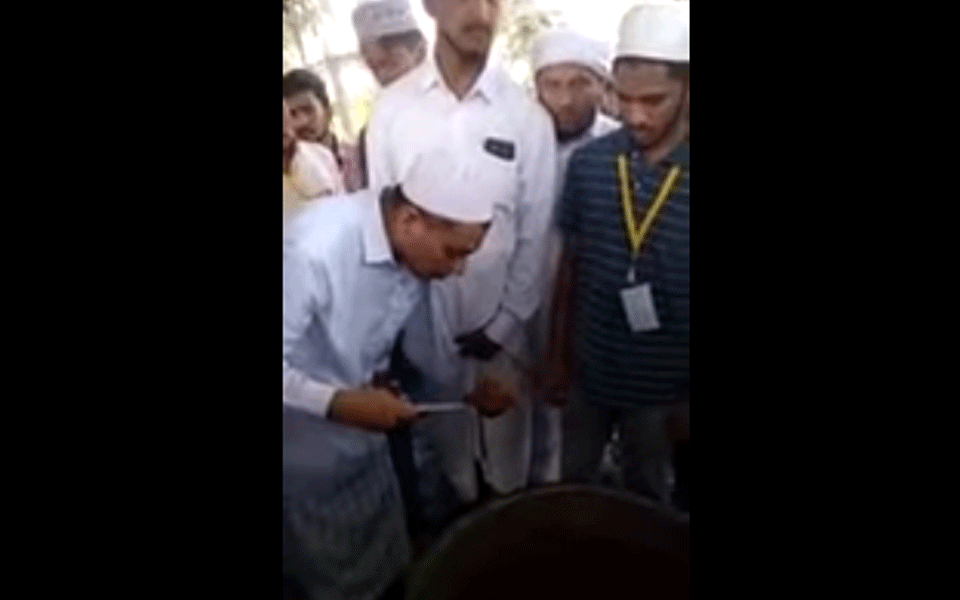
A video where a man can be seen scooping some food on a ladle, taking it close to his mouth and blowing on it is viral on social media. According to the accompanying claim, this is how members of the Muslim community involved in relief work during the lockdown are trying to spread coronavirus infection by spitting on the food. A post by Facebook page by Namo Always has amassed over 8,200 shares.
The complete message reads, “Watch how our country’s Islamic brothers involved in relief work for the poor are trying to further spread coronavirus. Try to open your closed eyes. (गरीबों के लिए राहत कार्य में जुटे हमारे देश के इस्लामिक भाई कैसे कोरोना वायरस को आगे फैलाने की कोशिश की जा रही है जरूर देखें और अपनी बंद आंखों को खोलने की कोशिश जरूर करें.)”
Many other users on Facebook and Twitter shared the video with the same claim.

Old, unrelated video
With the help of digital verification tool InVid, Alt News broke the video into multiple key-frames. We then reverse searched one of the key-frames on Google and found the same video posted on YouTube on December 15, 2018. The caption of the video says, “Those who understand Barkat in Islam shouldn’t eat the food they have spat on.”
Thus, it is clear that the video is unrelated to the recent coronavirus outbreak.
We contacted an Islamic scholar to know what exactly is happening in the video. The scholar said, “It’s called ‘Fatiha Jalana’. It’s done after the food is cooked. Some Quranic verses are read over the food to either pray to Allah to cure diseases or make a wish to Him. Some blow air and some don’t. It’s Fatiha where you take out some food and ask for Barkat (good fortune).” He further added that we see a lot of people gathering outside mosques with sick children after the prayers are said. Worshippers who step out of the mosque after reading namaz are asked to blow air over these children as it is believed that it has Barkat bestowed by Allah. It may be noted that this is an archaic practice followed by very few people.
This video explains how a person can recite Surah Al-Fatihah: “You can recite certain Ayat, Ayat Al-Kursi or Surat Al-Fatihah or whatever you can read of the Quran on the water then drink it. Make wudu or shower.”
While Alt News couldn’t independently verify the origin and context of this video, suffice to say that the video is unrelated to the recent nationwide lockdown.
The story was first published by Altnews.in (read the original post by clicking here.)
Let the Truth be known. If you read VB and like VB, please be a VB Supporter and Help us deliver the Truth to one and all.
Court can reject anticipatory bail but cannot direct accused to surrender: SC
New Delhi (PTI): A court can reject anticipatory bail of an accused but it has no jurisdiction to direct him to surrender before the trial court, the Supreme Court has said.
A bench of Justices J B Pardiwala and Ujjal Bhuyan made the observation while hearing a plea filed by a man accused of cheating and forgery.
"If the court wants to reject the anticipatory bail, it may do so, but the court has no jurisdiction to say that the petitioner should now surrender," the bench said.
The Jharkhand High Court had rejected anticipatory bail plea of the accused and asked him to surrender and seek regular bail.
In this case, a complaint had been filed before a magistrate alleging offences under Sections 323 (voluntarily causing hurt), 420 (cheating), 467 (forgery of valuable security), 468 (forgery for purpose of cheating), 471 (using forged document) and 120B read with 34 of the IPC, in connection with a land dispute.
The high court had dismissed the second anticipatory bail application of the accused on the ground that no new circumstances were shown.
It had relied on its earlier order rejecting his first anticipatory bail plea, in which the court directed the petitioner to surrender before the trial court and seek regular bail in terms of the decision in Satender Kumar Antil v. CBI.
The top court said such a direction was wholly without jurisdiction and said that if a court chooses to reject anticipatory bail, it may do so, but it cannot compel the accused to surrender.