Oligarchy prevailing in Kerala under CPI(M) rule: Governor
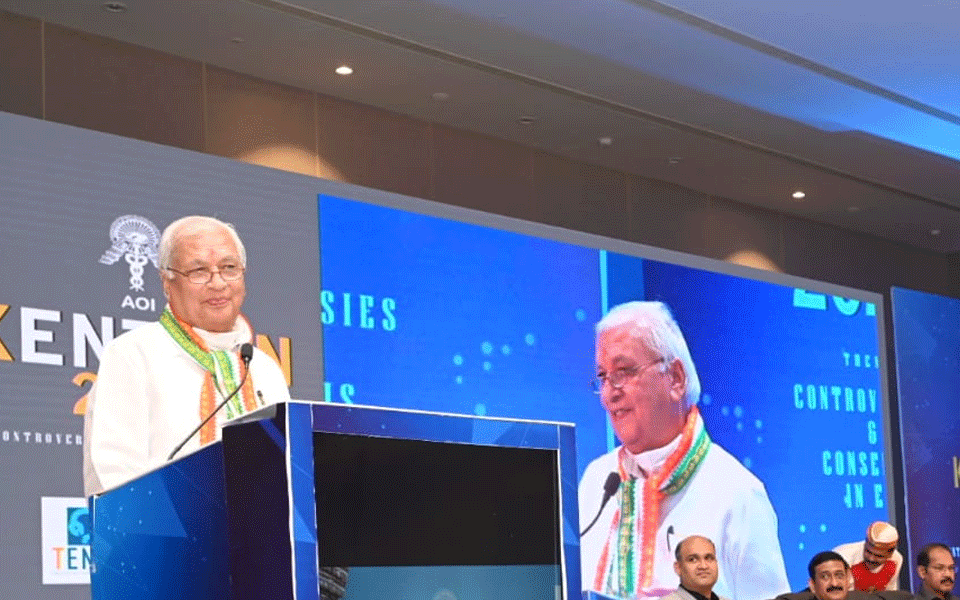
Kochi (PTI): Amidst the ongoing tussle between the Raj Bhavan and the Left government, Kerala Governor Arif Mohammed Khan on Monday alleged that a system of "oligarchy" is prevailing in CPI(M)-ruled state and it was evident from the incidents of party cadres being appointed in government jobs.
He made this remark while referring to the reports of a purported letter from the Thiruvananthapuram Mayor's office asking the "priority list" of CPI(M) cadres to be appointed in temporary posts in the civic body.
"The letter which is being discussed in the press is not the first of its kind. Many such letters exist with people. They have become like an oligarchy in Kerala," the Governor said.
He also claimed that the people were asking are all the jobs under Kerala government reserved for cadres and the university jobs for powerful people in Thiruvananthapuram.
The Governor, while talking to reporters here, also claimed that the CPI(M) central leadership has distanced itself from Finance Minister K N Balagopal's remarks allegedly affecting the unity of the country.
He had earlier accused Balagopal of violating his oath of office and informed Chief Minister Pinarayi Vijayan that the minister has ceased to enjoy his "pleasure".
Khan had asked the Chief Minister to take action which is "constitutionally appropriate".
The Governor spoke to the media after making sure that the media crew of CPI(M)-controlled "Kairali News" and Kozhikode-based "Media One" channel leave the venue.
He said he would not speak to mediapersons of the two channels alleging that they are cadres who masquerade as media.
Let the Truth be known. If you read VB and like VB, please be a VB Supporter and Help us deliver the Truth to one and all.
Bengaluru airport introduces AI-based system to enhance safety at vehicle-aircraft intersections

Bengaluru: Bangalore International Airport Limited (BIAL) has introduced an integrated smart airside safety system at Kempegowda International Airport to improve operational safety at key intersection zones.
According to The Hindu, the system has been designed to enhance safety at Cross Service Roads (CSRs), where aircraft and ground vehicle movements intersect.
According to BIAL, the system integrates AI-based computer vision, automation, and centralised monitoring to manage right-of-way movements and reduce the risk of human error.
“CRSs are among the most sensitive areas within airport operations, requiring precise and seamless coordination between aircraft and ground vehicles. Traditionally, right of way protection at these intersections relied on manual or semi-manual inset light activation, creating dependencies on human intervention, increasing the risk of delays and limiting operational visibility,” TH quoted BIAL as saying.
The new system uses real-time detection of vehicle movement, risk assessment, and automated signalling. AI-enabled cameras identify potential conflicts and trigger automated inset light signals to ensure aircraft priority. Normal operations resume once the area is confirmed clear.
“Based on these detections, the system triggers automated inset light activation to protect aircraft right‑of‑way and restores normal signalling once the intersection is confirmed clear. A centralised monitoring and analytics platform digitally logs all events, strengthening governance, compliance, and operational control,” BIAL said.
By embedding technology into operations, the system creates a data-driven separation layer between aircraft and ground vehicles, significantly reducing human error, especially during night and low-visibility conditions.
“Precision-led signal activation improves traffic flow, minimises unnecessary stoppage and enhances turnaround efficiency. It also establishes a scalable foundation for predictive safety analytics, enabling trend analysis, peak-hour optimisation, compliance mapping and risk forecasting to support continuous improvement and stronger airside governance,” BIAL said.