On Delhi's 95th year as national capital, Modi to inaugurate new PMO building
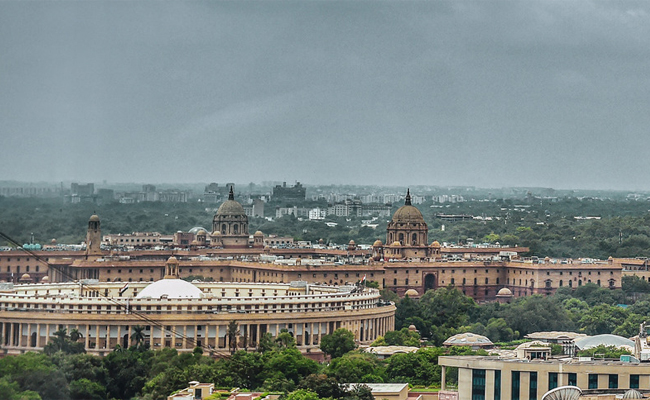
New Delhi (PTI): Prime Minister Narendra Modi will inaugurate the Seva Teerth -- the new building of the Prime Minister's Office -- and two other swanky government edifices on February 13, a date of historic significance as it marks exactly 95 years since New Delhi was formally inaugurated as India's modern capital.
Much has changed since the inauguration ceremony held on February 13, 1931. India gained independence in 1947, became a republic three years later, and is now charting its own course. Through these defining moments, the majestic Raisina Hill complex at the heart of the capital city has stood as a silent sentinel of time.
On Friday, this iconic landmark will witness yet another significant event -- the inauguration of the new PMO building adjacent to it, along with Kartavya Bhawan 1 and 2 in its vicinity.
ALSO READ: BNP claims victory in Bangladesh's election, set to return to power after 20 years
Seva Teerth houses the PMO, the National Security Council Secretariat, and the Cabinet Secretariat, all of which were previously located across different locations within the Central Vista area.
The new Kartavya Bhavan 1 and Kartavya Bhavan 2 will accommodate law, defence, finance, health, agriculture, and several other key ministries.
"The inauguration marks a transformative milestone in India's administrative governance architecture and reflects the prime minister's commitment to building a modern, efficient, accessible and citizen-centric governance ecosystem," the PMO said in a statement on the eve of the inauguration.
When Modi inaugurates the Seva Teerth complex, the occasion will be more than symbolic as the North Block and the South Block have been the seat of power since 1931.
The North Block housed the home ministry and the finance ministry, both of which have nearly moved out of the British-era building, while the South Block housed the defence ministry, the external affairs ministry and the PMO.
The upcoming Yuge Yugeen Bharat National Museum -- billed to be the largest museum in the world -- will be housed in the North Block and South Block, as planned by the government.
When New Delhi was inaugurated, the centrepiece of the new capital was the Raisina Hill complex, housing the majestic Viceroy's House (now Rashtrapati Bhavan) and the North Block and the South Block.
Foundation stones of the new capital were laid by King George V and Queen Mary over a century ago, and it was inaugurated on February 13, 1931, by Viceroy Lord Irwin.
The inauguration ceremony was spread over a week, during which the then Viceroy also dedicated the All India War Memorial Arch, now known as India Gate, on February 12 that year in memory of the soldiers who died in the First World War (1914-1918) and the Third Anglo-Afghan War (1919). The landmark has the names of soldiers inscribed on its surface.
The new imperial city was born on December 12, 1911, during a grand ceremonial 'Durbar' here when British monarch King George V announced the shifting of the capital from Calcutta to Delhi.
Three days later, a simple ceremony was held at the Government of India Camp, where King George and Queen Mary had laid two foundation stones of the new capital city in succession.
The stone blocks did not carry anything but a simple inscription of "15th December 1911", according to archival records.
After laying the foundation stones, the King-Emperor said: "It is my desire that the planning and designing of the public buildings to be erected should be considered with the greatest deliberation and care, so that the new creation may be in every way worthy of this ancient and beautiful city."
In consonance with the vision of the king, architects Sir Edwin Lutyens and Sir Herbert Baker built the new capital city of the British Raj, whose grandeur and architectural splendour rivalled the best of the cities in Europe and America.
The city, constructed between the two World Wars, took over 20 years to build. On the day of the inauguration, four iconic Dominion Columns, each made of red sandstone and topped by a replica of a ship, were unveiled by Lord Irwin amid fanfare of trumpets followed by the playing of the (British) national anthem, according to the book 'Glittering Decades: New Delhi in Love and War'.
The columns, each a gift from Australia, New Zealand, South Africa and Canada, marked a gesture of friendship and unity within the British Empire.
The foundation stone of the Parliament House -- an architectural marvel in stone, designed by Baker that is now revered as the country's traditional seat of democracy, was laid 101 years ago on February 12, 1921, by the then Duke of Connaught, who had said that this landmark will stand for future generations as the "symbol of India's rebirth to yet higher destinies".
The circular-shaped, elegant Parliament House building, originally called the 'Council House', was inaugurated on January 18, 1927, by Viceroy Irwin amid much fanfare. A new Parliament building, erected in its vicinity, was inaugurated by Modi on May 28, 2023.
The new imperial city, incidentally, was christened 'New Delhi' on December 31, 1926, by King George V, just a few years before its official inauguration.
The redevelopment project of the Central Vista -- the nation's power corridor -- envisaged a new Parliament building, a common central secretariat, revamping of the three-kilometre Rajpath (renamed Kartavya Path in 2022) that stretches from Rashtrapati Bhavan to India Gate, a new prime minister's residence and a new PMO as well as a new Vice President's Enclave.
Let the Truth be known. If you read VB and like VB, please be a VB Supporter and Help us deliver the Truth to one and all.
Meghalaya: Interstate ATM theft racket busted, 6 arrested

Shillong (PTI): An interstate racket involved in ATM thefts across several states has been busted, with the arrest of six persons in connection with a break-in at an electronic banking outlet in Meghalaya's Ri-Bhoi district, police said on Wednesday.
The accused were allegedly involved in breaking into an ATM of the Meghalaya Cooperative Apex Bank on April 5, 2024, they said.
Three of the accused were arrested from Barpeta in Assam, while the remaining were apprehended from Haryana, police said.
Ri-Bhoi SP Giri Prasad M said a special police team was constituted to investigate the case.
"With coordinated efforts and assistance from Assam and Haryana Police, we were able to apprehend the accused involved in the ATM break-in," he told PTI.
The case was registered at Umiam police station under sections of the Bharatiya Nyaya Sanhita (BNS).
According to police, the gang used gas cutters to break open the ATM safe and fled with the cash within minutes.
"The group is part of a larger network involved in similar ATM thefts across different states. Further investigation is underway to dismantle the entire network," the SP added.