One arrested in BJP youth activist's killing in Bengal

Kolkata, June 24: One person was arrested in West Bengal's Purulia district on Sunday for his alleged involvement in the killing of local BJP activist Trilochan Mahato, a senior CID officer said.
"Punjabi Mahato, 45, a resident of Supurdi Nich basti in Purulia's Balarampur, was arrested on Sunday after prolonged interrogation on the basis of the case registered by the deceased's father," Deputy Inspector General, CID, Nishad Parvez said in a release.
"Two mobile phones and two SIM cards were seized from the house of the accused and have been sent for forensic examination. He will be produced in court on Monday with a prayer for police custody," the officer said.
The body of 20-year-old Trilochan Mahato was found hanging from a tree in at the Khudigora jungle, a km away from his village in Balarampur area on May 30, with a message inscribed on the back of his T-shirt accusing him of supporting the BJP.
A poster found nearby claimed the youth had to die for his affinity for the saffron party.
The deceased who was missing since May 29, was allegedly hanged using his own cloths.
Three days after Mahato's death, the body of 32-year-old Dulal Kumar, also claimed to be a BJP activist, was found hanging from a high-tension tower in Dabha village in the same district.
The BJP leadership accused Bengal's ruling Trinamool Congress for both the killings and moved to the Supreme Court seeking a Central Bureau of Investigation (CBI) probe into the matter. However, they were asked to approach the Calcutta High Court.
The BJP accused the Trinamool and the local police was acting together with the miscreants to cover up the murders
The Trinamool has, however, denied its involvement in either of the incidents. The state government has handed over the probe to the CID.
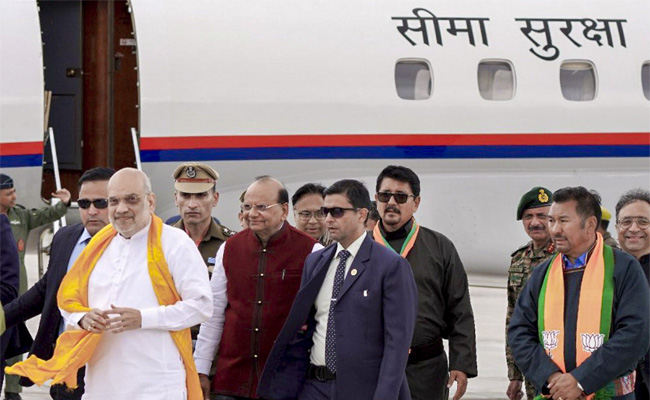
BJP President Amit Shah, who condemned both the killings on social media, is scheduled to meet the families of the two deceased during his visit to Bengal towards the end of June.
Let the Truth be known. If you read VB and like VB, please be a VB Supporter and Help us deliver the Truth to one and all.
AIITA welcomes Karnataka’s ban on obscene songs in school events
Bhatkal: The Karnataka unit of the All India Ideal Teachers Association (AIITA) has welcomed the Karnataka government’s decision to strictly ban school children from dancing to obscene songs during educational and cultural programmes in government, aided, and private schools across the state.
AIITA Karnataka State President M. R. Manvi congratulated the government for taking what he termed an important step to preserve the sanctity of education.
“Such decisions to safeguard the dignity of school children and uphold the values of education are the need of the hour. This rule should not be limited to government schools alone but must be strictly implemented in all private educational institutions as well,” he said.
He further urged the government to address other concerns within school programmes.
“The government should not only prohibit obscene dances in the name of school anniversaries, but also ensure that plays and dialogues that incite religious hatred are avoided. Schools should be centres of harmony, not platforms for spreading hatred,” he added.
According to a recent circular issued by the Department of School Education and Literacy, obscene dances are adversely affecting the mental health and moral values of students.
In this regard, schools have been advised to use songs that promote nationalism, positive thinking, the greatness of Kannada culture, and value-based traditions instead of inappropriate content during programmes.
The circular also emphasises that students should be dressed in decent attire.
AIITA also backed the department’s warning that disciplinary action would be taken against head teachers if such guidelines are violated. The association has further demanded that district Deputy Directors of Public Instruction strictly monitor the implementation of these rules.